12,160 wells on the Railroad Commission's orphan list — inactive 12+ months with the responsible operator's Form P-5 delinquent more than 12 months, so no solvent operator remains. 11,678 carry coordinates and appear here; the Commission publishes no location for the other 482. The list is republished monthly.
Orphan (P-5 delinquent)
Wells
Well Type
ⓘ
All
Oil
Gas
UIC / Injection
ⓘ
Off
Injection
SWD
Status
All
Active
Shut-In
Plugged
Well Direction
All
Horizontal
Vertical
Gas Composition
Gas Composition only
Show BHL LinesBHL = subsurface endpoint of horizontal lateral
Pipelines
All
Gas Gathering
Gas Trans.
Crude Oil
Zoom in to level 8+ to see pipeline segments.
Midstream Sites
All
Processing
Compressor
Treating
Gathering
Other
Unclassified
Zoom in to level 6+ to see midstream sites.
Pipeline Incidents (PHMSA)
Pipeline incident
County
Loading…
Inventory Year
UIC / Class II Injection
693 wells ECMC records as currently injecting for waste disposal or secondary recovery. Distinct from the UIC-classified sites in the site layer. ECMC publishes no injection volumes in bulk, so throughput is unavailable — click a well for its mechanical integrity test history.
Documented Orphan Wells
409 wells from the federal USGS documented-orphan dataset, dated July 2019 — not a current ECMC figure. ECMC counts 948 orphaned wells as of June 2025 and reports a backlog of 2,169 orphaned sites with 994 wells still to plug, but publishes no well-level list with coordinates, so this older federal file is the only mappable source.
Documented orphan (2019)
Well Density Heatmap
Emissions Heatmap
Pollutant
Sites
Segment
Operating Status
Production
Wells (ECMC)
Well Status
Well Type
Well Class
Gas Composition
AIRS Facilities ⓘ
Pipeline Incidents (PHMSA)
Pipeline incident
Pipelines (EIA)
Interstate
Intrastate
Other
County
Loading...
Wells
Well Type
Well Density Heatmap
Midstream Sites
Permit Class
Status
FRS Facilities
Oklahoma overlays
Earthquakes
Min Magnitude
UIC Wells
Orphan Wells
Arbuckle Injectors
HF Laterals
Environmental
PST Releases
Active Permits
Pipeline Incidents (PHMSA)
Pipeline incident
Pipelines (EIA)
Interstate
Intrastate
Other
County
Loading…
Wells
OCD well locations — clustered at low zoom, individual wells on zoom-in. NM does not publish well type, so wells are shown uncolored.
Well Density Heatmap
Pipeline Incidents (PHMSA)
Pipeline incident
Pipelines (EIA)
Interstate
Intrastate
Other
GHGRP Emissions (EPA)
GHGRP facility (size ∝ CO₂e)
NEI Equipment (EPA)
NEI facility (size ∝ tpy)
Air Compliance (EPA)
Open high-priority violation
Violations on record
No violations on record
Air Permits (NMED)
Oil & gas (compressor / gas plant / refinery)
Power / energy
Other permitted source
Orphan & Abandoned Wells
Orphan (Reclamation Fund)
Temporarily abandoned
Shut in
Plugged (not released)
Spills & Releases
Produced water
Oil / condensate
Gas
Other
OCD Facilities
Pit
Storage / tank
Compressor station
Gas plant / refinery
Gathering / pipeline
Injection / disposal
Flare stack
Other
Production Areas
Oil & gas
Gas
CO₂
County
Loading...
Wells
Well Type
Filter
Show BHL LinesBHL = subsurface endpoint of the wellbore
Well Density Heatmap
UIC / Class II Injection
4,369 wells WOGCC types as injection or disposal. Color separates waste disposal from injection that enhances recovery at nearby wells.
Documented Orphan Wells
911 wells on WOGCC’s own orphan well list, whose operator the Commission has declared orphaned. Where that list has not been loaded, the layer falls back to the federal USGS documented-orphan dataset (1,323 wells, dated June 2022); each well’s panel names which list it came from.
WOGCC orphan list
Spills & Releases
Oil-field releases reported to Wyoming DEQ, nearly all since 2009 — the ones filed with a location. WDEQ reports carry no API number, so spills are not linked to wells. WOGCC publishes no spill records of its own.
Produced water
Oil / condensate
Gas
Facilities
Every facility location (EPA FRS, GHGRP, NEI, and midstream). Click a facility to open its data. GHG emissions, equipment, and midstream details show up as tabs when available for that site.
Filter
EquipmentGHGMidstreamOther
Wyoming analysis
Pipeline Incidents (PHMSA)
Pipeline incident
Pipelines (EIA)
Interstate
Intrastate
Other
GHGRP Emissions (EPA)
GHGRP facility (size ∝ CO₂e)
NEI Equipment (EPA)
NEI facility (size ∝ tpy)
Air Compliance (EPA)
Open high-priority violation
Violations on record
No violations on record
County
Loading...
Wells
Well Type
Orphan & Abandoned Wells
13,893 wells WVDEP records as abandoned or unlocatable, all of them geo-located. 4,219 have no identified responsible party — WVDEP's own “operator unknown” marker, which makes them the state's liability — while 9,513 still name one. This is what WVDEP's public well layer supports; the agency separately cites more than 6,500 documented orphans, and its plugging-program roster is not published, so treat this as a floor.
Operator unknown (orphan)
Abandoned
Cannot be located
Facilities
EPA FRS / GHGRP / NEI facilities, WVDEP DAQ permits + EIA-757 gas plants. Click a facility for its GHG emissions, NEI equipment, and midstream details.
Filter
West Virginia infrastructure
Infrastructure
UIC / Class II Injection
Pipeline Incidents (PHMSA)
Pipelines (EIA)
Interstate
Intrastate
Other
County
Loading...
Wells
Well Type
Filter
Well Pads
3,920 well pads DEP maps, every one with coordinates. Click a pad to list the wells drilled from it — 15,340 wells resolve to a pad; DEP links 48 more to a pad whose location it does not publish. A pad is where wells were drilled from, not a drilling unit: Pennsylvania publishes no unit boundaries, one pad can serve several units, and one unit can be drilled from several pads.
UIC / Class II Injection
14,609 wells PA DEP types as injection or waste disposal — the largest such population in Atlas. 9,522 carry coordinates and appear here; DEP publishes no location for the rest. Gas-storage wells are a separate DEP category and are not shown.
Orphan & Abandoned Wells
37,892 wells DEP carries as orphan, abandoned, plugged-not-released, or unlocatable — 6,382 of them on DEP's Orphan List, where no viable responsible party remains. 31,862 carry coordinates and appear here; DEP publishes no location for the other 6,030. DEP's undocumented orphan wells — legacy wells located in the field but not yet carried in the well database — are not published in bulk and are not shown, so this is a floor on PA's orphan population.
DEP Orphan List
Abandoned
Plugged (not released)
Cannot be located
Facilities
Every facility location (EPA FRS, GHGRP, EIS/NEI/eFACTS equipment, midstream, and underground storage). Click a facility to open its data.
Filter
Pipeline Incidents (PHMSA)
Pipeline incident
Pipelines (EIA)
Interstate
Intrastate
Other
County
Loading...
Wells
Well Status / Trajectory
Wells Near an Address
Orphan Wells
10,590 wells ODNR carries as orphans — 10,589 of them geo-located. 9,220 are still an open liability (referred, assessed, scheduled, contracted, or pending) and 1,370 have been plugged under the Traditional, LOPTP, or federal track. This is ODNR's active program pipeline, not the full documented orphan backlog: the 2022 federal USGS inventory lists 20,557 Ohio wells, most of them legacy wells ODNR has not referred into the program.
In ODNR plugging program
Plugged
Facilities
EPA FRS / GHGRP facilities, Ohio EPA EIS equipment sites, ODNR facility registry + gas plants. Click a facility for its GHG emissions and equipment details.
Filter
Pipeline Incidents (PHMSA)
Pipeline incident
Pipelines (EIA)
Interstate
Intrastate
Other
—
Send to MAES
Bring sites into MAES Project Manager for simulation. Select sites by area, by filters, or both, then preview and send. The import wizard in MAES Project Manager guides the remaining choices.
Sites are CO ONGAEIR facilities; year, operator, county, and status filters apply.
Segment
Basin
Site condition
Operator
Showing a sample of wells in dense areas — zoom in for every well.
Well Type (color)
Gas
Oil
Other
Cluster
Well Status (shape)
Producing
Active
Shut-in
P&A
Other
Pipelines
Gas Gathering
Gas Trans.
Crude Oil
Other
Midstream Sites
Processing Plant
Compressor Station
Treating / Dehydration
Gathering
Cycling Plant
Other
Site Cluster
CO Sites
Production
Midstream
Pre-Production
UIC-classified site
UIC (Class II) wells
Test current (≤5 yr)
Outside 5-yr cycle
Outside 10-yr cycle
No test on file
Latest test failed
Atlas's derivation from ECMC test dates (5-YEAR UIC TEST); ECMC publishes no compliance determination.
Well Type (color)
Gas
Oil
Injection / Disposal
Other
Well Status (shape)
Producing
Active
Shut-in
P&A
Other
Site→Well link
CH₄ Intensity
LowHigh
metric tons / year
Well Type (color)
Gas
Oil
SWD / Injection
Other
Cluster
Well Status (shape)
Producing
Active
Shut-in
P&A
Other
Earthquakes
⊕M4+
⊕M3–4
⊕M2–3
Size = magnitude
UIC Wells
UIC Well
Orphan Wells
Awaiting Plugging
Being Plugged (State Funds)
Arbuckle Injectors
Arbuckle Disposal Well
HF Laterals
SHL → BHL line
PST Releases
PST Release (open petroleum storage tank leak)
Active Permits
▲Active Permit
Midstream Sites
Cluster
Natural Gasoline
Compressor / Drip
Treating
Gathering
Other
OCD Facilities
Pit
Storage / tank
Compressor station
Gas plant / refinery
Gathering / pipeline
Injection / disposal
Flare stack
Other
Facility→Well link
Orphan & Abandoned
Orphan (Reclamation Fund)
Temporarily abandoned
Shut in
Plugged (not released)
While this overlay is on, these wells show as stars instead of their usual Well Status shape, so each appears once.
Well Type (color)
Gas
Oil
Injection / Disposal
Other
Well clusters
Well Status (shape)
Producing
Active
Shut-in
P&A
Other
Well Type (color)
Gas
Oil
Injection
Other
Facility clusters
Well Status (shape)
Producing
Active
Shut-in
P&A
Other
UIC (Class II)
UIC — disposal
UIC — enhanced recovery
EPA FRS Sites
FRS Facility
Wells
Gas
Oil
Other
Well clusters
Facilities
Facility clusters
Equipment
GHG emissions
Midstream
UIC — disposal
UIC — enhanced recovery
Pipeline incident
Wells
Producing
Plugged
Other
Well clusters
Facilities
Equipment
GHG emissions
Midstream
Wells
Gas
Oil
Injection
Other
Cluster
UIC (Class II)
UIC — disposal
UIC — enhanced recovery
Facilities
Equipment
GHG
Midstream
Storage
Other
Zoom in and click a well on the map to view details
Select a well on the map
Loading…
Select a site on the map
Select a well on the map
Select a well on the map
Select a well on the map
Select a well on the map
Select a well on the map
Select a facility on the map
Select a well on the map
Select a facility on the map
Select a facility on the map
Sign in to access Atlas. A licensed account is required.
Choose a new password for your TetraSoft Atlas account.
This link works once and expires an hour after it was sent.
You're all set
You're signed in. Use the same email and password for each of these:
Create your Atlas account — a free 7-day trial starts when you verify your email. Fields marked * are required.
Check your email
We sent a verification link to .
Clicking it verifies your address and starts your 7-day free trial.
The link expires in 24 hours. Only the
newest link works — requesting a new one invalidates the old.
✓
Choose your Atlas plan
Conversion keeps your account, organization, and everything in it.
Wyoming Data Analysis
A statewide look across all of the Wyoming data, covering every record, including samples that are not shown on the map.
Loading…
Pennsylvania Data Analysis
A statewide look across all of the Pennsylvania data, covering every record, including samples that are not shown on the map.
Loading…
Ohio Data Analysis
A statewide look across all of the Ohio data, covering every record, including samples that are not shown on the map.
Loading…
West Virginia Data Analysis
A statewide look across all of the West Virginia data, covering every record, including samples that are not shown on the map.
Loading…
Oklahoma Data Analysis
A statewide look across all of the Oklahoma data, covering every record, including samples that are not shown on the map.
Loading…
New Mexico Data Analysis
A statewide look across all of the New Mexico data, covering every record, including samples that are not shown on the map.
Loading…
CO Reporting Quality
Scans Colorado facility reports and flags sites whose methane numbers look out of step with similar operations nearby
CH₄ Distribution by Equipment Group
ⓘ
▮ Count of sites in range ·
▮ Bin contains flagged site ·
● Top flagged sites (up to 5 shown) ·
| Group median (p50)
Statewide Emissions Trend(raw totals vs. outlier-adjusted)ⓘ
Top Flagged Facilitiesclick a row to open site
Loading…
Loading…
Top Operators by Total Emissions
ⓘ
Loading…
How Concentrated Are Emissions?
ⓘ
Highest-Emitting Sites
ⓘ
Loading…
Site Emission Distribution
ⓘ
Production Emissions by Well Orientation
ⓘ
Emission Intensity & Efficiency
ⓘ
Gas price:$/MCFfetching live price...
Reduction Potential — Targeting the Biggest Emitters
ⓘ
Emission Intensity by Site Type
ⓘ
How Much Would Fixing the Worst Sites Save?
ⓘ
Uses the gas price entered above. Load data to activate.
Fix the top10sites
Drag the slider to see potential savings.
Loading…
Emissions by Equipment Type
ⓘ
Which equipment categories leak the most methane, and across how many sites
Loading…
Methane Trend Over Time
ⓘ
Note: MT/MMCF and MT/BOE are only shown for years where gas production was widely reported in ONGAEIR submissions. Early years (2021-2022) had sparse production data, so intensity ratios for those years are not shown.
Methane by Year Sites First Reported to CDPHE
ⓘ
Average methane per site (MT), grouped by the start year the operator declared in their filing
Note: most sites do not include a declared start year in their CDPHE filing. Those appear in the "Unknown" bar. The 2010s and 2020s bars reflect only the small fraction of sites that did report one.
Loading…
Violation Notices (NOAVs)
ⓘ
Loading…
Drilling Permit Search
ⓘ
Enter an API number, permit number, operator, or well name.
Upcoming Permit Expirations
ⓘ
Loading…
Sites in Ozone Non-Attainment Areas
ⓘ
Loading…
Enforcement Gaps
Sites with anomaly flags in their data but no violation notice or spill on record
Loading…
Groundwater Contamination With No Enforcement on Record
ⓘ
Sites where water samples exceed EPA drinking water limits but no violation notice is on record
Loading...
Loading...
What is in the gas?
i
Average species composition across sampled wells, shown as both volume share (mole %) and weight share (mass %)
Loading...
Natural Gas Liquids (NGL) richness and heating value by county
NGL = ethane, propane, butane, and pentane that can be separated from raw gas and sold as separate liquid products. Counties with higher NGL content produce more valuable gas, which makes venting more costly and capture more worthwhile. Coverage column shows how many sites in each county were actually sampled -- low coverage means the average may not be representative.
Loading...
Heating value spread across wells (BTU per cubic foot)
Gray bars = very dry gas below 1,050 BTU (mostly methane, little NGL value). Cyan bars = moderate 1,050-1,200 BTU. Green bars = NGL-rich gas above 1,200 BTU. The two dashed vertical lines mark those thresholds. Pipeline tariffs and processing fees depend heavily on BTU content.
Where does the methane come from?
i
Each dot is one well site -- the median isotope reading across all gas samples taken there. Dots in the green zone produced microbial (biogenic) gas from shallow formations. Dots in the orange zone produced gas from deep buried organic matter (thermogenic). Points in between often reflect gas that migrated between formations, or two sources mixing underground. All sample years included.
Horizontal axis: carbon isotope ratio of methane (d13C-CH4, delta 13C, per mille). Vertical axis: hydrogen isotope ratio of methane (dD-CH4, delta D, per mille). Biogenic zone: d13C below -55 AND dD below -175. Thermogenic zone: d13C above -50. Source: ECMC gas sampling database.
Gas composition over time
Median CH4 mole%, C2+ richness (mole%), and average BTU by sample year. As reservoirs age, gas often gets drier -- CH4 rises and C2+ falls. All years with at least 20 gas samples are shown. BTU uses the right-hand axis (pink).
Hydrogen sulfide (H2S) detected by county
i
Counties ranked by highest H2S concentration ever detected in any sample. Red = above 1,000 ppm (requires gas sweetening, elevated equipment corrosion risk). Data coverage is partial -- only counties with at least one H2S measurement are listed.
Loading...
Texas Midstream Infrastructure
Gas plants, pipelines, and greenhouse gas emissions reported to EPA
Loading...
By Facility Type
Gas Intake by District (MCF)
Top 10 by Gas Throughput
Reporting year:
Loading...
Annual trend 2016-2023 (million MT CO2e)
Top 10 Emitters
Loading...
Miles by System Type
Top 10 Operators by Mileage
Loading...
Compliance Status Breakdown
Violations by County (Top 15)
Top 10 Facilities by Formal Enforcement Actions
Source: EPA ECHO (ICIS-Air). Covers TX O&G/midstream facilities with CAA air program records. Data as of latest ECHO Exporter export.
Loading...
Loading...
Composition from USGS lab samples and RRC G-10 well tests
Loading...
What is in the gas?
i
Average species composition across sampled wells, shown as both volume share (mole %) and weight share (mass %)
Loading...
Gas richness and quality by RRC district
Methane %, NGL richness (C2+ mole %), average BTU, and average gas gravity per Railroad Commission district. Higher C2+ and BTU mean richer gas with more recoverable liquids; higher gravity means more heavy hydrocarbons.
Loading...
Heating value spread across wells (BTU per cubic foot)
Gray bars = very dry gas below 1,050 BTU (mostly methane, little NGL value). Cyan bars = moderate 1,050-1,200 BTU. Green bars = NGL-rich gas above 1,200 BTU. Pipeline tariffs and processing fees depend heavily on BTU content.
Gas gravity spread across wells (RRC G-10 tests)
Specific gravity relative to air (air = 1.000, pure methane = 0.554). Higher gravity means more heavy hydrocarbons in the gas stream. Source: RRC G-10 well test reports.
Hydrogen sulfide (H2S) detected by county
i
Counties ranked by highest H2S concentration detected in any USGS sample. Red = above 1,000 ppm (requires gas sweetening, elevated corrosion risk).
Loading...
Source: USGS Natural Gas Compositional Analyses Dataset (DOI 10.5066/P9TR93E3) and Texas RRC G-10 well test reports.
Sources: Texas RRC Form R-3 (plants), FERC/NPMS pipeline data, EPA GHGRP Subpart W (emissions), EPA ECHO (compliance). Plant data: latest reporting period. GHGRP emissions: 2016-2023. District filter applies to Gas Plants tab only.
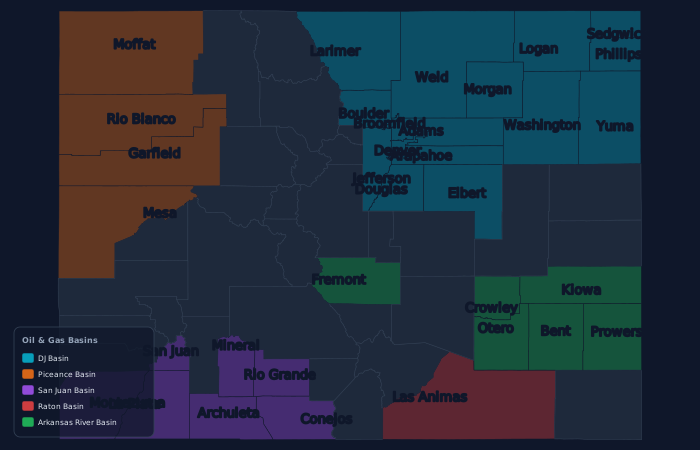
Colorado Oil & Gas Basins
County boundaries shown exactly. Basins are defined by which counties belong to each.
Archuleta, Conejos, La Plata, Mineral, Montezuma, Rio Grande, San Juan
▮ Arkansas River Basin
Bent, Crowley, Fremont, Kiowa, Otero, Prowers
▮ Raton Basin
Las Animas
How CO Reporting Quality Works
Methodology reference for the anomaly detection shown in this panel
Data Source
All figures come from Colorado's Oil and Natural Gas Atmospheric Emissions Inventory Report (ONGAEIR), submitted annually to CDPHE. Facilities report CH₄, CO, NOx, VOC, and CO₂e across 18 equipment categories. TetraSoft ingests each year's raw submissions as they become available and assigns each facility a stable site identifier, so the same physical location can be tracked across years even when its facility ID changes.
What the Analysis Does
For each facility and reporting year, CH₄ values are measured against the full population of facilities in the same equipment category, year, and site type. The score used for comparison is a modified z-score.
A standard z-score measures distance from the mean in units of standard deviation. That is sensitive to extreme values: a few very large reporters can inflate the baseline and make everyone else look normal. The modified version replaces the mean and standard deviation with the median and the median absolute deviation (MAD). The MAD is the typical gap between individual values and the group median. Because it is calculated from the middle of the distribution, a handful of outliers cannot shift the scale. A score of 0 means the record sits exactly at the group median. A score of 10 means it is ten MAD-units above it.
Not all equipment categories get the same treatment. Categories with fundamentally different operating patterns use different detection logic, described in the tier section below.
Warning vs. Critical
Warning: score above 3.5 and CH₄ above the category minimum floor. The record is statistically unusual. Worth a second look, but not far enough out to call definitively wrong.
Critical: score above 7.0 and CH₄ above the category critical floor (varies by tier, described below). At that level the record is well outside its peer group in both statistical and absolute terms. Critical records from Tier 1 categories are removed from the Adjusted CH₄ trend.
Equipment Category Tiers
Not all 18 ONGAEIR equipment categories behave the same way statistically. Treating them identically would produce misleading flags. The analysis uses three tiers.
Tier 1: Standard peer comparison
Tanks, Separators, Stationary Engines or Turbines, NR Internal Combustion Engines, Pneumatic Controllers, Amine Units, Combustion Control Devices, and all categories not listed in Tiers 2 or 3.
Each facility is scored against same-category, same-year peers in the same site type. Critical threshold: z-score above 7.0 and CH₄ above 5 times the category's 99th percentile. These are the categories where volumes are large enough that a genuine outlier represents a real data quality question. Only Tier 1 critical records are subtracted from the Adjusted trend line.
Same z-score logic as Tier 1, with one addition: critical severity also requires CH₄ above a fixed floor. These categories have very tight distributions. A heater reporting 2 MT can score a z-score above 40 simply because most heaters report under 0.1 MT. That statistical signal is real, but 2 MT is not the kind of emission that warrants an audit review. Below the floor, severity stays at Warning regardless of z-score. Tier 2 critical flags appear in the table but are not subtracted from the Adjusted trend.
Tier 3: Site-historical spike detection
Fugitives, Venting or Blowdowns, II.G Well Maintenance.
Peer comparison does not apply here. These categories exist to capture non-routine operational events: a fugitive emission, a series of planned blowdowns, maintenance activity. A midstream operator running many blowdowns in a year is supposed to report high values. Scoring them against a peer average would flag accurate reporting as anomalous.
Each site is compared against its own history instead. A year is flagged when the site's total for that category exceeds three times its own prior peak. Sites with no prior history are flagged at Warning if the value exceeds 10 MT. The goal is to catch something genuinely new at a specific site, not to penalize consistent high-volume operators.
Tier 3 flags never reduce the Adjusted trend. These are real emissions.
The Adjusted CH₄ Trend
The trend chart shows two lines. Raw is the total reported CH₄ across all CO ONGAEIR facilities for that year. Adjusted is the same total after removing critical Tier 1 records (SEVERE_OUTLIER flags in Tanks, Separators, Stationary Engines, and similar high-volume categories).
The gap between the lines shows how much of the statewide number comes from a small number of extreme records. A wide gap does not mean those records are wrong. Some are genuine large emission events. The Adjusted line answers one specific question: what does the trend look like if we set the statistical extremes aside?
Peer Groups and Site Types
Colorado ONGAEIR facilities report under four site types: Production (wellpads, the largest group at around 19,000 sites), Midstream (compressor stations, processing plants), Pre-Production (drilling sites), and UIC (injection wells). A wellpad and a compressor station handle very different operations, and treating them as one population would produce comparisons with no useful signal. Each site is scored against others in the same site type, equipment category, and year. When fewer than ten facilities exist for a given combination, the comparison expands to the full statewide population.
A note on Colorado's emissions reporting
Colorado ONGAEIR is among the most detailed oil and gas emissions reporting frameworks in the country. CDPHE has built a dataset that other states have looked to as a model, and that reflects years of sustained effort from both the agency and the operator community.
TetraSoft's founders have worked with this dataset since its early years. That history is what makes this analysis possible, and it is also why we read the flags carefully. The patterns surfaced here are statistical. They are starting points for review, not findings. A flagged record may turn out to be a legitimate large-emission event reported exactly as required. Others may reflect reporting conventions or edge cases in submitting software. We flag them so you can look, not so you can conclude.
This tool is for informational use only. Nothing here constitutes a regulatory finding, compliance determination, or audit result. Verify any flagged record against the original ONGAEIR submission before drawing conclusions.
What are EPA FRS Sites?
A quick guide to the Facility Registry Service overlay on the Wyoming map
What FRS is
Think of FRS as the EPA's master list of facilities it keeps an eye on. A site lands on this list because an environmental program regulates it or it has to report to one, not just because it happens to be operating out there. What you see on the map is the Wyoming oil and gas slice of that list: production batteries, gas plants, compressor stations, pipelines, and refineries.
Why a facility shows up
Every one of the 9,137 Wyoming oil and gas facilities here is on file for at least one environmental reason. Most of the time that reason is an air permit, usually a small one, not greenhouse gas reporting. A facility can be on file for several reasons at once, so the numbers below add up to more than the total.
Why it is on file
Facilities
Air permit, minor source
8,331
Registered in a state program
6,411
Compliance and emissions reporting
208
Air permit, major source
178
OSHA establishment
146
Hazardous waste (small-quantity generator)
140
Risk Management Plan (RMP) reporter
73
Air permit, synthetic minor
71
Criteria air pollutant, major
65
TSCA submitter
49
Greenhouse Gas Reporter (GHGRP)
44
What it is not
It is not a full list of everything out there. If a facility has never needed a permit and does not report to any state or federal program, it will not be here.
It is not the same as GHGRP. GHGRP only counts the big emitters (roughly 25,000 metric tons of CO₂e a year or more), and only 44 of these 9,137 make that cut. FRS casts a far wider net, since any air permit, waste registration, or program record is enough to be listed.
It is not the well list. These are regulated facilities, which is a different thing from the wells in the Wells layer (WOGCC's active wells plus its plugged and abandoned wells).
Source: EPA Facility Registry Service (FRS), Wyoming state combined file. Counts reflect the current data.
What are AIRS Facilities?
A quick guide to the AIRS overlay on the Colorado map
What AIRS is
AIRS is the facility registry behind Colorado's air-quality program, run by the state Air Pollution Control Division (part of CDPHE). Anything that holds an air permit or has to report air emissions gets an AIRS ID and a record in this system, so it covers far more than just oil and gas. The AIRS ID is the key you use to pull a facility's permit file from the CDPHE records portal.
What this overlay shows
Colorado's air program has 19,681 registered facilities. Of those, 15,730 already line up with sites in Atlas's oil and gas (ONGAEIR) layer, so we fold them in there. This overlay shows the remaining 3,951 that did not match an ONGAEIR site, so you can see the air-permitted facilities that the oil and gas layer alone would miss.
Where the state assigns an industry code, the largest groups are oil and gas:
Kind of facility
Facilities
Natural gas extraction
1,161
Natural gas pipelines
85
Crude oil pipelines
14
Other pipeline transport
12
Crude petroleum extraction
3
The other 2,676 do not carry an industry code in the source data, and they are a real mix. Some are midstream operators like gas processors, but plenty are not oil and gas at all: cell-tower backup generators, convenience stores and fuel stops, food processing, cement and aggregate plants, auto body shops, and the odd school or city facility. So treat this overlay as "everything else with an air permit," not as a clean midstream list.
What it is not
It is not the full oil and gas picture. The upstream production sites already live in the ONGAEIR layer. This overlay is the leftover air-permitted facilities, not a replacement for that layer.
It is not only midstream and processing. It does include those, but it also sweeps in a long tail of other permitted sources that have nothing to do with oil and gas.
It is not a list of big emitters. An air permit is enough to land here, no matter how small. Holding an AIRS record says a facility is regulated for air quality, not that it is a major source.
Source: Colorado CDPHE Air Pollution Control Division (AIRS), cross-referenced against the ONGAEIR oil & gas inventory. Counts reflect the current data.