Abandoned gas wells, like abandoned oil wells, stopped producing but were never fully plugged and released, and many have sat idle for years [1]. The hardest cases are orphan wells, where no solvent operator remains to plug them, so the cost falls to the state [1]. Across producing states, these inactive wells are tracked one regulator at a time, in separate status-coded lists. TetraSoft Atlas, a subscription data platform, pulls this inventory onto one map, keyed to each well’s status and operator [2]. Anyone who has traced an old well across a regulator’s status codes knows that friction, and one connected map removes it.
Quick Answer: Atlas maps orphaned and abandoned wells, starting with New Mexico’s inventory of 3,095 wells, including 497 true orphans with no responsible operator. Each well shows its status, operator, county, and location [2]. The inventory spans wells spudded from 1905 to 2022 [2].
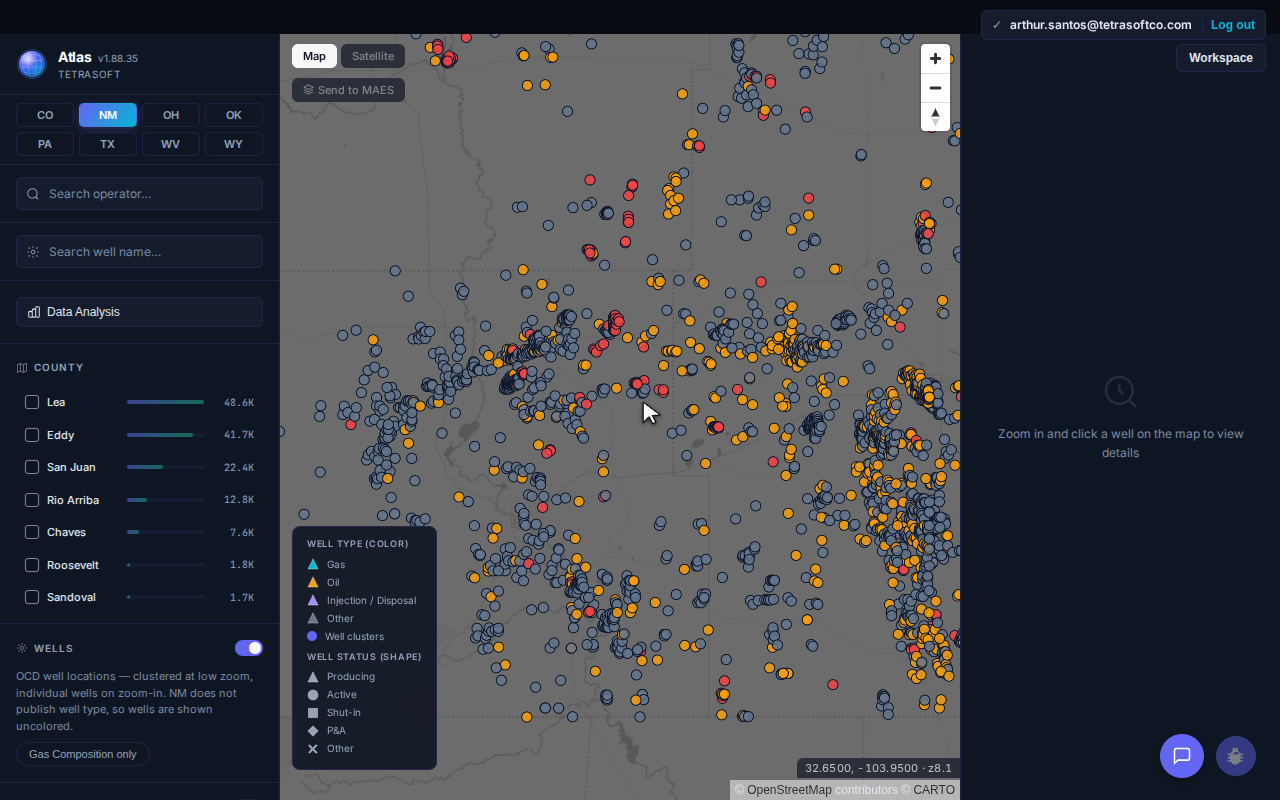
An orphan well map of New Mexico’s orphaned and abandoned wells, colored by status from true orphan (red) down to plugged-not-released (slate). [2]
What Counts as an Abandoned or Orphaned Gas Well
What counts as abandoned depends on the well’s status, and New Mexico tracks several distinct ones [1]. A temporarily abandoned well is shut down but still has an operator on record [1]. A plugged-not-released well is sealed but not yet cleared of its final obligations, such as surface reclamation and a final state inspection [1]. An orphan well has no solvent operator left to plug or reclaim it [1].
The distinction decides who pays to plug the well. A temporarily abandoned well is the operator’s problem; an orphan becomes the state’s [1]. On its own, the word “abandoned” tells you very little about who pays.
New Mexico’s records also show where each well sits in the cleanup process [1]. About 485 wells are already approved for the state reclamation fund, and another 12 are pending review. Others carry a temporary-abandonment status that has already expired [1]. Expired statuses are the ones most likely to slide toward orphan.
TetraSoft Atlas Maps New Mexico’s 3,095 Orphaned and Abandoned Wells
TetraSoft Atlas draws the full NMOCD inactive inventory into one map and one analysis view [2]. The current inventory holds 3,095 wells across 226 operators. Of those, 1,699 are plugged but not released, 832 are temporarily abandoned, and 497 are true orphans. The rest are shut in, awaiting their next status [2].
New Mexico, the second-largest oil-producing state in 2025, is one of the eight states in TetraSoft Atlas, which together produced 68 percent of US crude oil [4]. Atlas is self-serve, with no sales call: you sign up and start a 7-day trial with no credit card [5].
The largest bucket is also the most reassuring one. Most of the wells, 1,699 of them, are already plugged and only await final release. The active concern is the 497 orphans and 832 temporarily abandoned wells that are not yet sealed. A map helps you find those wells first.
The inventory also names the operators behind these wells [2]. Atlas ties 226 operators to the backlog, and you can filter the map to a single company’s share. The oldest well was spudded in 1905, so the map spans more than a century of drilling. Older wells dominate the inventory, and those are the ones whose operators are most likely gone.
Each record carries more than a dot on the map. A well’s OCD district, its legal location, and its last operator of record all travel with it [2]. The result is a path from a statewide count down to one well in one place. In New Mexico, “abandoned oil wells near me” becomes a map task: zoom to your county, click the nearest well and read its status.
The map makes the geography obvious in a way a table cannot. Lea County holds 1,319 of these wells and Eddy County holds 857, the New Mexico share of the Permian Basin. The same Permian counties that drive current production also carry the deepest inactive backlog [2].
New Mexico’s boom and its cleanup share the same map. The Southern Permian oil in 2024 analysis covers the production side of the same basin.
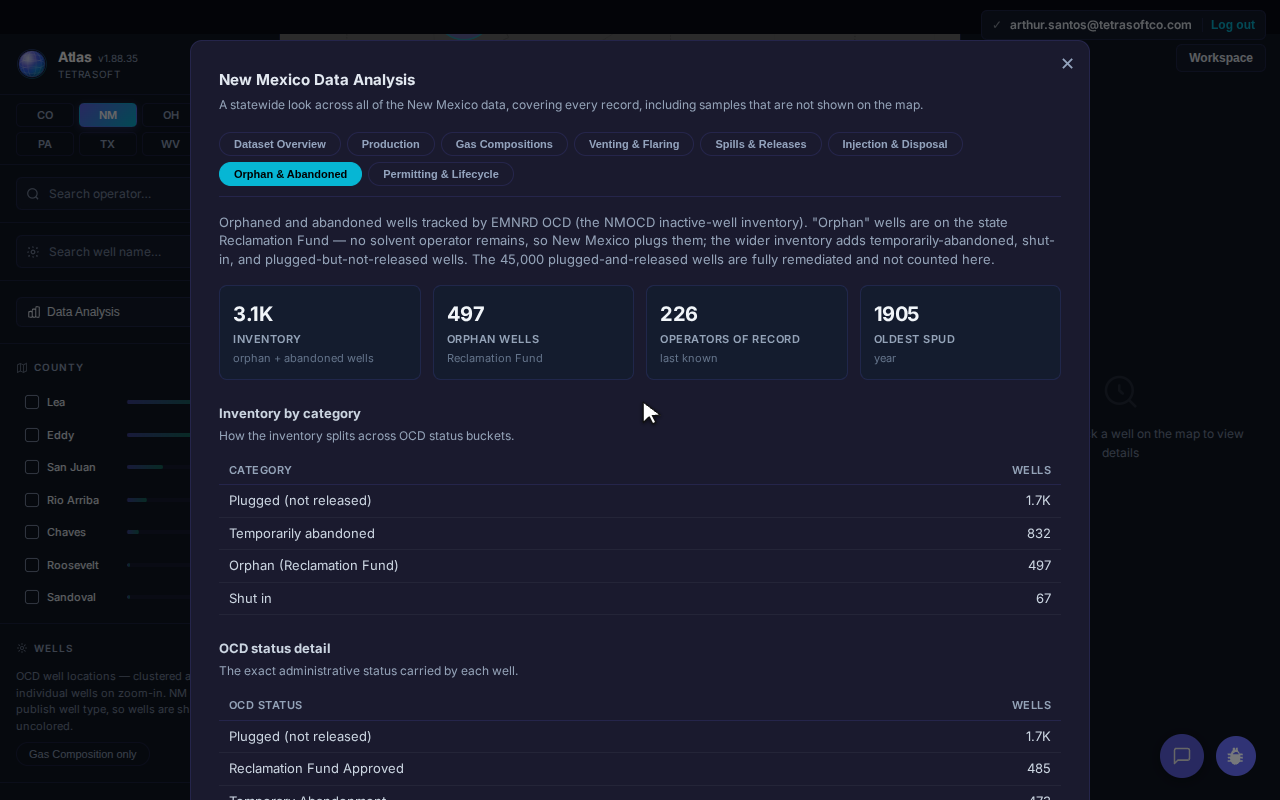
The statewide breakdown: status buckets and the counties that carry them. [2]
Why Abandoned Gas Wells Matter for Methane and Liability
Abandoned wells are tracked because an unplugged well can leak [3]. The EPA counts abandoned oil and gas wells as a distinct methane source in its national inventory [3]. A plugged well is meant to seal that path, which is why the plugged-not-released count matters.
The risk is not the same for every well [3]. The EPA’s inventory treats unplugged wells as the higher-emitting group and plugged wells as far lower [3]. So the 1,699 plugged wells in New Mexico’s inventory represent risk that is largely controlled. The unsealed orphans and temporarily abandoned wells are where the open methane risk sits.
The other reason is money. When a well becomes an orphan, the cost of plugging it moves to a state reclamation fund [1]. New Mexico’s inventory already flags wells approved for or pending that fund [2]. Seeing which counties carry that liability, and which operators left it behind, is the first step in scoping the work.
The plugging liability is not spread evenly across the state [2]. A small number of counties carry most of the inactive wells [2]. Seeing that concentration lets a state agency or a prospective buyer size the work before committing. To trace any single well’s identity and production history, the NMOCD well search maps every New Mexico well, active or not [2].
Frequently Asked Questions
How many abandoned wells are in New Mexico?
TetraSoft Atlas maps 3,095 orphaned and abandoned New Mexico wells from NMOCD records. The count includes plugged-not-released, temporarily abandoned, orphan, and shut-in wells [2]. It excludes roughly 45,000 wells that are already plugged and released, because those are considered fully remediated.
Do abandoned gas wells leak methane?
An unplugged well can provide a path for gas to reach the surface [3]. Because plugged wells emit far less, the plug status is what tells you the risk, not the word “abandoned.” Atlas shows each well’s status, so you can see which wells are sealed and which are not [2].
Where are New Mexico’s abandoned wells concentrated?
Lea and Eddy counties hold the most, with 1,319 and 857 wells. Chaves County follows with 450, and San Juan County in the northwest gas region carries 222. These are the Permian and San Juan basins where drilling has run longest [2].
How current is the abandoned-well data?
Atlas rebuilds the New Mexico inventory from NMOCD’s inactive-well records on a regular cycle [2]. Each well’s status, operator, and count track the state’s current records [2]. When a well is plugged or released, that change appears on the next refresh [2].
Can TetraSoft Atlas show abandoned wells in other states?
Yes. Atlas carries an orphan-well layer in all eight of its states: New Mexico, Texas, Colorado, Oklahoma, Wyoming, West Virginia, Pennsylvania, and Ohio [2]. Each layer follows its own state’s source, so what counts as orphaned differs from state to state [2].
Abandoned gas wells should not mean paging through a regulator’s status codes to find the ones that matter. Atlas puts New Mexico’s orphaned and abandoned inventory on one map, keyed to each well’s status, refreshed from NMOCD records [2]. Start your free 7-day trial.
This post is for informational purposes only and does not constitute legal or compliance advice. Consult qualified legal counsel or a compliance professional for guidance specific to your operations and jurisdiction.
References
- New Mexico Energy, Minerals and Natural Resources Department, Oil Conservation Division (EMNRD OCD, also called NMOCD) public oil and gas records. https://www.emnrd.nm.gov/ocd/
- TetraSoft Atlas, New Mexico orphaned and abandoned well inventory, from EMNRD OCD (NMOCD) records. https://www.tetrasoftco.com/atlas
- U.S. Environmental Protection Agency, Inventory of U.S. Greenhouse Gas Emissions and Sinks: 1990–2022, abandoned oil and gas wells category. https://www.epa.gov/ghgemissions/inventory-us-greenhouse-gas-emissions-and-sinks
- U.S. Energy Information Administration, crude oil field production and natural gas marketed production by state, annual 2025, accessed 23 September 2026. https://www.eia.gov/dnav/pet/pet_crd_crpdn_adc_mbbl_a.htm; https://www.eia.gov/dnav/ng/ng_prod_sum_a_EPG0_VGM_mmcf_a.htm
- TetraSoft Atlas landing page, accessed 24 September 2026. https://www.tetrasoftco.com/atlas-landing.html
Comments
0Share your thoughts. All comments are moderated before appearing.
No comments yet. Be the first to share your thoughts!