ACS ES&T Air 2025 · CSU-METEC · Published Methodology

Every facility has emissions your inventory doesn't capture. Now you can find them.

MAES simulates real equipment behavior, including failures, throughput changes, and gas composition shifts that factor tables consistently miss. Physics-based. Peer-reviewed. Born at CSU-METEC.

Start Free Trial Academic and Professional plans available. 7-day free trial. Annual billing saves 10%.

Emission factor tables were designed for the average facility. Your facility isn't average.

1.16× MAES vs. ONGAEIR reported. DJ Basin. Santos et al., ACS ES&T Air 2025, 2(8), 1598-1611 View paper →
1.19× MAES vs. ONGAEIR reported. CO statewide. Brown et al., COBE Final Report, June 30, 2025 (Colorado CDPHE) View Report →
$50M+ Combined research investment behind MAES. Energy Emissions Modeling and Data Lab, CSU and UT Austin, federal grants, and state-funded programs.

EF×AF methods multiply your equipment count by a lookup table value. They assume average throughput, no equipment failures, and stable gas composition. None of those assumptions hold at a real facility.

Valves stick and vent for hours before anyone notices. Pressure relief valves actuate. Thief hatches get left open after maintenance. These aren't edge cases. They're regular operational events at any active production site. A stuck dump valve alone shifts the C2/C1 gas composition ratio from 0.91 to 1.69. Your EF×AF inventory can't see any of this.

Top-down aerial and satellite surveys are now confirming the gap, basin by basin. In Colorado, statewide ONGAEIR inventories undercount emissions by 19% on average. In the DJ Basin, by 16%. When your regulator or investor has a top-down number and your submission is below it, you're the one who must explain the discrepancy. With a methodology that holds up to scrutiny. European buyers and OGMP 2.0 auditors are asking the same questions. Measurement-informed inventories are becoming the baseline expectation, not the exception.

"Calculated correctly per the regulatory method" and "accurate" are not the same thing. A physics-based simulation is the only way to account for what the method leaves out.

Not AI. Physics.

MAES is a discrete event simulator. It models the actual physical processes inside your equipment at one-second temporal resolution, then runs Monte Carlo iterations across your equipment configuration to produce a probability distribution of your facility's real emissions.
1
Input Operational Data
2
The Simulation Physics-Based
3
Monte Carlo P5 / Mean / P95
4
Results 35 Plots
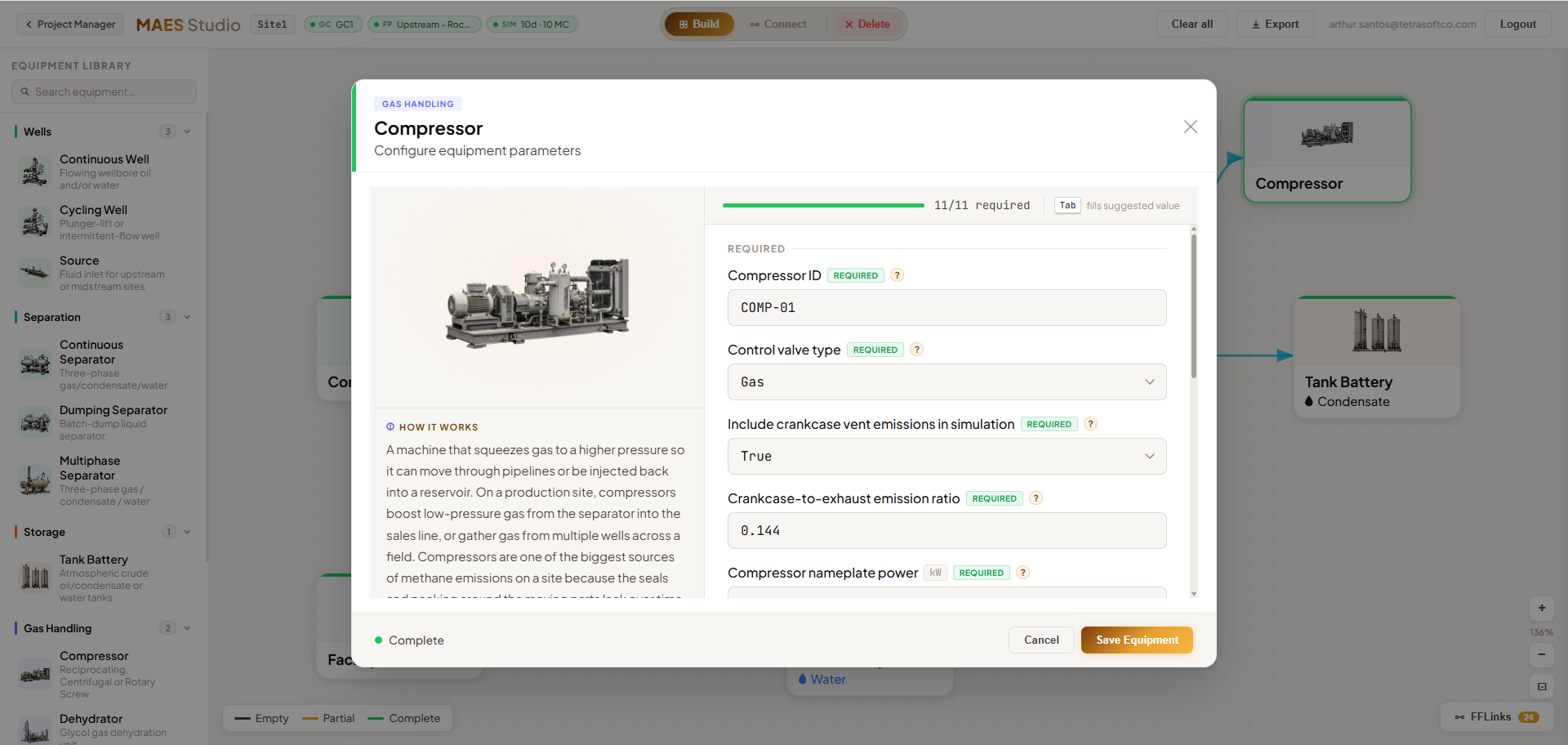
MAES Input: equipment configuration study sheet

You provide your facility's equipment inventory, gas composition, and operational parameters via the MAES Study Sheet. No special measurement hardware is required for a baseline simulation.
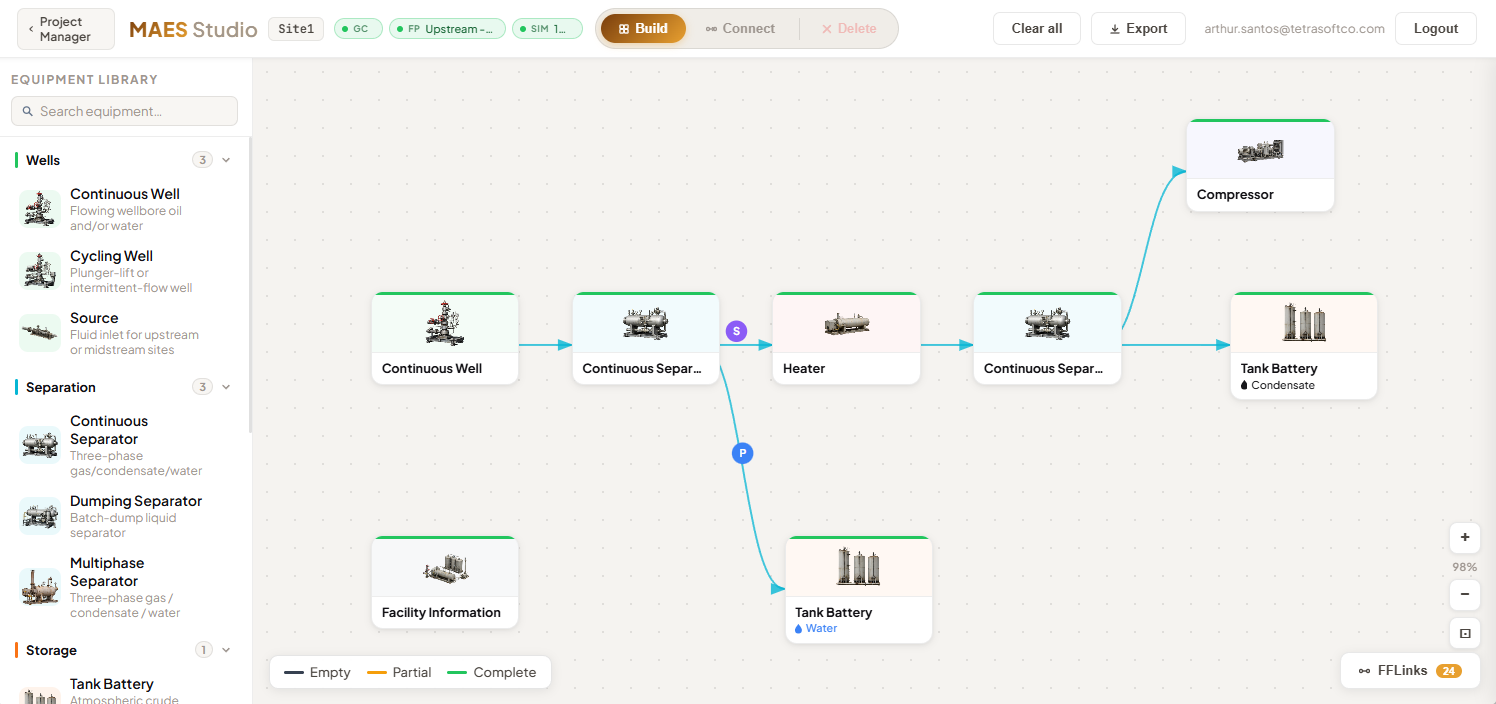
MAES Studio: equipment configuration interface

MAES models your equipment as it actually operates, including the things that go wrong. Valves stick. Pressure relief events occur. Hatches stay open after maintenance. Gas compositions change across separation stages. Throughput isn't constant. MAES captures all of this using mechanistic, physics-based models. Standard emission factor methods assume none of it happens.
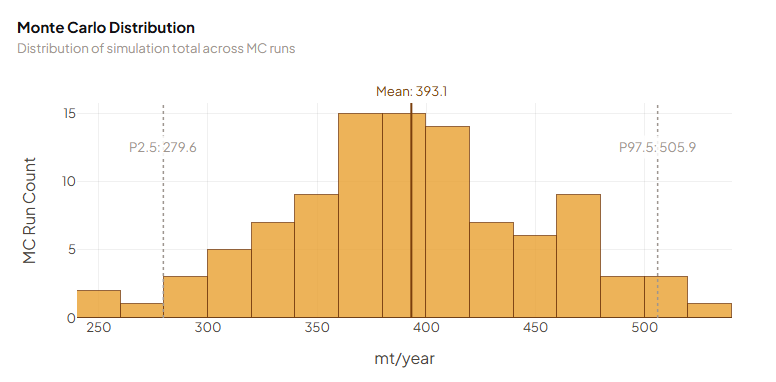
MAES Monte Carlo: probability distribution output

The MAES Engine runs Monte Carlo iterations across your equipment configuration. Each iteration samples from the failure mode probability distributions. The output isn't a single number. It's a P5/mean/P95 probability distribution of your actual facility emissions.
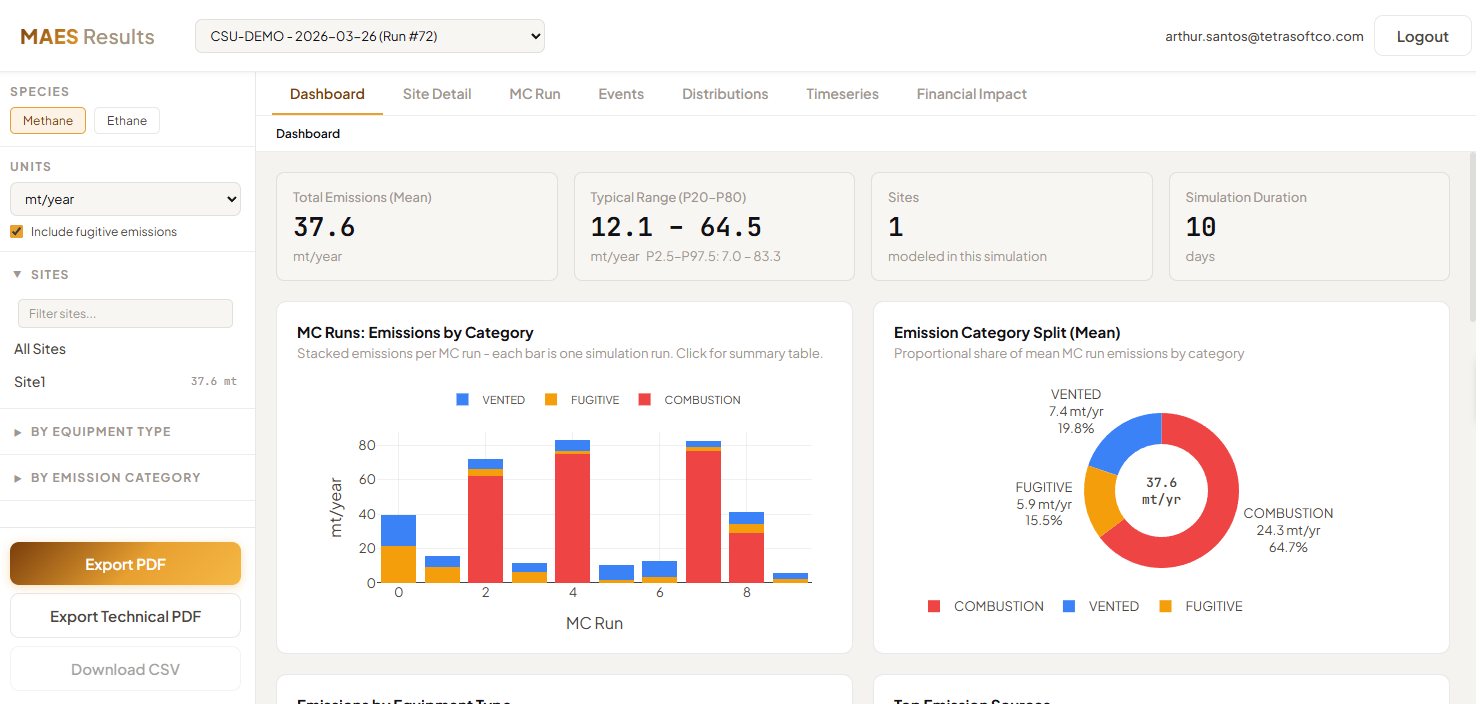
MAES Results: interactive dashboard with 35 plots across 5 tabs

The results appear across 35 interactive plots in 5 tabs: Dashboard, Site Detail, Timeseries, Probabilistic, and Comparison. See which equipment types contribute most, how failure events affect your emission profile, and probability distributions showing the full range of possible outcomes.

MAES Project Manager
Organize projects and configure simulations
MAES Studio
Configure equipment inventory and parameters
MAES Engine
Monte Carlo simulation runs in the cloud
MAES Results
35 interactive plots across 5 analysis tabs

Methodology developed at CSU-METEC, the world's leading methane emissions research facility. Published in ACS ES&T Air 2025 (Santos et al., 2(8), 1598-1611; Mollel et al., 2, 723-735).

Built on the science regulators and journals trust.

Used in 4 major CSU-METEC research campaigns

MAES is the simulation backbone behind the C3 (DJ Basin), COBE (Colorado statewide), SABER (DOE-funded regional assessment), and AMI (Appalachian midstream) campaigns. Each study applied MAES to real operator data across hundreds of sites.

Applied with major operators across multiple basins

MAES has been applied in field studies with major operators in the U.S., including EQT, CNX, Seneca, MPLX, and others. These are real operator engagements using real facility data, not theoretical case studies. TetraSoft's founders led these programs.

Published Methodology
Peer Reviewed

MAES methodology is published in ACS ES&T Air and multiple state-funded research reports. Every claim traces to a published source. No marketing numbers.

View Paper →
Founded by the scientists who built it

Jerry Duggan, Ph.D. and Arthur Santos, Ph.D. are co-founders and previously Research Scientists at CSU-METEC. They didn't license someone else's tool. They built MAES, published the results, and now offer commercial access to the same methodology.

$50M+ research foundation

MAES was developed through more than $50M in combined research investment, including the EEMDL industry-academic initiative (CSU and UT Austin), federal grants, and state-funded programs. This is research infrastructure built over years of sustained investment, not a startup side project.

100+ technologies evaluated at METEC

CSU-METEC is the world's largest methane detection testing facility. More than 100 detection technologies have been evaluated there. TetraSoft's founders led the research programs that applied MAES across multiple US basins and sectors, working directly with major operators on facility-level emission studies in both upstream and midstream operations.

Built for your use case.

Answer the failure-mode attribution question without rebuilding your methodology.
A peer-reviewed, reproducible simulation methodology that attributes emissions to specific physical processes. Your methods section describes exactly what MAES does, and every result can be traced back to the physics. That's the standard journals and grant reviewers expect.
Publishable methodology, not a black box.
Full discrete event simulation with Monte Carlo. All input parameters are transparent and every result is traceable to a physical equation. Your collaborators can run the same inputs and get the same outputs.
Grant-fundable. Annual billing fits a single grant line item.
Annual billing fits a single grant line item. Most university procurement thresholds don't require additional review for invoices under $10K. Non-commercial license verified with .edu email.
CSU-METEC provenance signals legitimacy to journals and grant reviewers.
MAES was developed at the world's leading methane emissions research facility. That heritage shows up in your methods section and tells reviewers you're building on peer-reviewed science.
Volume discounts for labs and research centers.
3-seat Academic: $584/user/mo billed annually. 6-seat: $539/user/mo. 15-seat: $449/user/mo. Single invoice per billing period.
Explain the gap before your regulator asks.
Satellite and aerial surveys are flagging basins where emissions exceed self-reported inventories. With MAES, you can attribute the difference to specific equipment and failure modes at each facility. You'll know where the gas is going before anyone else does.
Model what actually happens, not what the manual assumes.
Your factor-based inventory assumes steady-state operation. Equipment doesn't work that way. MAES models stuck valves, pressure relief events, variable throughput, and changing gas compositions so your inventory reflects how your facilities actually run.
Build your OGMP 2.0 Level 4/5 pathway.
MAES is the simulation backbone for Measurement-Informed Inventories (MII). Combined with your existing field measurement data, MAES produces a defensible, reproducible inventory that OGMP 2.0 Level 4/5 and EU Methane Regulation require.
P5/mean/P95 uncertainty ranges, not a single questionable number.
MAES outputs probability distributions, not point estimates. You can present the range of possible outcomes and explain what drives the uncertainty. That's a much more defensible position than a single factor-multiplication result.
Choose the right measurement technology before you go to the field.
MAES produces probability distributions of emission rates at the site and equipment level. Because aerial, drone, and ground-based technologies each have different minimum detection limits, knowing your emission distribution tells you whether a given technology can actually see what is at your site, before you commit to a survey campaign.
Document your methane intensity at facility level. European buyers will require it from 2027.
The EU Methane Regulation requires US LNG exporters to provide facility-level methane intensity documentation. MAES produces the facility-specific estimates that supply-chain methane intensity calculations require. OGMP 2.0 Level 4/5 sets the same expectation.
Your OGMP 2.0 Level 4/5 pathway is built into the simulation.
MAES is the simulation backbone for Measurement-Informed Inventories (MII). Combined with field measurement data, MAES produces the defensible, reproducible inventory required by OGMP 2.0 Level 4/5.
Show investors exactly what's normal and what's a failure event.
MAES outputs failure-mode emissions as a distinct category from routine baseline emissions. You can show investors and auditors exactly what share of your methane intensity comes from equipment failures vs. normal operations.
Methane intensity documentation your supply chain can use.
Compare your MAES-based facility estimate against your current ONGAEIR/GHGRP reported inventory. Show the gap and your remediation plan in the same platform. Before your European buyers ask for it.
Give clients a methodology they can hand to an auditor.
Consulting firms can deliver MAES-based studies as a standardized service. Structured inputs, automated Monte Carlo execution, and interactive results visualization. One platform, many clients, every study reproducible and auditable.

Two tiers. No hidden fees. Start free.

Academic and Professional plans. Monthly or annual billing. 7-day free trial on every plan.

Answers to the questions we get most often.

No. MAES is a physics-based discrete event simulator. It models actual equipment behavior using thermodynamic and fluid flow equations, not statistical patterns from training data. This distinction matters for regulatory defensibility. Every MAES result can be explained from first principles, traced to a physical equation, and reproduced by a third-party auditor. That's not possible with black-box models.
No. TetraSoft provides commercial and academic access to MAES through a special license with CSU. Professional plans are available to any O&G operator, consultant, or service company. Academic plans require .edu email verification for non-commercial use.
Traditional process simulation tools model steady-state engineering. They assume your equipment operates normally at all times. MAES is different because it models emissions specifically, including the abnormal process events that actually happen at operating facilities: equipment malfunctions, variable throughput, and changing gas compositions. Process simulators were designed to engineer a facility. MAES was designed to understand what that facility actually emits. That's a fundamentally different question, and it calls for a fundamentally different tool.
MAES requires facility equipment inventory, gas composition data, and basic operational parameters. Most operators already have this in their ONGAEIR study sheets or can pull it from SCADA records. No field measurement hardware is required for a baseline simulation. If you have existing measurement campaign data, MAES can incorporate it to produce a Measurement-Informed Inventory (MII).
MAES forms the simulation backbone for Measurement-Informed Inventories (MII). That's the methodology that enables OGMP 2.0 Level 4/5 reporting. Combined with field measurement data, MAES produces the defensible, reproducible inventory OGMP 2.0 requires. TetraSoft provides support for OGMP 2.0 Level 4/5 set up as part of the Professional onboarding process.
"Calculated correctly per the regulatory method" and "accurate" are not the same thing, for two reasons. First, the regulatory method can't capture failure modes or variable operating conditions. DJ Basin operators whose ONGAEIR submissions followed the method correctly still showed a 1.16x gap against MAES estimates, because the method doesn't account for what happens when equipment malfunctions (Santos et al., ACS ES&T Air 2025). Second, regulatory frameworks often don't require all emission sources to be reported in the first place. MAES models the complete emission profile of a facility, including sources the regulation asks about (more accurately) and sources it doesn't require. The gap already exists in the public record via top-down aerial and satellite surveys. MAES gives you the explanation and a path to address it. That puts you in a defensible position before anyone asks.
Both. MAES covers upstream production sites as well as midstream facilities including compressor stations, gas processing plants, and dehydration stations. The same simulation engine and methodology apply across all site types. If you operate across the value chain, you can run MAES on each facility type using the same platform.
MAES includes physics-based models for the equipment found across upstream and midstream O&G operations: wells (continuous and cycling), separators (two-stage, three-stage, multi-phase), storage tanks and tank batteries, compressors, heaters, flares, dehydrators, vapor recovery units (VRUs), and pneumatic devices (both continuous and intermittent). Across both upstream and midstream sites, MAES also models the abnormal operating events that drive the largest emission gaps: stuck dump valves, pressure relief valve actuations, thief hatch failures, and vent failures.

The emissions your reports are missing. Now you can see them.

7-day free trial on every plan. No credit card required. Cancel anytime.