If your operation reports emissions, two markets will quote you a price for a tonne of CO2, and the two are not comparable. Carbon markets come in two kinds that share a unit and almost nothing else. A compliance market prices a legal obligation, because a covered emitter must surrender an instrument for each tonne it emits. A voluntary market prices a claim a buyer has chosen to make.
That difference in who creates the demand is why the two trade at different prices. For an oil and gas operator the question is which market a given tonne belongs to. Below: what a compliance price is, how an allowance differs from a credit, and why neither changes a reported inventory.
Compliance prices also move far more than a headline figure suggests. The Regional Greenhouse Gas Initiative, or RGGI, is a cap-and-invest program run jointly by eleven eastern states over their fossil-fueled power plants [1]. Its allowances cleared at 37.65 dollars a short ton in September 2026, up from 22.25 a year earlier [2].
Quick Answer: A compliance market prices a legal obligation to surrender allowances; a voluntary market prices a claim. RGGI CO2 allowances cleared at 37.65 dollars a short ton at auction 73 in September 2026 [2]. That is 69 percent above the 22.25 dollars at auction 69 a year earlier [3].
The voluntary side trades an order of magnitude lower [4]. Average voluntary credit prices fell from 6.71 to 6.34 dollars per tonne of CO2 equivalent in 2024 [4]. Total reported voluntary market value fell 29 percent to 535 million dollars that year [4]. A compliance allowance and a voluntary credit are therefore not substitutes at any price.
A Compliance Price Is a Cost, Not a Forecast
A compliance allowance is a permit to emit one unit, created by the authority that set the cap. Covered emitters buy them at auction and surrender them against actual emissions. The clearing price is therefore an observed cost rather than an estimate of one.
RGGI publishes every auction result, which makes the series checkable [2]. Auction 69 in September 2025 cleared at 22.25 dollars a short ton [2]. Auction 73 in September 2026 cleared at 37.65 [2].
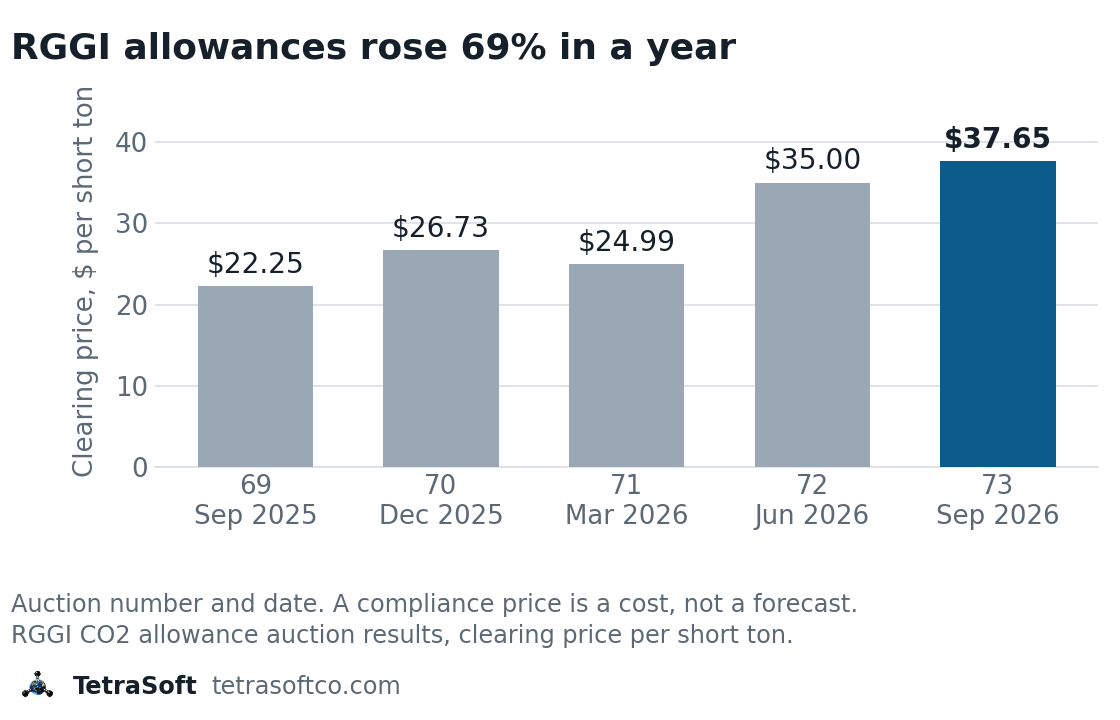
RGGI CO2 allowance clearing prices, auctions 68 to 72. Published auction results, dollars per short ton.
RGGI is one of several compliance systems and the smallest in scope of them. The EU Emissions Trading System was the world’s first carbon market, launched in 2005 [5]. It is now in its fourth trading phase, running from 2021 to 2030 [5]. The UK Emissions Trading Scheme came into effect on 1 January 2021 [6].
| Compliance system | In force since | Note |
|---|---|---|
| EU Emissions Trading System | 2005 | World’s first carbon market, now in its fourth phase to 2030 |
| RGGI | 2009 | Power sector only, in participating US states; auction results published for every auction |
| California Cap-and-Trade | 2013 | Under amendment as Cap-and-Invest; 2026 amendments proposed, comments taken to March 2026 |
| UK Emissions Trading Scheme | 2021 | Established after the UK left the EU ETS |
Four compliance systems a US reader is likely to meet. Each is a separate market with its own cap, its own unit and its own price.
The EU system carries the longest measured record. By 2023 it had helped bring emissions from European power and industry plants down about 47 percent against 2005 levels [5]. One allowance there gives the right to emit one tonne of carbon dioxide equivalent [5].
California is the one to watch for change rather than for price. Its Air Resources Board has proposed 2026 amendments recasting the program as Cap-and-Invest [7]. Public comment on those amendments ran from January to March 2026 [7]. Prices in these systems are not comparable across borders, because each cap covers different emitters under different rules.
The Series Does Not Move in One Direction
The rise was not a straight line, and the exception is the useful part. Auction 70 in December 2025 cleared at 26.73 dollars, and auction 71 in March 2026 cleared lower at 24.99 [2]. Auction 72 then cleared at 35.00 and auction 73 at 37.65 [2].
Anyone budgeting from a single auction is budgeting from a point on a moving series. The planning quantity is the range, not the last print.
Volume Moves With Price, and Not Always the Way You Expect
Auction volumes are published alongside the clearing prices [2]. Auction 71 in March 2026 sold 26,088,154 allowances and cleared at 24.99 dollars [2]. Auction 72 sold 18,349,699 and cleared at 35.00 [2]. Auction 73 then sold 28,537,847, the largest volume in the series, and cleared higher still at 37.65 [2].
Supply is what separates those results. A market where the regulator sets the quantity prices differently from one where a seller responds to demand. Reading a compliance price without the volume beside it misses half of what happened.
An Allowance and a Credit Are Different Instruments
The two words are used interchangeably and should not be. An allowance is created by the regulator that caps the market, and its supply is the cap. A credit represents a reduction that someone else achieved and had verified.
That difference sets what can go wrong with each. An allowance’s integrity rests on the cap being enforced. A credit’s integrity rests on the counterfactual being right, which is a modeling question rather than an accounting one.
A Cap Is a Quantity Decision, and Price Is the Consequence
A regulator setting a cap chooses the quantity and accepts whatever price clears. That is the reverse of an ordinary commodity market, where a producer responds to price by changing output. A covered emitter cannot decline to buy, so the demand side has no floor.
The consequence is that abatement cost and allowance price converge over time. An emitter reduces emissions when reducing is cheaper than buying, and buys when it is not. The price is therefore a running estimate of what the marginal tonne of abatement costs in that market.
That framing changes how the number should be read. A rise from 22.25 to 37.65 dollars is not only a bigger bill [2]. It is a statement about how much harder the next tonne of reduction has become in that market.
Verification Is the Common Weak Point
Both markets depend on someone believing a reported number. A compliance obligation is calculated from reported emissions, so the reporting method sits underneath the price. What the federal program still requires is set out in GHGRP Subpart W Reporting in 2026: What Is Still Required.
Measurement has repeatedly disagreed with reporting. The size of that gap is examined in Why Satellites Show About 2x More Methane Than Inventories. A market priced off a number that measurement contradicts is carrying a risk its price does not reflect.
Buying an Instrument Does Not Change the Inventory
A carbon market transaction and an emissions inventory are separate records. The GHG Protocol is the accounting standard most of these regimes are built on [8]. It is a voluntary international standard published by the World Resources Institute and the World Business Council for Sustainable Development [8].
It is not a law, and not any one country’s rule [8]. Regulators give it force by reference, as California and the ISSB have done [8]. Under it, scopes 1 and 2 record emissions from sources the company owns, controls, or buys energy from [8]. Buying an allowance or a credit does not alter what those sources released.
The distinction matters most where the claim is public. An inventory that has quietly been reduced by purchased instruments is no longer an inventory.
This post is for informational purposes only and does not constitute legal or compliance advice. Consult qualified legal counsel or a compliance professional for guidance specific to your operations and jurisdiction.
Frequently Asked Questions
What is the difference between a compliance and a voluntary carbon market?
A compliance market prices a legal obligation. Demand is created by law rather than by choice. A voluntary market prices a claim a buyer chooses to make, so its demand rests on that choice continuing.
What does a carbon allowance actually cost?
It depends on the market and the auction. RGGI CO2 allowances cleared at 37.65 dollars a short ton at auction 73 in September 2026 [2]. That is up from 22.25 dollars at auction 69 a year earlier [2].
Is a carbon allowance the same thing as a carbon credit?
No, and the issuers differ. An allowance is a permit to emit one unit, created by the authority that set the cap. A credit represents a verified reduction achieved by someone else.
Does buying credits reduce a company’s reported emissions?
Not in the inventory. The GHG Protocol scopes record emissions by control of the source [8]. A purchased instrument is reported separately rather than netted against the inventory total.
Get regulatory updates and emissions data insights in your inbox. Subscribe to the TetraSoft newsletter.
References
- Regional Greenhouse Gas Initiative. CO2 Allowance Auction Results, Prices and Volumes. https://www.rggi.org/Auctions/Auction-Results/Prices-Volumes
- World Resources Institute and World Business Council for Sustainable Development. The Greenhouse Gas Protocol: A Corporate Accounting and Reporting Standard, revised edition. https://ghgprotocol.org/corporate-standard
- European Commission. EU Emissions Trading System (EU ETS), Directorate-General for Climate Action. https://climate.ec.europa.eu/eu-action/eu-emissions-trading-system-eu-ets/what-eu-ets_en
- UK Government. Participating in the UK ETS. https://www.gov.uk/government/publications/participating-in-the-uk-ets/participating-in-the-uk-ets
- California Air Resources Board. Cap-and-Trade Program, including the proposed 2026 amendments to the Cap-and-Invest Regulation. https://ww2.arb.ca.gov/our-work/programs/cap-and-trade-program
- Clearing prices computed into percentage movements from the RGGI auction results cited above. No external source.
- Regional Greenhouse Gas Initiative. About the Regional Greenhouse Gas Initiative, fact sheet. Participating states, the one-short-ton allowance definition, and the quarterly auction format. https://www.rggi.org/sites/default/files/Uploads/Fact%20Sheets/RGGI_101_Factsheet.pdf
- Ecosystem Marketplace, State of the Voluntary Carbon Market 2025. Meeting the Moment: Renewing Trust in Carbon Finance. Average credit price and total market value for 2024. https://www.ecosystemmarketplace.com/publications/2025-state-of-the-voluntary-carbon-market-sovcm/
Interactive tool
Compliance allowance cost
A compliance price is a moving cost, not a fixed one. Enter a tonnage and pick an auction to see what covering it would have cost, and how far that has moved across recent auctions.
Cost at auction 73
$3.77M
at $37.65 a short ton
- At auction 73 (September 2026) the clearing price was $37.65 a short ton.
- Covering 100,000 short tons at that price costs $3.77M.
- Across the last 5 auctions the same tonnage ranged from $2.23M to $3.77M.
- Cheapest recent auction
- $2.23M
- Dearest recent auction
- $3.77M
- Range across the last five auctions
- $1.54M
RGGI CO2 allowance auction results, clearing price per short ton, read September 2026. RGGI covers CO2 from fossil-fuel electricity generation in its participating states. These are actual auction clearing prices, not forecasts, and they are not prices for voluntary credits, which trade separately and are not comparable.
Comments
0Share your thoughts. All comments are moderated before appearing.
No comments yet. Be the first to share your thoughts!