If you operate oil and gas facilities in Colorado, Regulation Number 7 is the rule that decides what you control and what you report [1]. It is also the rule your emissions are judged against [1]. It reaches leak inspections, pneumatic equipment, the annual emissions inventory and a greenhouse gas intensity target with money attached [1].
It is not the regulation most references describe [1]. Its official title is now Control of Emissions from Oil and Gas Emissions Operations, and the requirements moved in 2023 [1].
The regulation runs to three parts [1]. Part A carries applicability and definitions, Part B carries every requirement an operator has to meet, and Part C holds the statements of basis [1]. The oil and gas requirements sit in Part B, moved there from Part D [1]. Guidance and consultant memos still cite the old letter.
This post answers four questions, in the order an operator has to settle them.
- Which sections of Part B reach your sites. One is a Denver area rule; the rest are statewide [1].
- What the annual inventory filing has to contain. Everything downstream is computed from it [1].
- How the greenhouse gas intensity target works for upstream operators, and which multiplier CDPHE applies to the upstream methane they report [1].
- What the 2025 Colorado Ongoing Basin Emissions (COBE) study did to that multiplier. It is the number most likely to move your compliance position this year.
The COBE study is the newest of those and the least settled [2].
Quick Answer: Colorado Regulation Number 7, 5 CCR 1001-9, is titled Control of Emissions from Oil and Gas Emissions Operations [1]. Part B Section I applies only in the 8-Hour Ozone Control Area, the Denver metro region failing the federal ozone standard [1]. It also reaches northern Weld County [1]. Part B Sections II through VIII apply statewide and are marked State Only, so they are not federally enforceable [1]. Section VIII requires every intensity operator to build a measurement-informed inventory, using either the state default verification factor or an operator-specific program [1]. The current version took effect July 15, 2026 [3].
On this page
- What Colorado Regulation 7 Covers Now
- Which Sections Apply to Your Facilities
- Section V Is the Filing Everything Else Is Computed From
- Section VIII Is Where Regulation 7 Costs Money
- What the COBE Study Found About the Multiplier
- The Way Out Is a Measurement-Informed Inventory
- What Changed in Regulation 7 This Year
What Colorado Regulation 7 Covers Now
Regulation 7 is organised into three parts, and only one of them carries requirements [1]. Part A sets applicability and definitions and carries Appendix A, the ozone nonattainment and attainment maintenance area maps [1]. Part C holds the statements of basis and statutory authority [1]. Everything an operator has to do is in Part B, across eight numbered sections.
| Part B section | Subject | Where it applies |
|---|---|---|
| I | Volatile organic compound emissions from oil and gas operations | 8-Hour Ozone Control Area and northern Weld County |
| II | (State Only) Statewide controls for oil and gas operations | Statewide |
| III | (State Only) Natural gas-actuated pneumatic controllers and pumps | Statewide |
| IV | (State Only) Natural gas transmission and storage segment | Statewide |
| V | (State Only) Oil and natural gas operations emissions inventory | Statewide |
| VI | (State Only) Pre-production, early-production and production operations | Statewide |
| VII | (State Only) Midstream segment fuel combustion equipment | Statewide |
| VIII | (State Only) Greenhouse gas intensity program, upstream segment | Statewide |
Section titles and applicability as written in 5 CCR 1001-9, version effective July 15, 2026. [1]
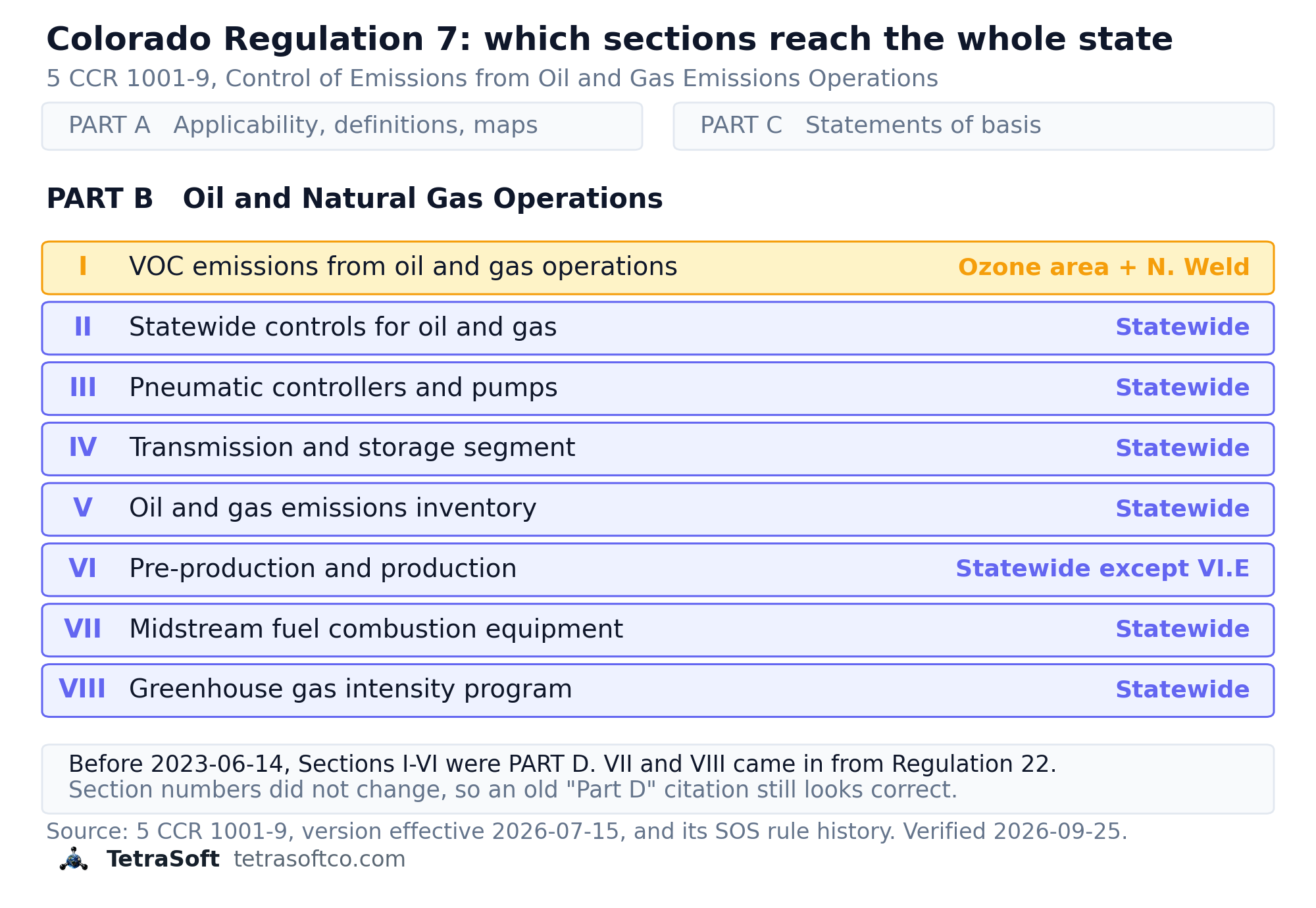
Regulation 7’s three parts, and which of Part B’s eight sections reach the whole state. Built from 5 CCR 1001-9, version effective July 15, 2026.
The State Only marking is not cosmetic. Part A states that Sections II through VIII, and any other section marked State Only, are not federally enforceable unless otherwise identified [1]. Section I is the federally enforceable portion, which is why it is tied to the ozone nonattainment area and the state implementation plan.
Part D Is Gone, and Most Citations Still Point There
Until the version effective February 14, 2023, Regulation 7 was a different document [3]. It was titled Control of Ozone via Ozone Precursors and Control of Hydrocarbons via Oil and Gas Emissions [3]. It ran to Parts A through F and put the oil and gas requirements in Part D [3]. The version effective June 14, 2023 retitled it and collapsed it to Parts A, B and C [3].
Section numbering survived the move, which is what makes the stale citations easy to miss. Part D Section I and Part B Section I are both titled Volatile Organic Compound Emissions from Oil and Gas Operations [1]. A memo citing Part D Section I.L. points at real requirements under a letter the regulation no longer uses.
Which Sections Apply to Your Facilities
Applicability turns on geography first and equipment second [1]. Part B Section I applies to oil and gas operations that collect, store or handle hydrocarbon liquids or produced water [1]. Those operations must sit in the 8-Hour Ozone Control Area, at or upstream of a natural gas plant [1]. Since February 14, 2023 the section also reaches those operations in northern Weld County [1].
The 8-Hour Ozone Control Area is the region Colorado must control because its air fails the federal 8-hour ozone standard [1]. That standard is the National Ambient Air Quality Standard for ground-level ozone, set at 70 parts per billion in 2015 [1].
An area fails it on a three-year record rather than a bad afternoon [4]. EPA averages each year’s fourth-highest daily maximum eight-hour reading over three years, and designates the area nonattainment when that figure exceeds 70 ppb [4]. Regulation 7 names its members: Adams, Arapahoe, Boulder, Douglas and Jefferson counties, Denver and Broomfield, and defined portions of Larimer and Weld [1].
That is the same boundary the regulation maps in Part A, Appendix A [1]. It is the only geography in Regulation 7 that decides applicability [1].
That geography covers a large share of Colorado’s wells [5]. Of the 125,717 wells on record in Colorado, 54,734 sit in those nine counties [5]. Weld County alone holds 45,875 of them, and Weld is covered end to end [5].
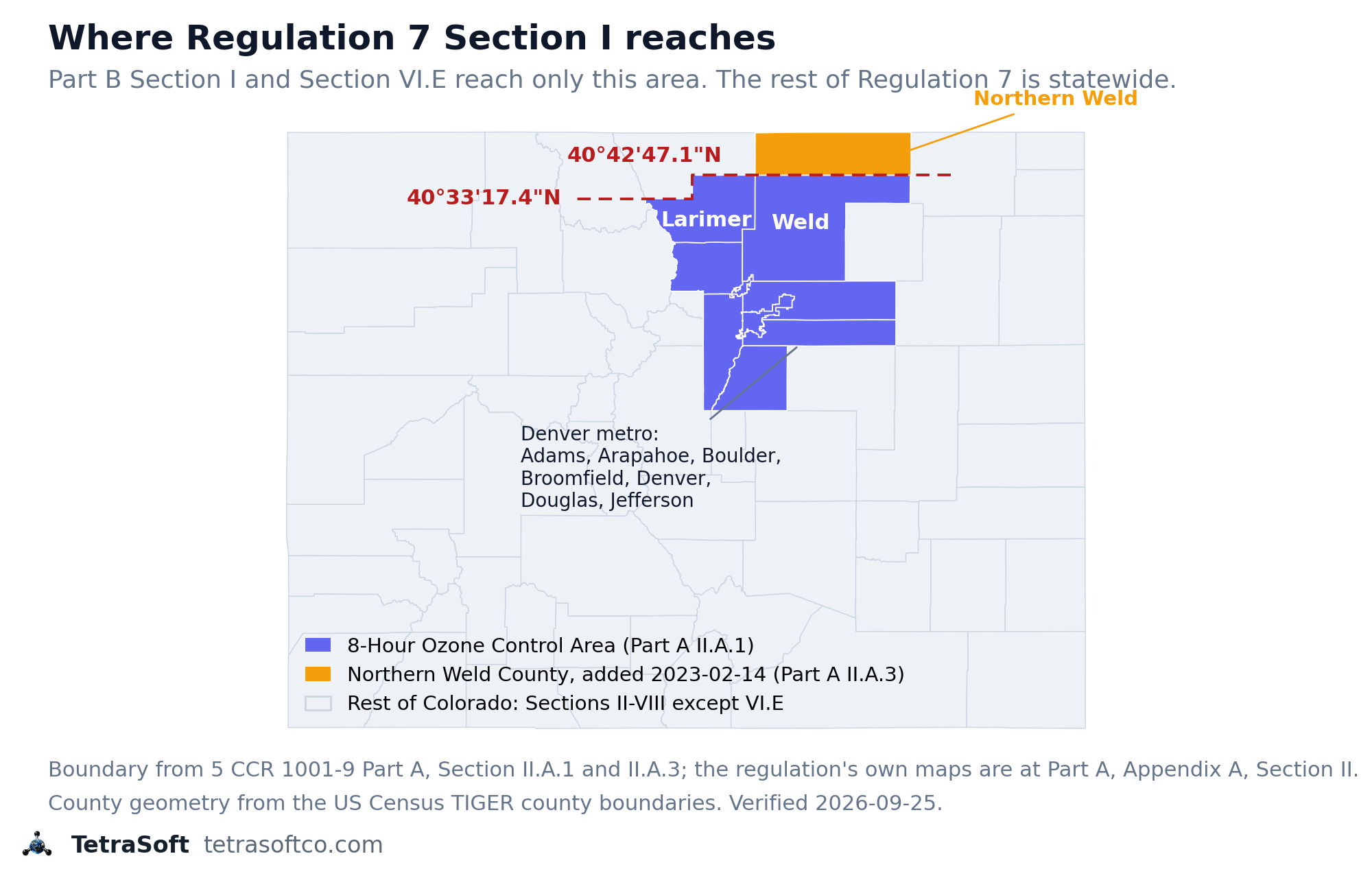
Where Part B Section I reaches. Boundary from 5 CCR 1001-9 Part A, Section II.A.1 and II.A.3; the regulation’s own maps are at Part A, Appendix A, Section II. [1]
How Often Regulation 7 Makes You Look for Leaks
Section I.L. sets leak detection and repair frequency by facility type and emissions [1]. Natural gas compressor stations inspect at least quarterly using an approved instrument monitoring method [1]. Section I.B.3 defines that term [1]. It means an infra-red camera, EPA Method 21, or another instrument-based method the Division approves under Section I.L.8 [1].
For most operators that is an optical gas imaging camera, with Method 21 as the instrument alternative. Well production facilities inspect at least annually where uncontrolled actual VOC emissions are between 1 and 6 tons per year [1]. Above 6 tons per year, on a rolling twelve-month total, they inspect at least semi-annually [1].
One detail in that test is easy to get wrong, and it changes the answer. Where storage tanks are present, the tier is set by the highest emitting single tank rather than the facility total [1]. Only where no oil or condensate tanks are present does the facility-wide figure govern [1]. Centralized oil stabilization facilities inspect quarterly from April 1, 2023, and transmission and storage compressor stations from May 1, 2026 [1].
Section V Is the Filing Everything Else Is Computed From
Before the intensity program can judge anything, it needs a number to judge. Section V supplies it [1]. It requires the annual Oil and Natural Gas Annual Emission Inventory Report, known as ONGAEIR, from operators statewide [1]. Everything in the next two sections is computed from the methane figure that filing carries, so an error there propagates straight into the intensity ratio.
That dependency runs in both directions. COBE could not model 19 percent of facilities because their ONGAEIR entries lacked key information [2]. An incomplete filing does not merely risk a reporting finding, it removes the option of being modelled at all. The filing itself is covered in Colorado ONGAEIR Due June 30: A Practical Filing Checklist.
Section VIII Is Where Regulation 7 Costs Money
Section VIII is the greenhouse gas intensity program, and it works differently from every other section in two ways [1]. It sets a target in metric tons of CO2 equivalent per thousand barrels of oil equivalent, rather than an equipment standard [1]. And it binds only the upstream segment [1].
Section VIII.A defines an intensity operator as one that operates upstream segment activities or equipment [1]. A midstream-only or transmission-only operator sits outside this section entirely.
The target depends on how much you produce [1]. Section VIII sets its own two classes, and they are not the ones Section VI uses for NOx [1].
A majority operator is an intensity operator whose company-wide Colorado production in calendar year 2022 reached 10,000 kBOE or more [1]. A minority operator is one below that line [1]. Separate rules cover operators new to the Colorado market [1].
For calendar year 2025 the targets were 10.94 mtCO2e/kBOE for a majority operator and 34.39 for a minority operator [1]. Operators producing less than 45 kBOE that year had no intensity target at all [1].
The number you are judged on is not the number you reported [1].
Section VIII.F.3 requires every intensity operator to comply with “either Section VIII.F.3.a or Section VIII.F.3.b to develop a measurement-informed inventory used to demonstrate compliance” [1].
Route (a) is the state default intensity verification factor [1]. The Division publishes it by December 31 each year through 2029, and applies it to upstream methane only [1]. Operators “must apply a state default intensity verification factor to their ONGAEIR methane emissions… unless the operator elects to use an operator-specific program” [1].
For the 2025 reporting year the CDPHE upstream intensity multiplier was 1.164, a single statewide figure [6]. An operator reporting 500 metric tons of upstream methane was judged on 582 [7].
The peer-reviewed work behind a multiplier of that size was first-authored by TetraSoft cofounder Arthur Santos [8]. It derived a MAES multiplier of 1.16 for the Denver-Julesburg Basin [8]. That implies roughly 16 percent of the methane reported to CDPHE was missing or underreported [8]. How the factor is applied and what it costs are covered in Colorado Regulation 7: GHG Intensity Verification Factor and What Colorado’s 1.164 Verification Factor Costs Operators.
What the COBE Study Found About the Multiplier
The 2026 factors do not come from 1.164 [2]. They come from the Colorado Ongoing Basin Emissions project, a joint CDPHE and Colorado State University study built to inform the 2026 verification rule [2]. COBE flew anonymous aerial campaigns over upstream facilities statewide, built measurement-informed inventories from the results, and compared them to ONGAEIR [2]. Its stated purpose was to “provide recommended ratios of modeled total emissions to corresponding reported emissions” [2].
The reason COBE lands somewhere different from the 2025 figure is the measurement, not the arithmetic. The 2025 multiplier rested on Carbon Mapper aerial data gathered over an 18-day campaign [8]. That sensor’s detection limit runs from 50 to 150 kg/h, depending on windspeed and ground reflectance [8].
92.8 percent of what it detected sat above 50 kg/h [8]. Emissions below that threshold were largely invisible to it [8].
COBE was built to see further down [2]. It used three aerial vendors rather than one [2]. Bridger’s Gas Mapping LiDAR reported detection limits of 5 and 10 kg/h, and Insight M 10 and 25 kg/h [2]. The study was designed explicitly to inform emissions falling below those limits [2].
It also covered far more ground [2]. Of Colorado’s 11,681 operating upstream facilities, 9,411 were modelled [2]. Between 20 and 25 percent were re-surveyed at least a day apart, to catch intermittent sources [2].
A campaign that resolves smaller and more intermittent emissions finds more of what a bottom-up inventory omits. That is the quantity both studies are measuring. The 2025 paper anticipated the gap, noting that “measurement technologies with lower detection limits capture emissions from abnormal processes that may be missed” [8].
Two teams modelled the same measurements and did not agree [2]. METEC used a mechanistic model and Colorado School of Mines used a statistical one [2]. The gap between them is the single most consequential number in Colorado methane compliance right now.
| Model | Statewide emissions estimate | Ratio to reported |
|---|---|---|
| Mechanistic Air Emissions Simulator (MAES), METEC | 38,936 mt/y | 1.47 |
| Statistical model, Colorado School of Mines, same facility subset | 87,210 to 134,352 mt/y | 3.30 to 5.09 |
| Statistical model, all ONGAEIR facilities | 109,384 to 167,848 mt/y | 3.81 to 5.85 |
Ratios of modelled total emissions to reported emissions, from the 2024 ONGAEIR dataset. [2]
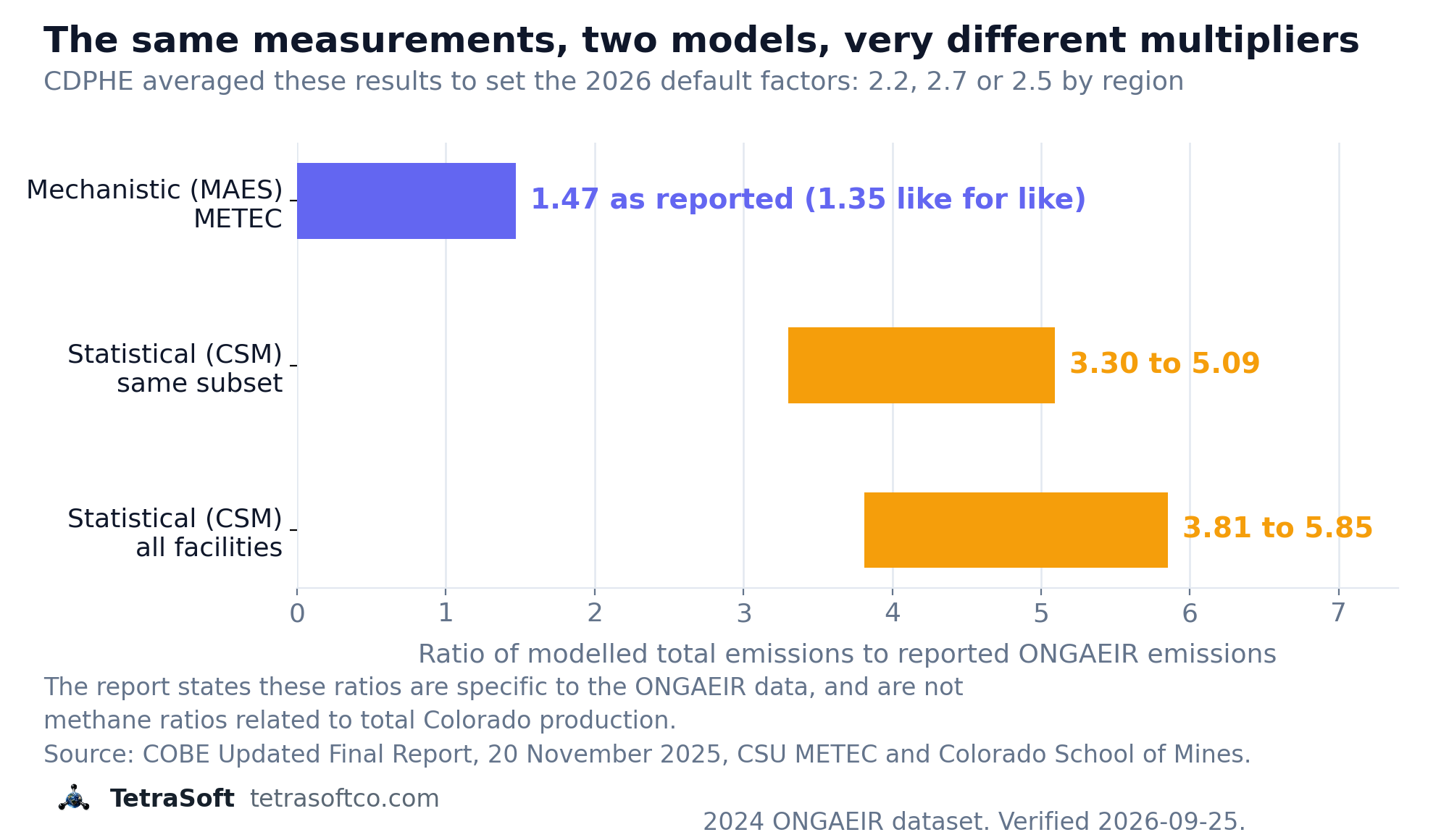
The two COBE models applied to the same measurements. TetraSoft analysis of the COBE Updated Final Report, November 2025.
The report is explicit about what those ratios are not. It states the ratios “are specific to the ONGAEIR data and should not be interpreted as methane ratios related to total production in Colorado” [2]. A further limitation matters for anyone whose reporting is thin.
Nineteen percent of facilities could not be modelled at all, because ONGAEIR was missing key information [2]. The remaining 81 percent of operating upstream facilities were modelled [2].
If the distance between a 1.47 multiplier and a 3.81 one would decide your compliance position, the operator-specific route below is worth the arithmetic. TetraSoft runs MAES-based estimation for that calculation.
The Way Out Is a Measurement-Informed Inventory
Section VIII.F.3.b is the alternative to accepting whatever multiplier the state publishes [1]. It lets an operator use an operator-specific program built on a measurement strategy [1]. For calendar years 2025 and 2026 that strategy must be one the Division developed [1]. From calendar year 2027 operators may use a strategy developed by either the Division or themselves [1].
The arithmetic decides whether that is worth doing. A default multiplier applies a statewide or basin-wide average to your inventory whether or not your sites resemble the average. An operator-specific inventory is built from your own equipment and your own measurements [1]. On the COBE numbers, the distance between a 1.47 multiplier and a 3.81 one is the difference between clearing an intensity target and missing it.
The TetraSoft MAES Platform, our subscription platform for emissions modelling, runs the Mechanistic Air Emissions Simulator [9]. That is the model METEC used to build COBE’s measurement-informed inventories [2]. MAES builds a facility from its equipment, its operating states and its gas composition [2]. It then adds the measured emissions the reported inventory does not already contain, mostly coming from upset conditions [2].
The distinction that matters for an individual operator is how much detail the model has to work with. A statewide study models thousands of sites from what the inventory happens to record, and fills the gaps with assumptions where facility detail is missing [2]. An operator running the same model on their own sites supplies equipment counts, operating conditions and gas compositions directly. Fewer of those assumptions are then needed.
What that produces is a figure built from your sites rather than from the state’s average. Whether it lands above or below the default is an empirical question about your operations.
The model was developed at CSU and UT Austin, and TetraSoft uses it through a partnership with CSU [9]. The same approach was applied to the Denver-Julesburg Basin in peer-reviewed work on measurement-informed inventory [8].
Two boundaries are worth stating before anyone reads a promise into that. MAES will not model a facility whose reported inventory is missing key information, which is exactly why 19 percent of COBE’s facilities fell out [2]. And an operator-specific program still needs Division approval and an approved measurement strategy, which the model does not supply [1].
Operators weighing that route are welcome to approach us about it. TetraSoft builds measurement-informed inventories on MAES for Colorado upstream operators, and will discuss what one would involve for a given set of facilities. What the model does is turn measurements into a defensible inventory at the equipment level, which is the artefact Section VIII.F asks for.
What Changed in Regulation 7 This Year
Regulation 7 was amended three times in the twelve months to September 2026 [3]. Permanent rules took effect on January 14, 2026, April 14, 2026 and July 15, 2026, with a correction also effective July 15, 2026 [3]. An operator working from a copy downloaded a year ago is working from a superseded document.
Two of those changes alter an obligation rather than wording. Section I.A.5., effective January 14, 2026, extended the leak detection program to transmission and storage segment compressor stations [1]. Those stations begin quarterly inspections on May 1, 2026 [1]. Section V.D., the Division’s annual information reporting duty to the Commission and the Colorado Oil and Gas Conservation Commission, was repealed effective July 15, 2026 [1].
More is coming for the intensity factor specifically [2]. A second phase, COBE-2, will reconcile the two models and develop recommended default factors for 2027 [2]. Its public report is expected near the end of 2026 [2]. Lowering your own factor through an approved program is covered in How to Get a Colorado Operator-Specific Verification Factor.
Frequently Asked Questions
Is Colorado Regulation 7 Part D the same as Part B?
Part D is the old numbering [3]. Until the version effective February 14, 2023 the regulation ran to Parts A through F with oil and gas in Part D [3]. The version effective June 14, 2023 restructured it to Parts A, B and C [3]. Section numbers carried across unchanged, so Part D Section I and Part B Section I share a title [1].
Does Colorado Regulation 7 apply outside the Denver ozone area?
Most of it does [1]. Part B Section I is the geographically limited one [1]. It reaches the 8-Hour Ozone Control Area, the Denver metro region failing the federal ozone standard, and northern Weld County [1].
Sections II through VIII apply statewide [1].
What is the state default intensity verification factor?
It is a multiplier applied to your ONGAEIR methane emissions before they are compared against the intensity target [1]. The Division publishes it by December 31 each year through 2029 [1]. The 2025 reporting year factor was 1.164 statewide [6].
What is a measurement-informed inventory?
It is an inventory that starts from reported emissions and adds measured emissions the report does not already contain [2]. Section VIII.F requires every intensity operator to develop one [1]. The two routes are the state default factor and an operator-specific program [1].
Why did the two COBE models disagree so much?
Because they estimate the emissions nobody measured in different ways [2]. Aerial surveys only see emissions above their detection limit, so both teams had to account for what sits below it [2].
The mechanistic model builds each facility from its reported equipment and simulates what it emits [2]. That anchors the total to the inventory, and returned a ratio of 1.47 [2].
The statistical model extrapolates from the measured distribution across facilities [2]. It returned 3.30 to 5.85, depending on the facility set and the below-threshold method [2]. COBE-2 is tasked with reconciling them [2].
Is Colorado Regulation 7 federally enforceable?
Only in part [1]. Part A provides that Sections II through VIII, and any other section marked State Only, are not federally enforceable unless otherwise identified [1]. The distinction decides who can bring an action, not whether the requirement binds you.
Interested in building a Measurement-Informed Inventory for your operations? Contact us to learn about our MAES-based estimation services.
This post is for informational purposes only and does not constitute legal or compliance advice. Consult qualified legal counsel or a compliance professional for guidance specific to your operations and jurisdiction.
References
- Colorado AQCC Regulation Number 7, 5 CCR 1001-9, Control of Emissions from Oil and Gas Emissions Operations, version effective July 15, 2026. Colorado Secretary of State, Code of Colorado Regulations. https://www.sos.state.co.us/CCR/GenerateRulePdf.do?ruleVersionId=12621&fileName=5%20CCR%201001-9
- Colorado Secretary of State, rule history for 5 CCR 1001-9, Air Quality Control Commission, listing every adopted version with its effective date. https://www.coloradosos.gov/CCR/DisplayRule.do?action=ruleinfo&ruleId=2341&deptID=16&agencyID=7&deptName=Department+of+Public+Health+and+Environment&agencyName=Air+Quality+Control+Commission&seriesNum=5+CCR+1001-9
- Brown et al., 2025, Colorado Ongoing Basin Emissions Updated Final Report. Brown, J. A.; Moy, M.; Santos, A.; Rimelman, E.; Mollel, W.; Khaliukova, O.; Okenberg, C.; Daniels, W. S.; Hammerling, D. M.; Zimmerle, D.; Hodshire, A. L. Energy Institute, METEC, Colorado State University, and Colorado School of Mines, November 20, 2025.
- CDPHE, Oil and Gas Greenhouse Gas Intensity Program, state default intensity verification factor publications and methodology. https://cdphe.colorado.gov/oil-and-gas-greenhouse-gas-intensity-program
- Mollel et al., 2025, ACS ES&T Air, 2, 723-735, DOI 10.1021/acsestair.4c00168. Using Prototypical Oil and Gas Sites to Model Methane Emissions in Colorado’s Denver-Julesburg Basin Using a Mechanistic Emission Estimation Tool. https://doi.org/10.1021/acsestair.4c00168
- Santos et al., 2025, ACS ES&T Air, 2, 1598-1611, DOI 10.1021/acsestair.5c00089. Using Measurement-Informed Inventory to Assess Emissions in the Denver-Julesburg Basin. https://doi.org/10.1021/acsestair.5c00089
- TetraSoft analysis of Colorado well locations by county, September 2026. County-level well counts computed from the TetraSoft canonical Colorado dataset as published by Colorado ECMC; county totals are whole-county and therefore an upper bound where the 8-Hour Ozone Control Area boundary runs mid-county.
- Computed from the 2025 state default verification factor of 1.164 applied to a 500 metric ton reported figure. No external source.
- US EPA, NAAQS Table, criteria air pollutants, giving the 2015 ozone standard of 0.070 ppm and its form as the annual fourth-highest daily maximum 8-hour concentration averaged over three years. https://www.epa.gov/criteria-air-pollutants/naaqs-table
Applicability screener
Which parts of Regulation 7 reach this facility?
Geography decides first. Section I is an ozone-area rule; Sections II to VIII are statewide.
Highest emitting single tank where tanks are present, not the facility total.
Part B Section I applies, and so do Sections II to VIII
Leak inspections: At least annually
Statewide regardless of location
- IIStatewide controls for oil and gas operations
- IIIPneumatic controllers and pneumatic pumps
- IVNatural gas transmission and storage segment
- VOil and natural gas operations emissions inventory
- VIPre-production, early-production and production operations
- VIIMidstream segment fuel combustion equipment
- VIIIGreenhouse gas intensity program, upstream segment
Screens the applicability tests as worded in 5 CCR 1001-9, version effective July 15, 2026. It does not know where your facility is, does not compute uncontrolled VOC emissions, and does not resolve the Larimer and Weld boundary, which the regulation draws by latitude rather than by county line. LDAR tiers from Part B, Section I.L.: at least annually from 1 to 6 tons per year, at least semi-annually above 6.
Comments
0Share your thoughts. All comments are moderated before appearing.
No comments yet. Be the first to share your thoughts!