OOOOb is the EPA rule that sets emission standards for new oil and gas facilities [1]. It is codified at 40 CFR Part 60, Subpart OOOOb, and limits greenhouse gases and VOC [1]. New here means built, modified, or reconstructed after December 6, 2022 [1].
The name is read as quad O b, and the letters are a subpart identifier rather than an acronym [1]. Three sibling subparts sit alongside it, and which one applies depends entirely on when a site was built [2].
That date boundary is the whole structure, and it is the part most summaries leave out. Getting it wrong means preparing for the wrong rule entirely.
Quick Answer: OOOOb covers oil and gas facilities constructed, modified, or reconstructed after December 6, 2022 [1]. Older sites fall under OOOOa or OOOO, and existing sources are addressed by OOOOc through state plans [3]. OOOOb and OOOOc both face potential repeal or administrative stay, so everything below describes the rule as written rather than as a fixed obligation.
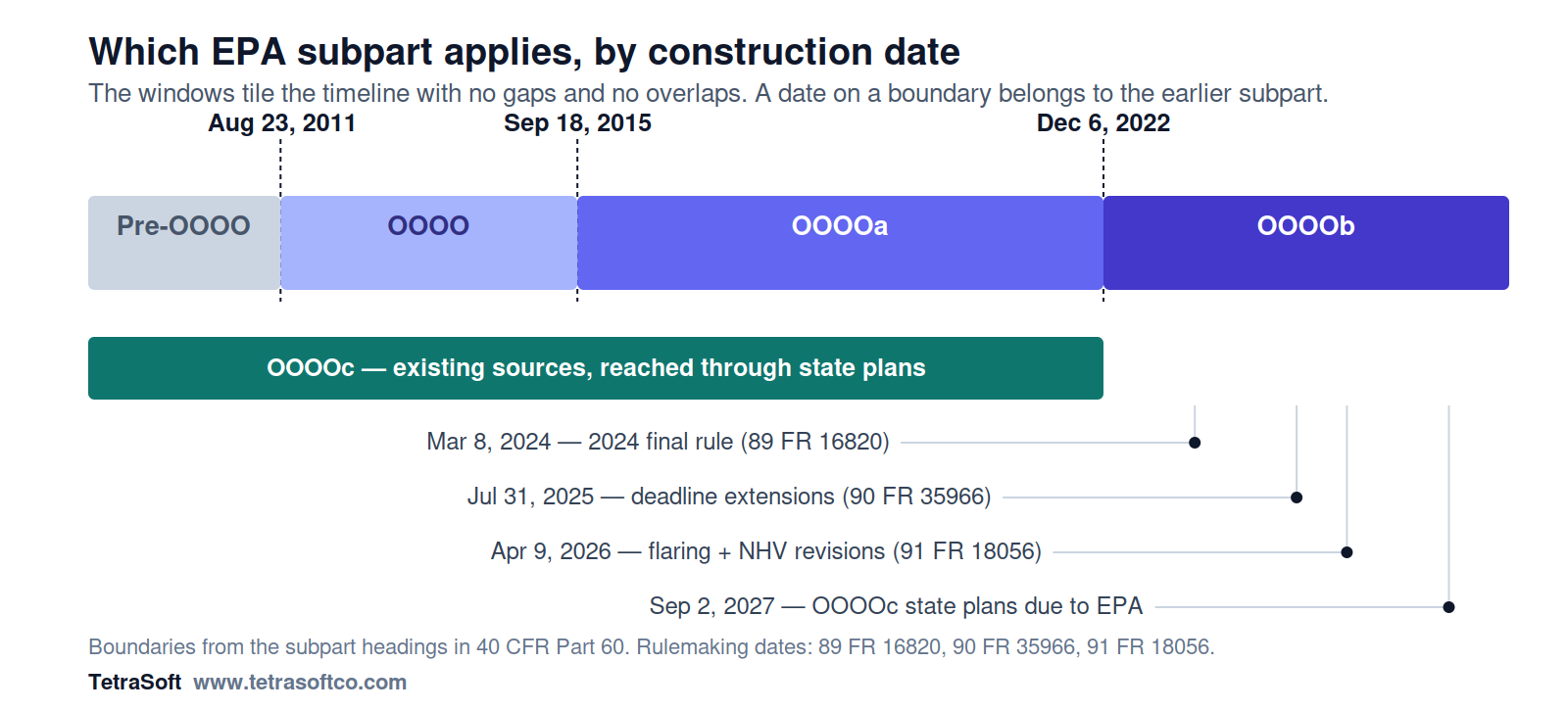
*The four windows tile the timeline with no gaps [1]. A date landing on a boundary belongs to the earlier subpart. *
What OOOO, OOOOa, OOOOb, and OOOOc Actually Are
Each subpart is a separate rule bounded by construction dates, and together they form a chain with no gaps [1]. The subpart titles in the Code of Federal Regulations carry the dates directly, which makes them the fastest way to check applicability.
| Subpart | Applies to construction, modification, or reconstruction | Covers |
|---|---|---|
| OOOO | After August 23, 2011 and on or before September 18, 2015 | VOC and sulfur dioxide |
| OOOOa | After September 18, 2015 and on or before December 6, 2022 | Adds methane |
| OOOOb | After December 6, 2022 | Greenhouse gases, as methane, and VOC |
| OOOOc | Existing sources, on or before December 6, 2022 | Greenhouse gases, as methane, via state plans |
Every date above is drawn from the subpart headings, and each pollutant scope from the subpart’s own purpose section [4]. The dates do the work here.
Greenhouse gas in the two later rows means methane [5]. EPA sets the OOOOb and OOOOc greenhouse gas standards in the form of limitations on methane emissions [5]. The pollutant is therefore the same one OOOOa named, written in the vocabulary the later rules use.
Why OOOOc Is Not Simply the Existing Source Version of OOOOb
OOOOc is an emissions guideline rather than a directly enforceable standard, which changes who implements it [3]. States write plans that establish performance standards for designated facilities, and EPA reviews those plans [3]. EPA extended the deadline for state plan submittal to September 2, 2027 [6].
The practical consequence is that an existing source’s obligations arrive through its state, not directly from the federal rule.
A single site can sit under a new source standard and be an existing source at the same time. A well site built in 2019 is an OOOOa affected facility. It also commenced on or before December 6, 2022, which makes it a designated facility for OOOOc purposes [3]. Reading only the new source standard leaves the state plan obligation invisible until the plan lands.
Which Subpart Applies to Your Sources, and From When
Find the construction date and the subpart follows from it, because the windows do not overlap [2]. A site built in 2019 sits under OOOOa, and one built in 2023 sits under OOOOb.
Modification and reconstruction matter as much as original construction here [1]. An older site that undergoes a qualifying modification after December 6, 2022 can move into OOOOb, even though the original wellsite predates it. That is the detail operators most often miss when they assume vintage alone settles the question.
What OOOOb Actually Requires, Equipment by Equipment
The standards are organized by affected source, so obligations attach to equipment rather than to the site as a whole [5]. The figures below come from EPA’s own summary table in the 2024 final rule [5].
Fugitive Emissions Monitoring Runs on a Schedule Set by Site Type
Monitoring frequency depends on what equipment the site holds, not on its size alone [5]. Audio, visual, and olfactory checks run alongside optical gas imaging surveys at most site types [5].
| Site type | AVO surveys | OGI surveys |
|---|---|---|
| Single wellhead only and small well sites | Quarterly | Not required |
| Multi-wellhead only well sites, two or more wellheads | Quarterly | Semiannual |
| Well sites with major production and processing equipment, and centralized production facilities | Bimonthly | Quarterly |
| Compressor stations | Monthly | Quarterly |
| Well sites and compressor stations on the Alaska North Slope | Not required | Annual |
EPA Method 21 monitoring is an optional alternative to OGI, with 500 ppm defined as a leak [5]. Repair timing differs by survey type. AVO findings carry a 15 day first attempt and a 15 day final repair, and OGI findings carry 30 days for each [5]. Monitoring continues at a well site until the site is closed and a well closure report is submitted [5].
That last clause is the one that surprises people. Plugging the wells is part of ending the obligation, not a separate matter [5].
Equipment Standards, and the Super-Emitter Program That Sits Apart
A storage vessel becomes an affected facility at 6 tons per year of VOC potential to emit [7]. The methane threshold is 20 tons per year [7]. Those thresholds are evaluated on the tank battery, defined as a group of storage vessels manifolded together for liquid transfer [7]. Emissions are counted cumulatively across every vessel in that battery [7].
An affected storage vessel must capture emissions and route them to a control device achieving 95 percent reduction of VOC and methane [5]. Splitting a battery across separate calculations understates the total and is the common route to a wrong applicability answer.
Natural gas-driven process controllers must meet an emission rate of zero for methane and VOC [5]. Natural gas-driven pumps carry the same zero emission rate [5]. Alaska sites without onsite power are handled separately, with low-bleed controllers limited to a bleed rate of 6 standard cubic feet per hour [5].
Compressors outside well sites are governed by volumetric flow rate limits per seal or per cylinder [5].
| Compressor type | Limit |
|---|---|
| Wet seal centrifugal, self-contained or mechanical seal | 3 scfm per seal |
| Wet seal centrifugal, Alaska North Slope with seal oil recovery | 9 scfm per seal |
| Dry seal centrifugal | 10 scfm per seal |
| Reciprocating | 2 scfm per cylinder |
Wet seal centrifugal compressors may instead route degassing emissions to a control device achieving 95 percent reduction [5]. Compressors located at well sites are treated differently from the rest [5].
The Super-Emitter Program responds to third party detections rather than to a scheduled survey [5]. A super-emitter event is an emissions event at an oil and gas facility, found by remote detection. Its quantified rate must be 100 kilograms per hour of methane or greater [5].
An operator must initiate an investigation within 5 days of receiving an EPA notification and report the results within 15 days [5]. That clock starts on someone else’s measurement, which is what makes the program structurally different from the rest of the rule.
Deadlines in this rule set have already moved once, and the status of the standards themselves is unsettled. Subscribe for compliance updates and regulatory news.
Compliance Deadlines Moved in 2025, and Most Summaries Predate the Change
EPA extended a set of OOOOb compliance deadlines through an interim final rule in July 2025 [6]. The agency stated that the action did not reopen the substance of the 2024 rule [6]. Numeric standards and thresholds were unchanged; only dates moved [6].
| Requirement | Extended deadline |
|---|---|
| Zero-emissions standard for process controllers, phase 2 | January 22, 2027 |
| Super-Emitter Program implementation | January 22, 2027 |
| Storage vessel legally and practicably enforceable limit criteria | January 22, 2027 |
| Equipment leak repairs | January 22, 2027 |
| Performance testing for enclosed combustion devices | January 22, 2027 |
| Net heating value monitoring for flares and enclosed combustion devices | November 28, 2025 |
| OOOOc state plan submittal | September 2, 2027 |
EPA cited supply chain constraints for monitoring equipment, laboratory capacity, and complexity in state plan development as the reasons [6]. A guide written before July 2025 will carry the superseded dates without saying so.
The Rules Are Still Being Amended
EPA published a final rule on April 9, 2026 revising two technical provisions of the 2024 framework, effective June 8, 2026 [8]. The revisions addressed temporary flaring provisions for associated gas and net heating value monitoring for flares [8]. EPA described the changes as two narrow technical aspects of the earlier rules [9]. For what those revisions changed in practice, see EPA’s April 2026 OOOOb/OOOOc Amendment: What Changed.
OOOOa remains in effect and enforceable for the sites inside its window, whatever happens to the newer subparts. OOOOb and OOOOc face potential repeal or administrative stay, which makes them unreliable planning targets on their own. Separately, Congress disapproved EPA’s implementing rule for the IRA Methane Waste Emissions Charge, leaving no enforceable charge [10].
They are not one rule. Reading those three as one regulatory picture is what produces wasted effort. For the current status of each and how to plan around it, see EPA OOOOb/c Status Is Uncertain: How Operators Should Plan.
Knowing which sites sit in which window has to come first. That is a records question before it is a compliance question. TetraSoft Atlas, a subscription platform for oil and gas records, holds permit and completion history across eight states. Those dates can be checked against the wells themselves.
Reporting Obligations Do Not Move With the Standards
Subpart W of the greenhouse gas reporting program is a separate rule from the OOOO series, under a different part of the CFR [11]. A change to an OOOO subpart does not alter what a facility must report under Subpart W. Operators regularly conflate the two, and the confusion runs in both directions. For what Subpart W still requires, see GHGRP Subpart W Reporting in 2026: What Is Still Required.
Frequently Asked Questions
What does OOOO stand for?
Nothing [4]. The letters are a sequential subpart identifier within 40 CFR Part 60, in the same way earlier subparts are lettered A, B, and so on [4]. It is spoken as quad O, and the trailing letter distinguishes each successive rule.
Is OOOOb still in effect?
Yes, and it is also under active reconsideration. EPA amended two technical provisions in April 2026 and left the rest of the framework standing [8]. Repeal or a stay remains possible, so the status is worth re-checking before it drives a spending decision.
Which subpart applies to a site built before August 23, 2011?
None of the three new source standards reach it, because OOOO starts at that date [4]. Sites that predate the OOOO window are existing sources for these purposes. Existing sources are addressed through OOOOc and the state plans written under it [3].
Does a site on the boundary date fall under the earlier or later subpart?
The earlier one, because each window is written as after one date and on or before the next [2]. A site whose construction commenced on December 6, 2022 is inside the OOOOa window, not the OOOOb one. One day either side of a boundary changes which rule governs the site.
Do the storage vessel thresholds apply per tank?
No, they apply to the tank battery as a whole [7]. Several small vessels can therefore cross the 6 tons per year VOC threshold together while none crosses it alone. Sizing each vessel below the threshold individually does not keep the battery out of scope.
Regulatory status in this sector changes faster than most compliance calendars. Subscribe for compliance updates and regulatory news.
This post is for informational purposes only and does not constitute legal or compliance advice. Consult qualified legal counsel or a compliance professional for guidance specific to your operations and jurisdiction.
References
- 40 CFR Part 60, Subpart OOOOb. https://www.ecfr.gov/current/title-40/chapter-I/subchapter-C/part-60/subpart-OOOOb
- 40 CFR Part 60, Subpart OOOOa. https://www.ecfr.gov/current/title-40/chapter-I/subchapter-C/part-60/subpart-OOOOa
- 40 CFR Part 60, Subpart OOOOc. https://www.ecfr.gov/current/title-40/chapter-I/subchapter-C/part-60/subpart-OOOOc
- 40 CFR Part 60, Subpart OOOO. https://www.ecfr.gov/current/title-40/chapter-I/subchapter-C/part-60/subpart-OOOO
- EPA, Standards of Performance for New, Reconstructed, and Modified Sources and Emissions Guidelines for Existing Sources: Oil and Natural Gas Sector Climate Review. Final rule, 89 FR 16820, March 8, 2024. https://www.govinfo.gov/content/pkg/FR-2024-03-08/html/2024-00366.htm
- EPA, Extension of Deadlines in Standards of Performance for New, Reconstructed, and Modified Sources and Emissions Guidelines for Existing Sources: Oil and Natural Gas Sector Climate Review. Interim final rule, 90 FR 35966, July 31, 2025. https://www.govinfo.gov/content/pkg/FR-2025-07-31/html/2025-14531.htm
- EPA, Frequently Asked Questions: Storage Vessels, Controlling Air Pollution from the Oil and Natural Gas Industry. https://www.epa.gov/controlling-air-pollution-oil-and-natural-gas-operations/frequently-asked-questions-storage-vessels
- EPA, Reconsideration of Standards of Performance for New, Reconstructed, and Modified Sources and Emissions Guidelines for Existing Sources: Oil and Natural Gas Sector Climate Review. 91 FR 18056, published April 9, 2026, effective June 8, 2026. https://www.govinfo.gov/content/pkg/FR-2026-04-09/html/2026-06808.htm
- EPA, 2026 Final Rule to Reduce Burden on the Oil and Natural Gas Industry. https://www.epa.gov/controlling-air-pollution-oil-and-natural-gas-operations/2026-final-rule-reduce-burden-oil-and
- Congressional Review Act disapproval of EPA’s implementing rule for the IRA Methane Waste Emissions Charge (IRA Section 60113); H.J.Res.35, signed into law as Public Law 119-2 on March 14, 2025. https://www.govinfo.gov/content/pkg/PLAW-119publ2/html/PLAW-119publ2.htm
- 40 CFR Part 98, Subpart W. https://www.ecfr.gov/current/title-40/chapter-I/subchapter-C/part-98/subpart-W
Comments
0Share your thoughts. All comments are moderated before appearing.
No comments yet. Be the first to share your thoughts!