A natural gas BTU value is the heat released by burning one cubic foot of the gas, and it depends on what the gas contains. Pipeline-quality gas is treated as roughly 1,020 Btu per dry standard cubic foot, which is the average EPA uses for its combustion factors [1]. Gas at the wellhead has not been processed yet, so it still carries the ethane, propane and heavier fractions that a plant strips out. Those components carry more energy per cubic foot than methane, which pushes the measured heating value up. Measured wellhead analyses from eight states sit on one screen in TetraSoft Atlas, our subscription platform that joins well, production, emissions and enforcement records [2].
Quick Answer: Pipeline gas is usually assumed at about 1,020 Btu per dry standard cubic foot [1]. Measured wellhead gas runs higher, with state medians between 1,033 and 1,206 Btu across 31,823 analyses carrying a heating value [2]. Every one of the eight state medians sits above the 1,020 assumption [2].
Wellhead Gas Is Not the 1,020 Btu Standard
The convenient round number comes from processed gas, not produced gas. AP-42 states that its natural gas combustion factors are based on an average higher heating value of 1,020 Btu per standard cubic foot [1]. Dividing by that same 1,020 converts those factors from a volume basis to a heat-input basis [1].
Wellhead gas is a different substance. In Colorado produced-gas analyses the median stream is about 72.4 per cent methane by mass, with 12.3 per cent ethane and 6.1 per cent propane [2].
Composition Is What Moves the Heating Value
Methane is the lightest component and the lowest energy carrier per cubic foot of the hydrocarbons present. A stream that is only three-quarters methane therefore carries a quarter of its volume in components with more energy each.
Colorado’s methane fraction spans a wide band across the sample set [2]. The fifth percentile sits at 56.5 per cent methane and the ninety-fifth at 81.6 per cent, across 6,754 produced-gas analyses [2].
Colorado’s ECMC records carry both a heating value and a methane fraction, so the mechanism is visible directly [2]. Sorting the 19,443 analyses that hold both shows heating value climbing as methane gives way to heavier components [2].
| Methane fraction | Analyses | Median Btu/scf | Median nitrogen |
|---|---|---|---|
| 90 per cent and above | 533 | 1,008 | 2.1 per cent |
| 80 to 90 per cent | 3,554 | 1,160 | 1.6 per cent |
| 70 to 80 per cent | 10,656 | 1,234 | 1.0 per cent |
| 60 to 70 per cent | 2,642 | 1,296 | 3.2 per cent |
| Below 60 per cent | 2,058 | 859 | 24.6 per cent |
Colorado ECMC analyses only; the USGS, Wyoming and West Virginia records carry no methane fraction [2].
A nearly pure methane stream reads 1,008 Btu, within a dozen points of the AP-42 figure [2]. AP-42 puts pipeline gas at 1,020 Btu and says it usually varies from 950 to 1,050 [1]. The leanest wellhead streams land inside that band; the rest sit above it. That is why most analyses clear 1,020.
The bottom band falls for the opposite reason. Analyses below 60 per cent methane carry a median of 24.6 per cent nitrogen [2]. Every other methane band sits between 1.0 and 3.2 per cent [2]. Inert dilution drags those streams down while liquids enrichment lifts the rest.
The Spread Matters More Than the Median
A median is a poor summary when the distribution is this wide. Colorado heating values run from roughly 760 Btu at the fifth percentile to 1,392 at the ninety-fifth [2]. Wyoming spans roughly 806 to 1,506 over the same percentiles [2].
A calculation that assumes 1,020 for a 1,400 Btu stream is wrong by more than a third on that input alone.
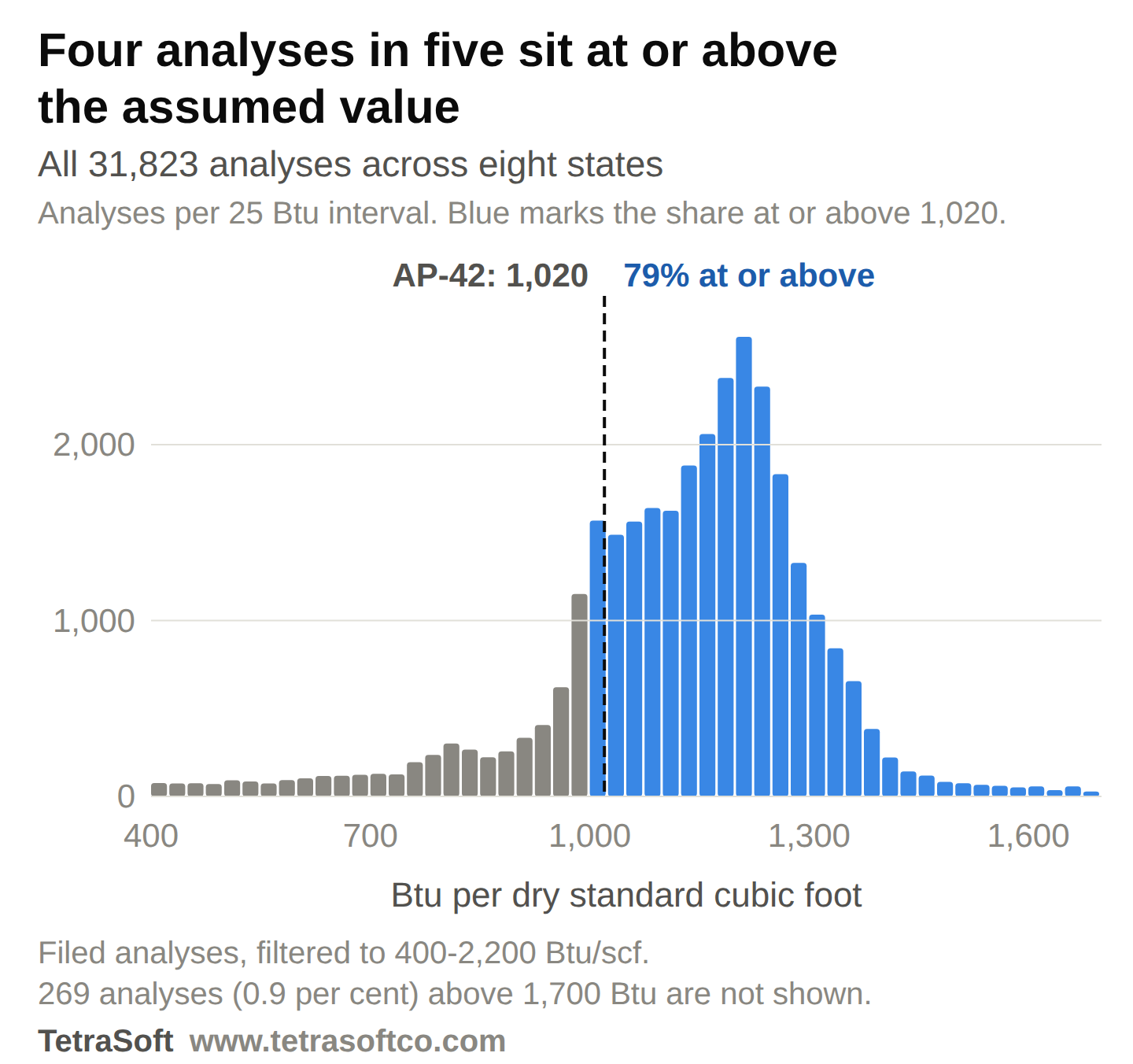
Across all 31,823 filed analyses, 79 per cent sit at or above the 1,020 Btu assumption. [2]
Two checks on that share. Colorado supplies 64 per cent of the analyses and the highest median, yet excluding it the share above 1,020 is still 70.3 per cent [2]. The 400 Btu floor discards 2,296 records whose median value is 74 Btu, which is not a plausible gas stream [2].
Eight States of Wellhead Analyses Sit in TetraSoft Atlas
TetraSoft Atlas aggregates gas chromatography analyses filed with the state agencies and attaches them to the well or facility they came from [2]. The analyses come from two source families, state agency filings and the USGS gas composition database [2]. Colorado is mostly ECMC filings, while Texas, New Mexico and Oklahoma are entirely USGS survey records [2]. Of the 38,655 analyses held, 31,823 carry a heating value in a plausible range [2].
The eight states in TetraSoft Atlas produced 83 percent of US marketed natural gas and 68 percent of US crude oil in 2025 [3]. Atlas is self-serve, with no sales call: you sign up and start a 7-day trial with no credit card [4].
| State | Analyses with BTU | Median Btu/scf | 5th–95th percentile |
|---|---|---|---|
| Colorado | 20,452 | 1,206 | 760 – 1,392 |
| Texas | 4,581 | 1,067 | 779 – 1,273 |
| Oklahoma | 2,935 | 1,073 | 795 – 1,268 |
| Wyoming | 1,586 | 1,092 | 806 – 1,506 |
| New Mexico | 1,004 | 1,097 | 652 – 1,357 |
| West Virginia | 477 | 1,100 | 966 – 1,309 |
| Ohio | 398 | 1,069 | 940 – 1,207 |
| Pennsylvania | 390 | 1,033 | 979 – 1,216 |
*Heating values filtered to 400–2,200 Btu/scf. *
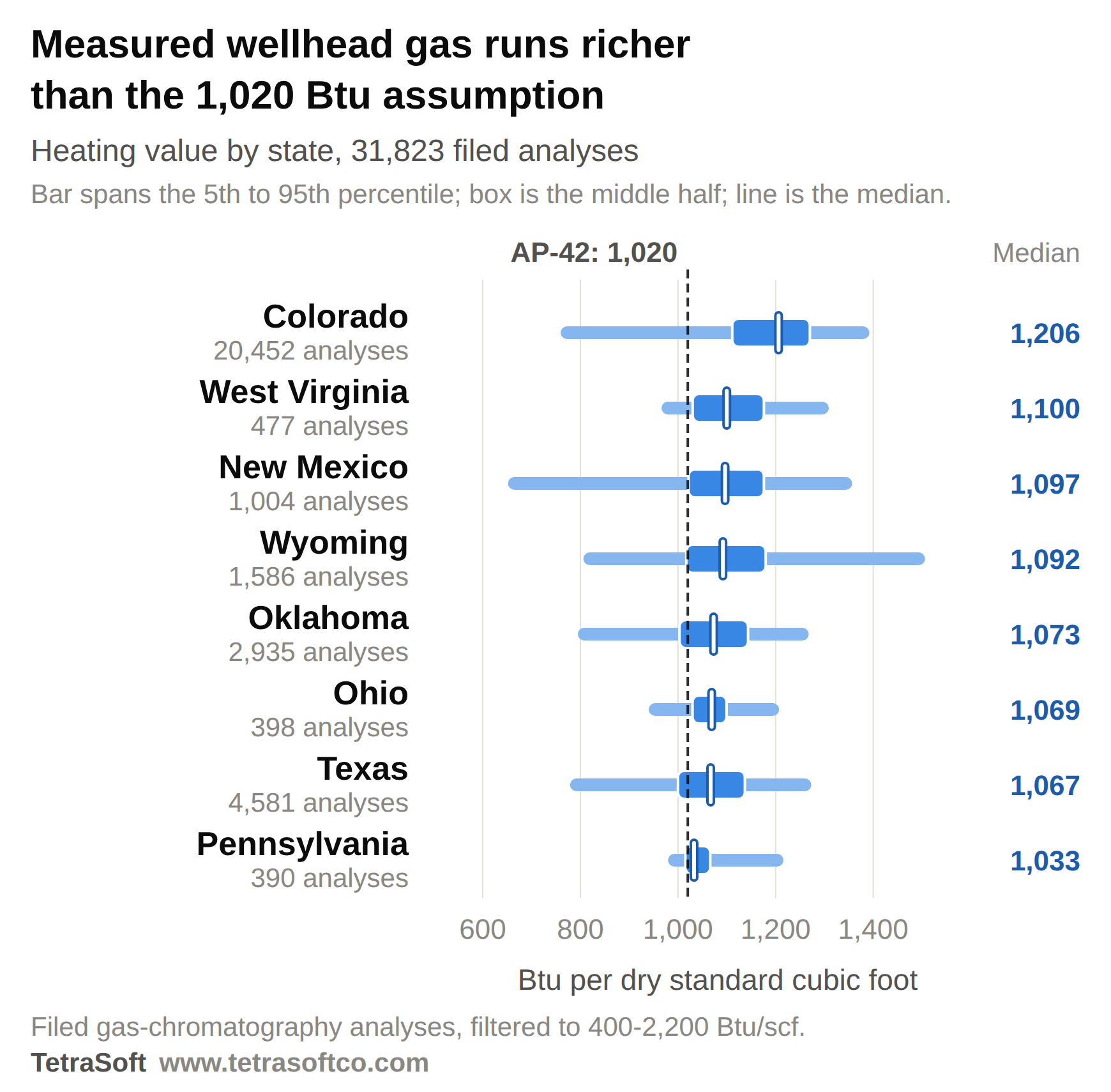
Every state median sits above the assumed value, and the spread within any single state is wider than the 173 Btu range between state medians. [2]
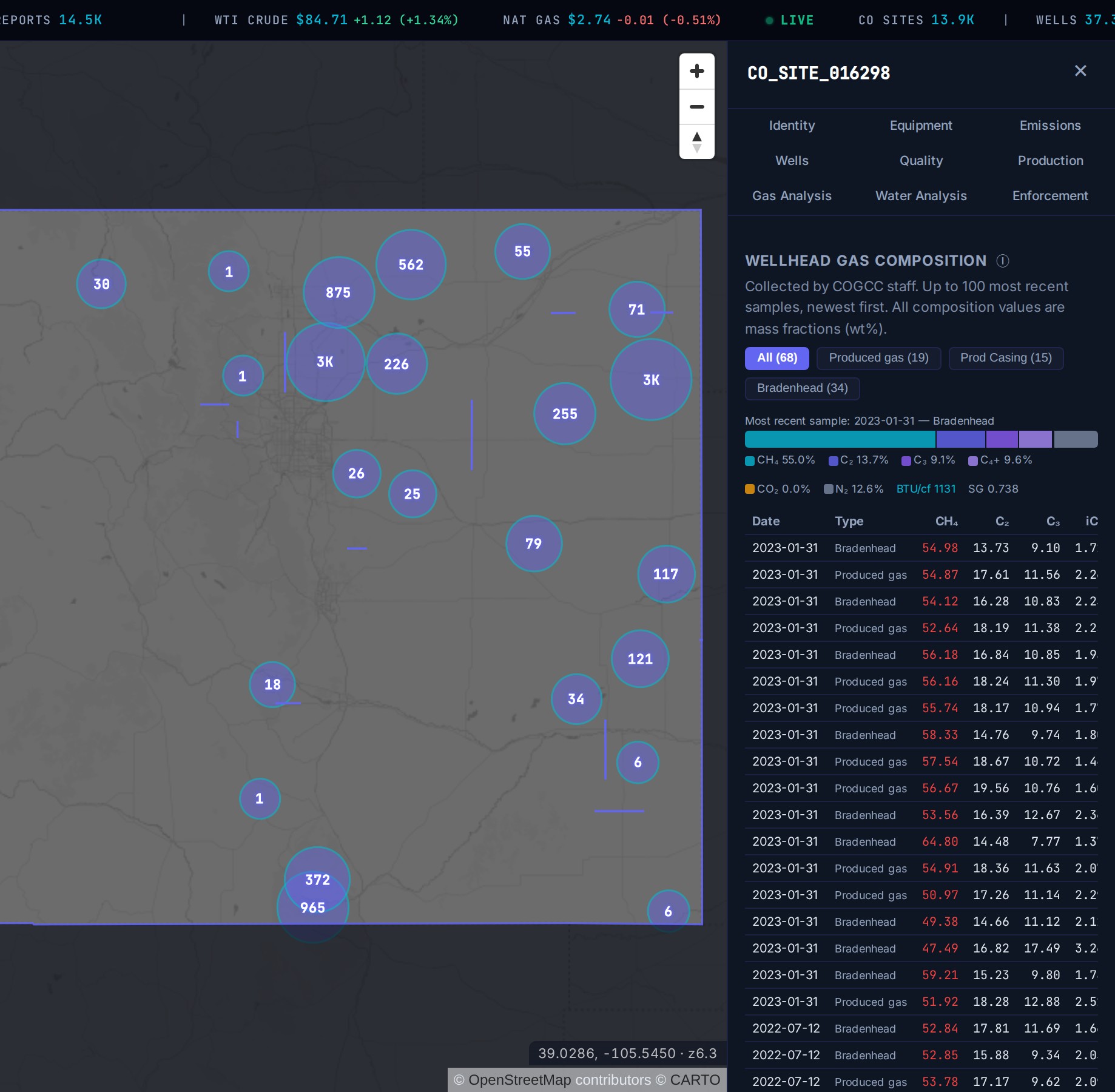
A Colorado wellhead gas analysis in TetraSoft Atlas, showing the most recent sample’s component mole percentages and its heating value of 1,131 Btu per cubic foot [2].
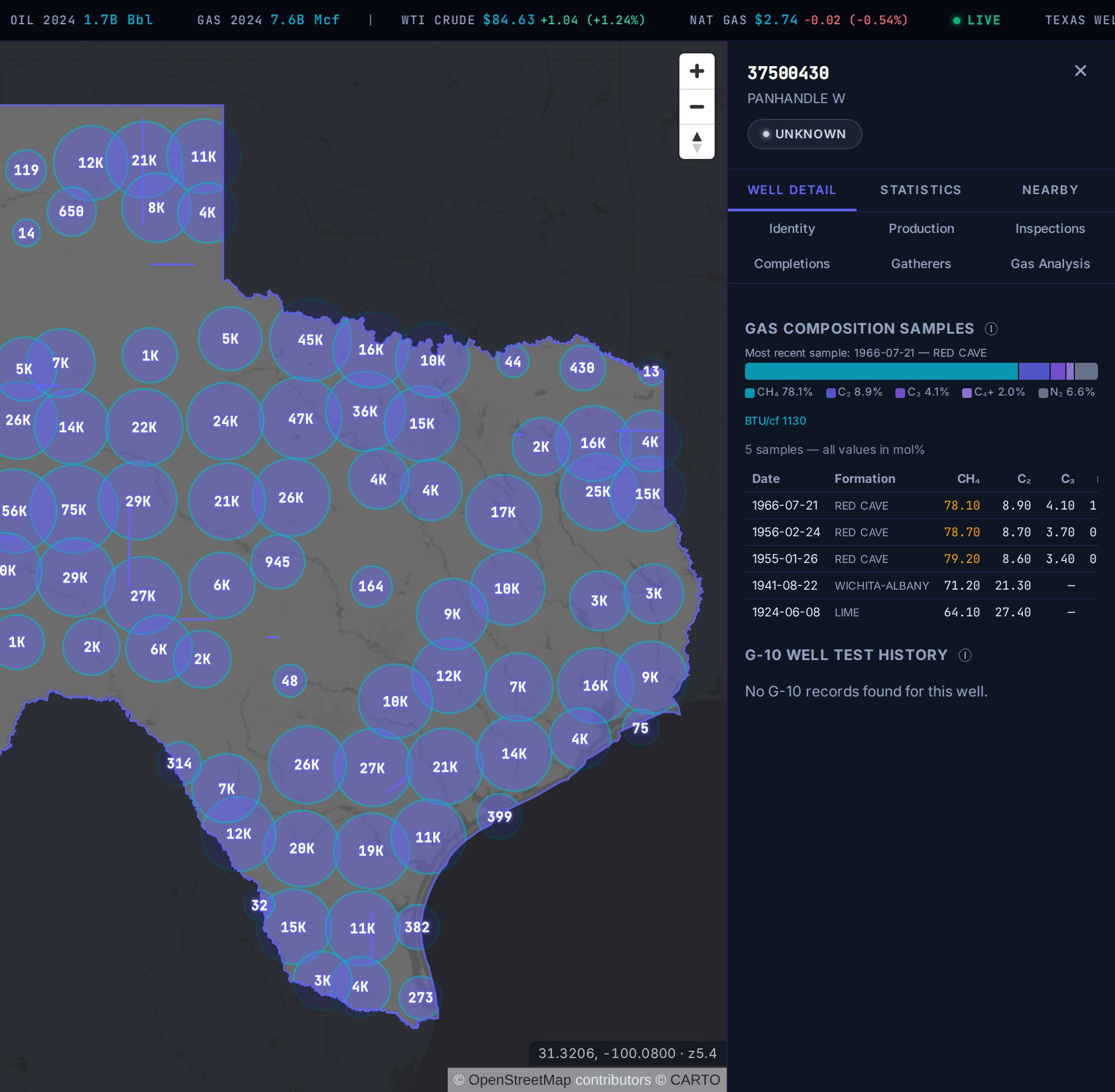
A Texas well’s gas samples in TetraSoft Atlas, reported in mole per cent, with the most recent at 1,130 Btu per cubic foot [2].
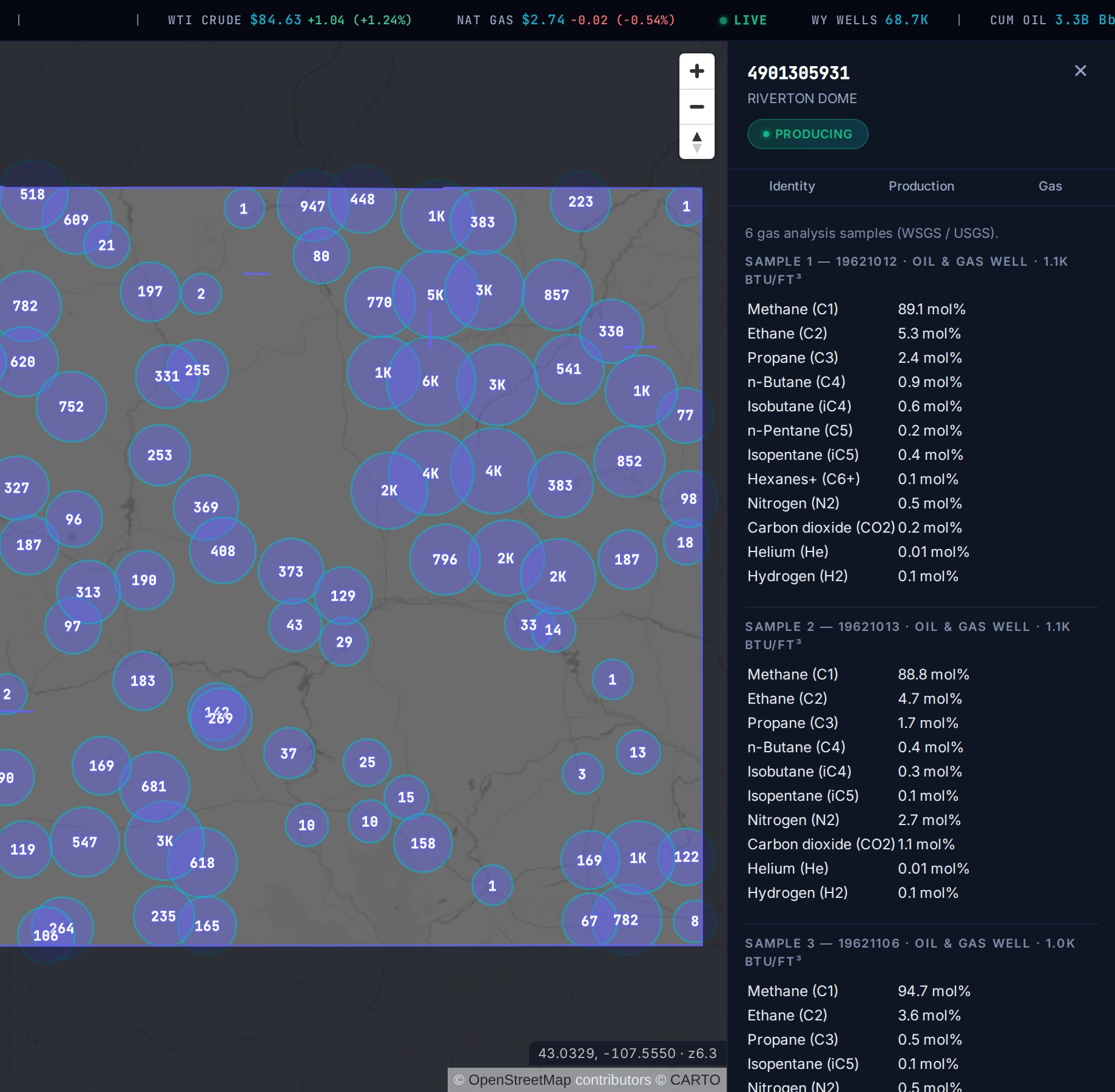
A producing Wyoming well on the Riverton Dome field, whose leanest sample still reaches 89.1 per cent methane [2].
All three panels report component mole percentages, so they are directly comparable [2]. Reconstructing each Colorado sample’s own reported specific gravity from its components confirms that basis [2]. The median error is 0.10 per cent, against 14.2 per cent if the same figures are read as mass fractions [2]. The heating value itself is stated per cubic foot in every case, which is why it compares cleanly.
Every State Median Sits Above the Assumed Value
Not one of the eight state medians falls below 1,020 Btu [2]. The lowest is Pennsylvania at 1,033 and the highest Colorado at 1,206 [2].
That consistency is the part worth pausing on. Eight independent state datasets landing on the same side of the assumption is not a coincidence.
Where an Assumed BTU Breaks a Calculation
An assumed heating value distorts any factor converted between a volume basis and a heat-input basis [1]. AP-42 publishes natural gas combustion factors per million standard cubic feet, and conversion to a per-million-Btu basis runs through the 1,020 assumption [1]. AP-42 also states that its factors may be converted to other heating values by scaling with the ratio of the specified value to the average [1].
The mismatch only bites where the burner is fed produced gas. Separator and line heaters, treater burners, dehydrator reboilers, compressor engines and flares all burn field gas. Their fuel comes off the stream on the pad rather than from a sales line. The analysis filed for that well therefore describes the fuel those units are burning.
Three limits keep this from being a general correction.
The first is scope. Downstream of a processing plant the assumption is the right one, because the plant has stripped the heavier fractions that lift a wellhead reading. The eight state medians describe gas before that step and say nothing about gas after it.
The second is that a factor used on a volume basis never touches a heating value [1]. AP-42 publishes its combustion factors in pounds per million standard cubic feet [1]. An inventory that stays in those units carries no heating-value error at all. The assumption enters only at the step that crosses between volume and heat input.
The third limit is the one worth stating loudest, because getting it wrong reverses the sign. Heating value is not the lever for vented or fugitive methane. Those volumes scale with the methane fraction, and a rich gas carries a lower methane fraction rather than a higher one.
Colorado’s median stream is about 72.4 per cent methane by mass, and its median heating value is the highest of the eight states [2]. Scaling a leak estimate up because the gas reads rich moves it the wrong way.
None of that dissolves the problem. Combustion units on a pad burn produced gas. Converting between a volume basis and a heat-input basis is a routine step in assembling an inventory.
Across the filed analyses, 79 per cent sit at or above the assumed value [2]. The substitution AP-42 asks for is one public filing away.
Use the Measured Analysis Where One Exists
The scaling instruction is the important detail, because it means the assumption is meant to be replaced. An operator with a filed gas analysis has the site-specific number already.
Reading a factor without checking its heating-value basis is where the error enters. The wider AP-42 picture is set out in Colorado ONGAEIR Due June 30: A Practical Filing Checklist, which walks an annual inventory filing end to end.
One Analysis Supplies More Than the Conversion Constant
A gas analysis reports more than energy content [2]. Hydrogen sulphide is recorded in parts per million on the same record, and 1,954 Colorado analyses carry a value above zero [2].
The same analysis that fixes a conversion constant therefore also flags a sour stream. For where the 1,020 Btu average comes from and what else rides on it, see AP-42 Emission Factors by Source Type, and What They Assume.
Frequently Asked Questions
What is a typical BTU value for natural gas?
Pipeline-quality gas is usually treated as about 1,020 Btu per dry standard cubic foot [1]. That is the average AP-42 uses as the basis for its natural gas combustion factors [1]. Measured wellhead gas runs higher, with state medians between 1,033 and 1,206 Btu [2]. The gap exists because wellhead gas has not been processed.
How is a gas heating value actually determined?
By gas chromatography on a physical sample drawn from the stream. The analysis reports each component as a percentage, from methane through the hexanes-plus fraction [2]. The unit is mole per cent in the Colorado, USGS and Wyoming records alike [2]. The heating value follows from that breakdown rather than from a direct measurement. Some are operator filings and some are USGS survey samples, and both are public records [2].
What is the hexanes-plus fraction on a gas analysis?
A single bucket holding every hydrocarbon heavier than pentane. The filed analyses carry it as its own field alongside methane through the pentanes [2]. Grouping matters because those heavy components carry the most energy per cubic foot. A large hexanes-plus fraction is the signature of a rich stream.
Why do some analyses have no heating value recorded?
Because the agencies publish different fields, and not every filed analysis includes one. Some records carry component percentages without a derived heating value [2]. Others fall outside a plausible range and are excluded from summary statistics [2]. A composition-only record is still usable, since the heating value can be derived from the fractions.
How current are these gas analyses?
The dataset was last verified on 31 July 2026 and refreshes monthly from the agency filings. An analysis filed this week arrives at the next refresh rather than immediately. Heating values are reported on a dry basis in the underlying records [2]. A sample taken years ago still describes that well at that date, which is what a historical analysis is for.
A heating value assumed at 1,020 Btu is a stand-in for a number the operator usually already has on file. Atlas puts 38,655 wellhead analyses across eight states next to the wells they came from [2]. Start your free 7-day trial.
References
- EPA AP-42 Chapter 1.4, Natural Gas Combustion, April 2026. United States Environmental Protection Agency, Compilation of Air Pollutant Emission Factors. https://www.epa.gov/sites/default/files/2020-09/documents/1.4_natural_gas_combustion.pdf
- TetraSoft Atlas, multi-state wellhead gas composition dataset. 38,655 gas chromatography analyses across eight states, sourced from state agency filings and the USGS gas composition database, verified 2026-07-31. https://tetrasoftco.com/atlas-landing.html#pricing
- U.S. Energy Information Administration, crude oil field production and natural gas marketed production by state, annual 2025, accessed 23 September 2026. https://www.eia.gov/dnav/pet/pet_crd_crpdn_adc_mbbl_a.htm; https://www.eia.gov/dnav/ng/ng_prod_sum_a_EPG0_VGM_mmcf_a.htm
- TetraSoft Atlas landing page, accessed 24 September 2026. https://www.tetrasoftco.com/atlas-landing.html
This post is for informational purposes only and does not constitute legal or compliance advice. Consult qualified legal counsel or a compliance professional for guidance specific to your operations and jurisdiction.
Volume and energy
Volume to volume is fixed arithmetic. Volume to energy is not: it depends on how much heat your gas actually carries, so the heating value is a field you can edit.
BOE uses the SEC and industry convention of 6 Mcf to one barrel. That is an energy equivalence at the burner tip and says nothing about relative value at the wellhead, where the ratio is rarely 6:1.
The 1037 Btu/scf default is EIA's 2025 US average. EIA notes that heat content shifts with location, with the type of customer, and over time. If you have a gas analysis, type its number in instead.
- scf
- 1,000
- Mcf
- 1
- MMcf
- 0.001
- Bcf
- 0.000001
- MMBtu
- 1.037
- therm
- 10.37
- GJ
- 1.0941
- BOE
- 0.166667
- Sm3
- 28.2623
- Nm3
- 26.7911
Methane and nitrous oxide to CO2e
Mass times global warming potential. The potential you use depends on what you are filing under, and the two US answers differ by 12 percent, so pick the one that applies to you.
Effective 1 January 2025. What the EPA Greenhouse Gas Reporting Program requires today.
One standard atmosphere. The scientific and API base.
The list holds the two values US rules actually require. IPCC AR6 gives 29.8 for fossil methane, 27.0 for non-fossil, and 273 for nitrous oxide (IPCC AR6 Working Group I, Table 7.15). Fossil is the one covering oil and gas leaks. Why it is not in this list.
- Gas mass
- 1
- tonnes
- CO2e
- 28
- tonnes CO2e
- CO2e
- 28,000
- kg CO2e
- Multiplier used
- 28
- GWP, 100-year
Volume inputs assume pure gas at 60 °F and the pressure base you picked, against a molar mass of 16.043 for methane. The base matters: Texas reports at 14.65 psia, so running RRC volumes through the 14.696 default overstates mass, and CO 2e with it, by about 0.31 percent. Real pipeline gas is also a mixture, so a measured mass will beat this for anything you have to defend.
Emission rate
A leak survey reports grams or kilograms an hour. A permit is written in tonnes a year. An engineer thinks in scfh. Same leak, three vocabularies.
Annualised at 8,760 hours, and volume rates cross to mass through the same standard-condition density the CO2e panel uses, so a leak quoted in scfh and the same leak in kg/hr cannot disagree.
- kg/hr
- 1
- g/hr
- 1,000
- kg/day
- 24
- t/yr
- 8.76
- scfh
- 52.148
- Mcf/d
- 1.2516
Comments
0Share your thoughts. All comments are moderated before appearing.
No comments yet. Be the first to share your thoughts!