A Spill Prevention, Control, and Countermeasure plan is the oil-spill prevention document EPA requires under the final SPCC rule, 40 CFR Part 112 [1]. The rule applies to facilities storing oil above a capacity threshold [1].
Most operators searching this topic already suspect a plan applies to them, and the harder question is which version. The answer turns on aggregate aboveground capacity, the size of the largest single container, and any reportable discharges in the previous three years [2].
A facility holding 10,000 gallons or less with a clean discharge record can certify its own plan [2]. The largest container decides which tier that is, not whether an engineer is needed [2]. Above 10,000 gallons, or with a disqualifying discharge, a licensed Professional Engineer must certify it [2]. This guide walks operators through the two applicability thresholds, the three certification paths, the extra requirements for onshore production facilities, and the review cycle.
Quick Answer: SPCC applies once a facility’s aggregate aboveground oil storage exceeds 1,320 gallons, counting only containers of 55 gallons or more [1]. At 10,000 gallons or less with no disqualifying discharge, the operator self-certifies as a qualified facility [2]. A single container above 5,000 gallons makes that Tier II rather than Tier I, and both tiers self-certify [2]. Above 10,000 gallons, or with a disqualifying discharge, a licensed Professional Engineer must certify the plan [2].
Two Capacity Numbers Decide Whether the Rule Applies at All
A facility escapes SPCC only by staying under both capacity thresholds at once, not either one [1]. The exemption in 112.1(d)(2) requires completely buried storage of 42,000 gallons or less and aggregate aboveground storage of 1,320 gallons or less [1]. Missing one test is enough to bring the facility into the rule.
Only containers with a capacity of 55 gallons or greater count toward the aboveground total [1]. The rule counts container capacity, not the volume of oil sitting in the container on a given day. An empty tank still counts. That single detail is where most self-assessments go wrong, because operators inventory their oil rather than their containers.
The 55-gallon floor is not the only thing left out of the total [1]. The aggregate aboveground capacity also excludes permanently closed containers and motive power containers [1]. A motive power container is an onboard container used primarily to power the movement of a motor vehicle [3].
Both terms are defined in 112.2, and permanently closed carries conditions: liquid removed, lines disconnected and blanked, valves locked, and a dated sign posted [3]. The same paragraph excludes hot-mix asphalt, residential heating oil, pesticide equipment and milk containers, none of which trouble a wellpad [1].
The buried side carries the exclusion most likely to change an answer. Completely buried tanks regulated as underground storage tanks do not count toward the 42,000 gallon threshold [1].
The test is whether the tank is currently subject to all the technical requirements of 40 CFR part 280 [1]. A state program approved under part 281 counts the same way [1]. The exclusion also covers the underground piping, ancillary equipment, and containment connected to those tanks [1]. A facility that counts its regulated USTs into the buried total can talk itself into Part 112 without being in it.
Applicability also requires that the facility could reasonably be expected to discharge oil in quantities that may be harmful into navigable waters [1]. The test looks at facility location and drainage, not at whether a discharge has ever happened [1]. A dry arroyo that reaches a river during a storm still counts as a pathway.
Three Certification Paths, Split by Capacity and Discharge History
The default rule is that a licensed Professional Engineer must review and certify the plan [2]. Section 112.3(d) states that requirement plainly, with one carve-out: the qualified-facility route in 112.6 [2]. Qualified facilities come in two tiers, and the split is narrower than most summaries suggest.
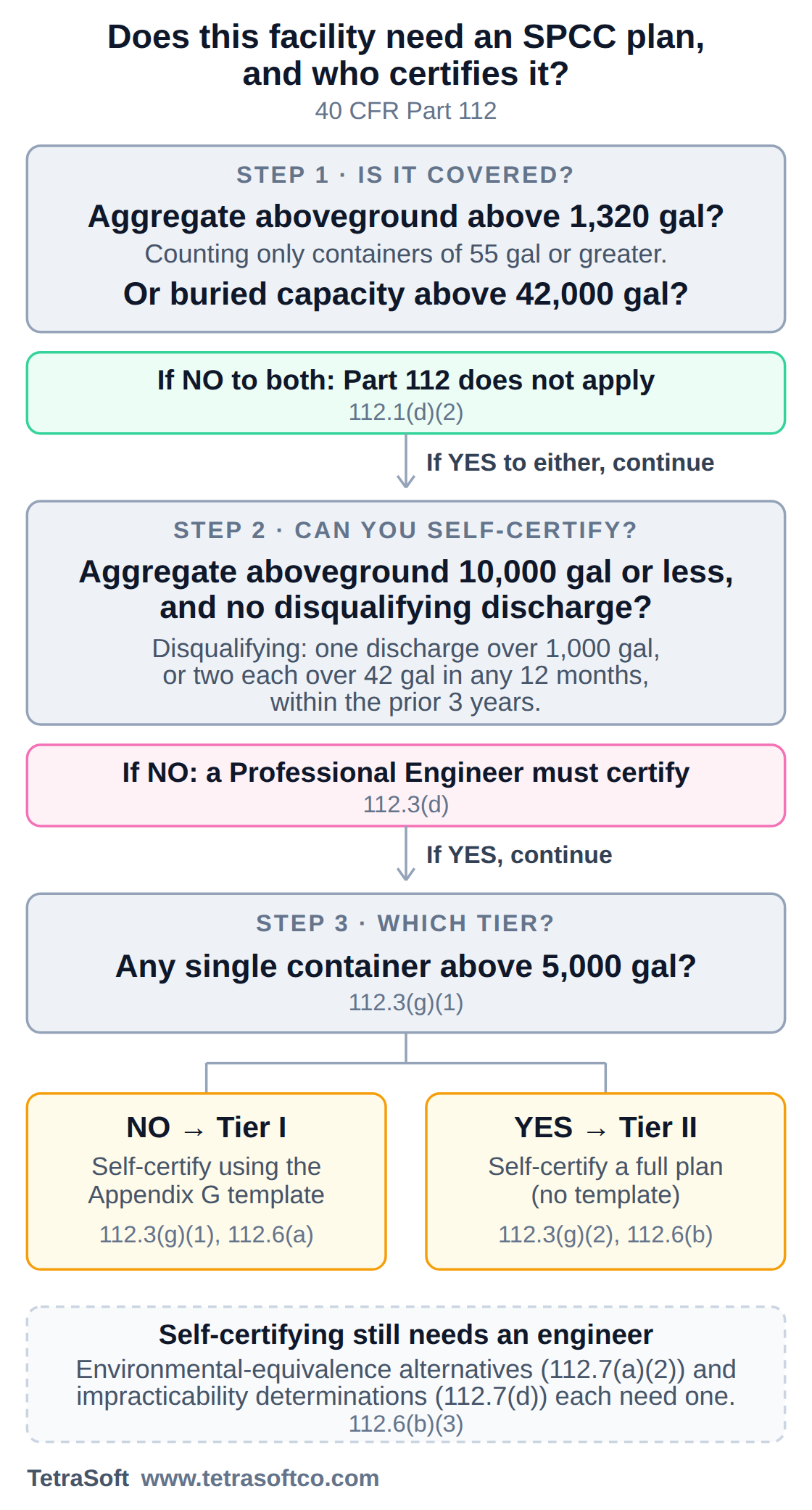
Two capacity tests decide whether Part 112 applies; the 10,000 gallon line and discharge history decide who certifies. [2]
| Path | When it applies | Who certifies |
|---|---|---|
| Tier I qualified | 10,000 gal or less aggregate, no container above 5,000 gal, clean discharge history | Operator self-certifies |
| Tier II qualified | 10,000 gal or less aggregate, a container may exceed 5,000 gal, clean discharge history | Operator self-certifies |
| Full plan | Above 10,000 gal aggregate, or any disqualifying discharge at any size | Licensed PE |
A Tier II qualified facility holds 10,000 gallons or less aggregate aboveground and has a clean recent discharge record [2]. Clean means no single discharge above 1,000 gallons in the three years before self-certification [2]. It also means no two discharges each above 42 gallons within any twelve-month period [2]. Natural disasters, acts of war, and terrorism are excluded from that count [2].
A Tier I qualified facility meets every Tier II condition and adds one more: no individual aboveground container larger than 5,000 gallons [2]. Tier I is therefore a subset of Tier II, not a parallel category. The 42-gallon figure deserves attention. Two modest releases inside one twelve-month window can cost a facility its self-certification, even though neither looks serious.
A Tier II Plan Still Needs an Engineer for Two Provisions
Choosing the self-certification route does not remove a Professional Engineer from the picture entirely [4]. A self-certified plan must still comply with 112.7 and the applicable requirements of subparts B and C [4]. A Tier II plan may not claim environmental equivalence under 112.7(a)(2) unless a Professional Engineer certifies each alternate method in writing [4]. The same condition attaches to any determination that secondary containment is impracticable [4].
A Tier I facility works from the Appendix G template, which is the Tier I Qualified Facility SPCC Plan form in 40 CFR part 112 [4]. An operator departing from that template must prepare an equivalent plan and add a section cross-referencing where each requirement is met [4]. The self-certification itself is a signed statement that the operator knows the rule and has examined the facility [4]. Signing it while leaning on an impracticability determination is the failure mode worth guarding against.
If you track federal reporting obligations across several programs, our GHGRP Subpart W Reporting in 2026: What Is Still Required covers a separate deadline on the same compliance calendar.
Production Facilities Carry Requirements the Generic Guides Skip
Onshore oil production facilities answer to 40 CFR 112.9 on top of the general rules [5]. Tank battery, separation, and treating installations need secondary containment sized for the entire capacity of the largest single container, plus freeboard for precipitation [5]. Flow-through process vessels and produced water containers are handled under separate provisions [5].
Flowlines are the requirement most often missed. For flowlines and intra-facility gathering lines without secondary containment, the plan must instead contain an oil spill contingency plan following 40 CFR part 109 [5]. That route does not apply to an operator who has already submitted a facility response plan under 40 CFR 112.20 [5].
It, meaning the SPCC plan of an operator without a facility response plan, must also carry a written commitment of manpower, equipment, and materials to control and remove a discharge [5]. The rule offers an alternative to containment here, not relief from it.
Produced water handling draws its own inspection duty [5]. Operators must inspect saltwater disposal facilities often, and particularly after a sudden change in atmospheric temperature [5].
Aboveground valves and piping tied to transfer operations carry their own periodic inspection duty on a regular schedule [5]. The rule names flange joints, valve glands and bodies, drip pans, pipe supports, and bleeder and gauge valves [5]. Facilities routing produced water to injection wells should read that duty alongside the underground injection rules, which our UIC Well Classes: Class II, Class VI, and Where to Look explains by class.
Plans do not stay valid on their own [6]. A facility must complete a review and evaluation at least once every five years from the date it became subject to the rule [6]. Any resulting amendment must be prepared within six months and implemented no later than six months after preparation [6]. A change in facility design, construction, operation, or maintenance that materially affects discharge potential starts the same clock independently [6].
The Plan also has to sit where an inspector can read it [2]. Keep a complete copy at the facility if it is attended at least four hours a day, and otherwise at the nearest field office [2]. It must be available to the EPA Regional Administrator for on-site review during normal working hours [2].
This post is for informational purposes only and does not constitute legal or compliance advice. Consult qualified legal counsel or a compliance professional for guidance specific to your operations and jurisdiction.
Frequently Asked Questions
Does a facility need an SPCC plan if it has never had a spill?
Yes. Applicability turns on storage capacity and the potential to discharge to navigable waters, not on spill history [1]. Discharge history enters only at the next decision, where it determines whether a covered facility may self-certify rather than use a Professional Engineer [2]. The two tests are often conflated, which leads operators with clean records to assume they are outside the rule.
How often does an SPCC plan have to be reviewed?
At least once every five years from the date the facility became subject to the rule [6]. Facilities operating on or before August 16, 2002 count five years from the date their last review was required [6]. A technical amendment must additionally be certified by a Professional Engineer, unless the facility self-certifies under 112.6 [6]. Cadence and certification are separate duties, so meeting the five-year cycle does not satisfy the second.
Do flowlines need secondary containment?
Not necessarily, because an SPCC plan may substitute an oil spill contingency plan and a written commitment for flowline containment [5], and two conditions on the alternative are easy to miss. An operator who has already filed a facility response plan under 40 CFR 112.20 is exempt from that route [5]. The contingency plan and the written commitment are then not required [5].
Separately, every operator must prepare and implement a written maintenance program for flowlines and intra-facility gathering lines [5]. That maintenance program applies whether or not secondary containment is present [5].
What happens when a self-certified facility grows past 10,000 gallons?
It stops qualifying for self-certification and needs a Professional Engineer to review and certify the plan [2]. Added storage is a change in facility design, so the amendment timing in 112.5 applies [6]. Operators planning a tank addition are the ones most likely to cross the threshold without noticing it.
Get regulatory updates and emissions data insights in your inbox. Subscribe to the TetraSoft newsletter.
References
- U.S. Environmental Protection Agency. 40 CFR 112.1: General applicability. Code of Federal Regulations. https://www.law.cornell.edu/cfr/text/40/112.1
- U.S. Environmental Protection Agency. 40 CFR 112.3: Requirement to prepare and implement a Spill Prevention, Control, and Countermeasure Plan. Code of Federal Regulations. https://www.law.cornell.edu/cfr/text/40/112.3
- U.S. Environmental Protection Agency. 40 CFR 112.2: Definitions. Code of Federal Regulations. https://www.law.cornell.edu/cfr/text/40/112.2
- U.S. Environmental Protection Agency. 40 CFR 112.6: Qualified Facilities Plan Requirements. Code of Federal Regulations. https://www.law.cornell.edu/cfr/text/40/112.6
- U.S. Environmental Protection Agency. 40 CFR 112.9: Spill Prevention, Control, and Countermeasure Plan Requirements for onshore oil production facilities. Code of Federal Regulations. https://www.law.cornell.edu/cfr/text/40/112.9
- U.S. Environmental Protection Agency. 40 CFR 112.5: Amendment of Spill Prevention, Control, and Countermeasure Plan by owners or operators. Code of Federal Regulations. https://www.law.cornell.edu/cfr/text/40/112.5
Interactive tool
Do you need an SPCC plan, and which tier?
Four numbers and two questions decide it. Count container capacity, not the oil in them today, and count only containers of 55 gallons or more. An empty tank still counts, which is where most self-assessments go wrong.
Full plan, Professional Engineer certified
A licensed Professional Engineer must review and certify the plan.
Why each test, and the section it comes from
- Aboveground capacity of 12,000 gal exceeds 1,320 gal, counting only containers of 55 gallons or more. 40 CFR 112.1
- Aggregate aboveground capacity of 12,000 gal is above the 10,000 gal qualified-facility ceiling, so self-certification is not available at any discharge history. 40 CFR 112.3
Still applies either way
- Onshore oil production facilities also answer to 112.9: secondary containment sized for the largest single container plus freeboard, and a written flowline maintenance program whether or not containment is present. 40 CFR 112.9
- Plans need review at least every five years, and a change in facility design that materially affects discharge potential starts the amendment clock independently. 40 CFR 112.5
- A Professional Engineer certifies the plan itself here, so the equivalence and impracticability conditions that constrain a self-certified Tier II plan are absorbed into that review. 40 CFR 112.3
Thresholds from 40 CFR Part 112, sections 112.1, 112.3, 112.5, 112.6 and 112.9. This reports what the federal rule says and is a starting point, not a compliance determination. Nothing leaves your browser.
Comments
0Share your thoughts. All comments are moderated before appearing.
No comments yet. Be the first to share your thoughts!