Multi-state oil and gas operators in the United States now face a divided regulatory environment. Federal and state emissions reporting requirements are moving in opposite directions, and the distance between them is growing.
EPA proposed on September 16, 2025 to rescind most of the Greenhouse Gas Reporting Program, and has taken no final action since (90 FR 44591) [1]. Colorado’s ONGAEIR program, New Mexico’s methane rules under NMED and OCD, and other state programs remain fully in effect and independent of any federal action [2].
For an operator filing in two or more states, the compliance burden shifts between jurisdictions rather than disappearing.
Federal Uncertainty Creates Planning Problems, Not Compliance Relief
EPA’s proposed suspension of GHGRP Subpart W facility-level reporting does not eliminate federal emissions obligations for oil and gas operators [1]. EPA separately moved the RY2025 Subpart W deadline from March 31 to October 30, 2026 (91 FR 9712) [1]. EPA is using that window to evaluate whether to suspend the reporting requirement for RY2025 through RY2034 [1].
The deadline extension is final, and the rescission proposal behind it is not [1]. The October 30 filing date now arrives before any final federal decision [1].
Operators who interpret this as a signal to reduce emissions data collection face a specific risk. State programs still require the same underlying operational data that fed GHGRP submissions. Colorado’s ONGAEIR program requires annual emissions inventories from covered facilities regardless of whether those facilities also report under GHGRP [2]. New Mexico’s Oil Conservation Division venting and flaring rule (19.15.27 NMAC) and NMED’s air quality requirements for oil and gas similarly operate on state authority [3].
EPA amended OOOOb and OOOOc rather than repealing them [4]. A final rule published April 9, 2026 made discrete technical changes to two aspects of the standards (91 FR 18056) [4]. Those are the temporary associated-gas flaring provisions and the vent gas net heating value monitoring requirements [4]. The rule states it does not alter the substance of any emission standard in the March 2024 rule [4].
EPA had extended OOOOb and OOOOc compliance deadlines twice before that rule (90 FR 35966; 90 FR 55671) [4]. A separate NESHAP technology review for the sector remains at proposal (91 FR 21672) [5]. The standards stand, so the planning question is which compliance date applies rather than whether the rule survives.
For a detailed analysis of what Subpart W’s uncertain future means for your federal obligations, see: GHGRP Subpart W Deadline Moved to October 2026.
State Programs Remain the Binding Constraint for Most Operators
State programs bind on their own authority, whatever EPA decides. Texas TCEQ air quality permitting requirements for oil and gas facilities remain in effect alongside them [6].
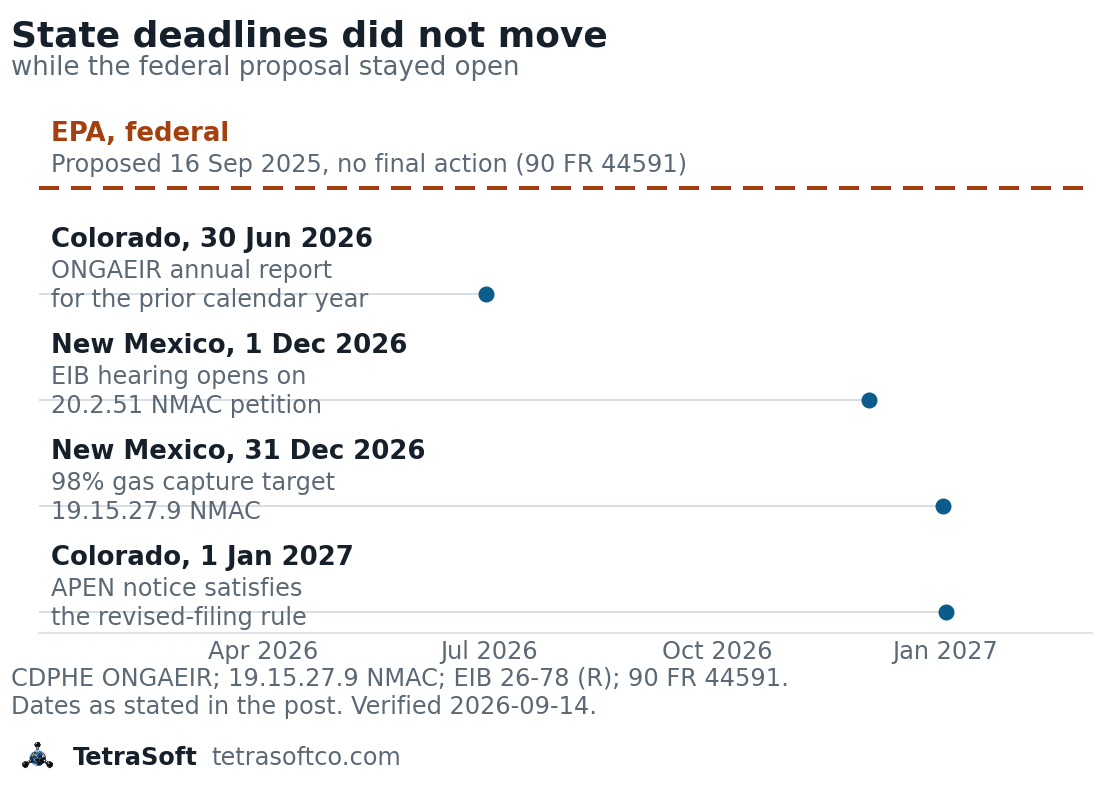
Colorado’s ONGAEIR annual report deadline is June 30 for the prior calendar year [2].
Every operator with facilities above the Colorado reporting threshold must submit a complete facility-level emissions inventory to CDPHE on that schedule [2]. That obligation holds regardless of what happens at the federal level. The program covers equipment-level emissions from pneumatic controllers, storage tanks, dehydrators, compressors, and fugitive sources [2].
Colorado changed the plumbing around that filing this year, without touching the date. The Air Quality Control Commission adopted revisions to Regulations 3 and 7 on May 22, 2026, effective July 15, 2026 [7]. The annual ONGAEIR submission is now an Emissions Reporting Notice [7].
From January 1, 2027, that notice satisfies the requirement to file a revised APEN for a significant emissions change or before expiry [7]. Revised APENs are still required for an ownership change, new control equipment, or a permit-limit modification [7]. The June 30 reporting deadline is unchanged [7].
New Mexico splits the work across two rules adopted in 2021 and 2022 [8]. OCD’s venting and flaring rule sets a 98% natural gas capture target by December 31, 2026 (19.15.27.9 NMAC) [8]. The Environmental Improvement Board’s ozone precursor rule sets VOC and NOx standards for the sector in eight counties (20.2.50 NMAC) [3]. NMED and OCD enforce both rules on state authority [3].
New Mexico is not finished adding to that framework. NMED petitioned the Environmental Improvement Board on August 13, 2026 to adopt 20.2.51 NMAC, Methane Abatement (EIB 26-78 (R)) [9]. The proposal would create a super-emitter notification and repair program, and from January 1, 2031 a zero-methane standard for gas-driven process controllers [9]. The board scheduled a hearing beginning December 1, 2026, and NMAC still lists Part 51 as reserved [9].
State Filings Still Need the Data Federal Reporting Collected
Suspending federal reporting removes a filing, not the data underneath it. Operators who built their data collection workflows around GHGRP Subpart W calculation methodologies often used those same pipelines to satisfy state reporting. If GHGRP reporting is suspended, the incentive to maintain those federal-format pipelines diminishes.
The data outlives the filing. Equipment counts, throughput, gas composition and operating hours all remain necessary for state submissions.
OGMP 2.0 and EU Obligations Apply Regardless of Federal Action
OGMP 2.0 imposes obligations independent of US federal action [10]. The EU Methane Regulation adds a separate, binding requirement on imported gas [11]. Some US operators carry OGMP 2.0 voluntary commitments or prepare for EU requirements on imported gas. European buyers are requiring methane intensity documentation from US LNG suppliers, and that requirement does not soften because EPA suspends a domestic reporting program.
How Multi-State Operators Should Respond to Diverging Requirements
The operational response is not to wait for federal clarity. Federal clarity may not come. Operators reporting in Colorado, New Mexico, Texas, or any combination should treat state requirements as the binding constraint. From there, build data systems that satisfy the most demanding jurisdiction first.
Equipment-Level Data Collection Should Continue on the Federal Schedule
Equipment inventories, operational throughput data, and activity records should continue on the same schedule and granularity that GHGRP Subpart W required. That holds even if federal reporting is suspended. Operators who pause data collection during a federal reporting gap risk creating a hole that becomes expensive to fill. That gap becomes a liability if requirements are reinstated or if state auditors request supporting documentation.
Each Jurisdiction Calculates the Same Source Differently
Colorado ONGAEIR, New Mexico’s OCD rule 19.15.27 NMAC, and GHGRP Subpart W each use different calculation methodologies for overlapping emission source categories. Pneumatic controller emissions, for example, are calculated differently under Subpart W than under ONGAEIR [12]. [2]
Subpart W gives four methods for pneumatic device venting, ending in a default population factor from Table W-1 [12]. Colorado requires the Division’s default factor where one is published, or another Division-accepted factor [2]. A site-specific factor needs supporting documentation and re-verification every five years [2].
A crosswalk is the practical answer. Operators need one showing where methodologies align between jurisdictions and where state-specific adjustments are required.
For Colorado-specific preparation guidance, see: Colorado ONGAEIR Due June 30: A Practical Filing Checklist.
A crosswalk is only half the work, because the reasoning behind each choice has to be recorded too. If EPA reinstates Subpart W reporting after a gap year, operators must show which methodology they used during the suspension for state filings. They will also need to show how it relates to their prior federal submissions. Documenting methodology choices, data sources, and calculation assumptions in a retrievable format protects against both state audit requests and future federal reconciliation requirements.
Frequently Asked Questions
What happens to my existing GHGRP submissions if reporting is suspended?
They do not go away, and they remain the comparison point. The proposal suspends reporting for RY2025 through RY2034 rather than withdrawing what was already filed [1]. A state auditor, or a reinstated federal program, reads any gap against the years on either side of it.
If Subpart W is suspended, can I keep using its methods for state filings?
Not automatically, because the state programs prescribe their own. A suspension changes what a reporter files federally, not which method a state accepts. Colorado’s accepted factors are set out above, and a filing that carries a Subpart W number without meeting them is still non-conforming.
Does the EU Methane Regulation reach a US producer that does not export?
It reaches them through the buyer rather than directly. The requirement attaches to gas imported into the EU [11]. A US producer meets it as a contract term from the buyer, not as a rule applied to them directly.
What is the risk of waiting for federal clarity before updating compliance systems?
Colorado’s ONGAEIR annual deadline is June 30 [2]. The 2026 filing came and went with EPA’s Subpart W proposal still open [1]. Operators who delay system updates pending federal resolution risk missing state deadlines or submitting with errors caused by outdated workflows. Maintaining state-compliant data systems during federal uncertainty costs less than retroactive correction after a missed deadline or a CDPHE-flagged submission error.
This post is for informational purposes only and does not constitute legal or compliance advice. Consult qualified legal counsel or a compliance professional for guidance specific to your operations and jurisdiction.
Get regulatory updates and emissions data insights in your inbox. Subscribe to the TetraSoft newsletter.
References
- EPA. “Reconsideration of the Greenhouse Gas Reporting Program,” proposed rule, 90 FR 44591, September 16, 2025; “Extending the Reporting Deadline Under the Greenhouse Gas Reporting Rule for 2025,” final rule, 91 FR 9712, February 27, 2026, corrected at 91 FR 34161, June 5, 2026.
- Colorado Department of Public Health and Environment (CDPHE). Oil and Natural Gas Annual Emission Inventory Reporting (ONGAEIR) program guidance. https://cdphe.colorado.gov/ongaeir
- New Mexico Environmental Improvement Board. Oil and Gas Sector - Ozone Precursor Pollutants, 20.2.50 NMAC, effective August 5, 2022. Promulgated on NMED petition; applies in eight counties.
- EPA. “Reconsideration of Standards of Performance for New, Reconstructed, and Modified Sources and Emissions Guidelines for Existing Sources: Oil and Natural Gas Sector Climate Review,” final rule, 91 FR 18056, April 9, 2026, effective June 8, 2026; deadline extensions at 90 FR 35966, July 31, 2025 and 90 FR 55671, December 3, 2025.
- EPA. “National Emission Standards for Hazardous Air Pollutants: Crude Oil and Natural Gas Production Facilities and Natural Gas Transmission and Storage Facilities,” proposed rule, 91 FR 21672, April 22, 2026.
- Texas Commission on Environmental Quality (TCEQ). Air quality permitting requirements for oil and gas facilities under Texas Health and Safety Code Chapter 382.
- Colorado Air Quality Control Commission. Revisions to Regulation Number 3 (5 CCR 1001-5) and Regulation Number 7 (5 CCR 1001-9), adopted May 22, 2026, effective July 15, 2026. Emissions Reporting Notice at Regulation Number 3, Part A, Sections II.A.1.a and II.C.1.i. Colorado Secretary of State eDocket 2026-00010 and 2026-00011.
- New Mexico Oil Conservation Division (OCD). Venting and Flaring Rule, 19.15.27 NMAC; statewide natural gas capture requirements at 19.15.27.9 NMAC.
- New Mexico Environment Department. Petition to adopt 20.2.51 NMAC, Methane Abatement, EIB 26-78 (R), filed August 13, 2026. Environmental Improvement Board hearing scheduled to begin December 1, 2026. https://www.env.nm.gov/air-quality/proposed-regs/
- UNEP. Oil and Gas Methane Partnership 2.0 (OGMP 2.0) Reporting Framework, final, 19 November 2020. https://www.ogmpartnership.org/sites/default/files/resources/2025-04/OGMP_20_Reporting_Framework.pdf
- European Union. Regulation 2024/1787 on methane emissions reduction in the energy sector (EU Methane Regulation).
- EPA. Greenhouse Gas Reporting Program, Subpart W: Petroleum and Natural Gas Systems. 40 CFR Part 98, Subpart W.
Comments
0Share your thoughts. All comments are moderated before appearing.
No comments yet. Be the first to share your thoughts!