Which air quality permit a facility needs is decided by its potential to emit, not by what the facility actually emitted last year [1]. A Title V operating permit is triggered at 100 tons per year of any air pollutant subject to regulation, or 10 tons of one hazardous air pollutant [1]. Prevention of Significant Deterioration review is a separate track, aimed at new construction and major modifications rather than ongoing operation [2]. Every one of those determinations rests on an emissions number that somebody calculated before the application was ever filed. That calculation, not the permit form itself, is where most of the real uncertainty lives.
This guide covers the Title V thresholds and how oil and gas sites are aggregated. PSD review and its significant emission rates follow, then permit by rule and general permits, and where the emissions estimate itself changes the answer.
This post is for informational purposes only and does not constitute legal or compliance advice. Consult qualified legal counsel or a compliance professional for guidance specific to your operations and jurisdiction.
Quick Answer: Title V applicability turns on potential to emit at or above 100 tpy of a regulated pollutant [1]. The hazardous air pollutant tests sit at 10 tpy for one HAP and 25 tpy for a combination [1]. PSD applies to major stationary sources at 100 tpy for a list of named source categories and 250 tpy for everything else [2]. Both are compared against a calculated number, usually built from published emission factors [3].
The three regimes sit at different levels, and the gap between them is easier to see than to describe.
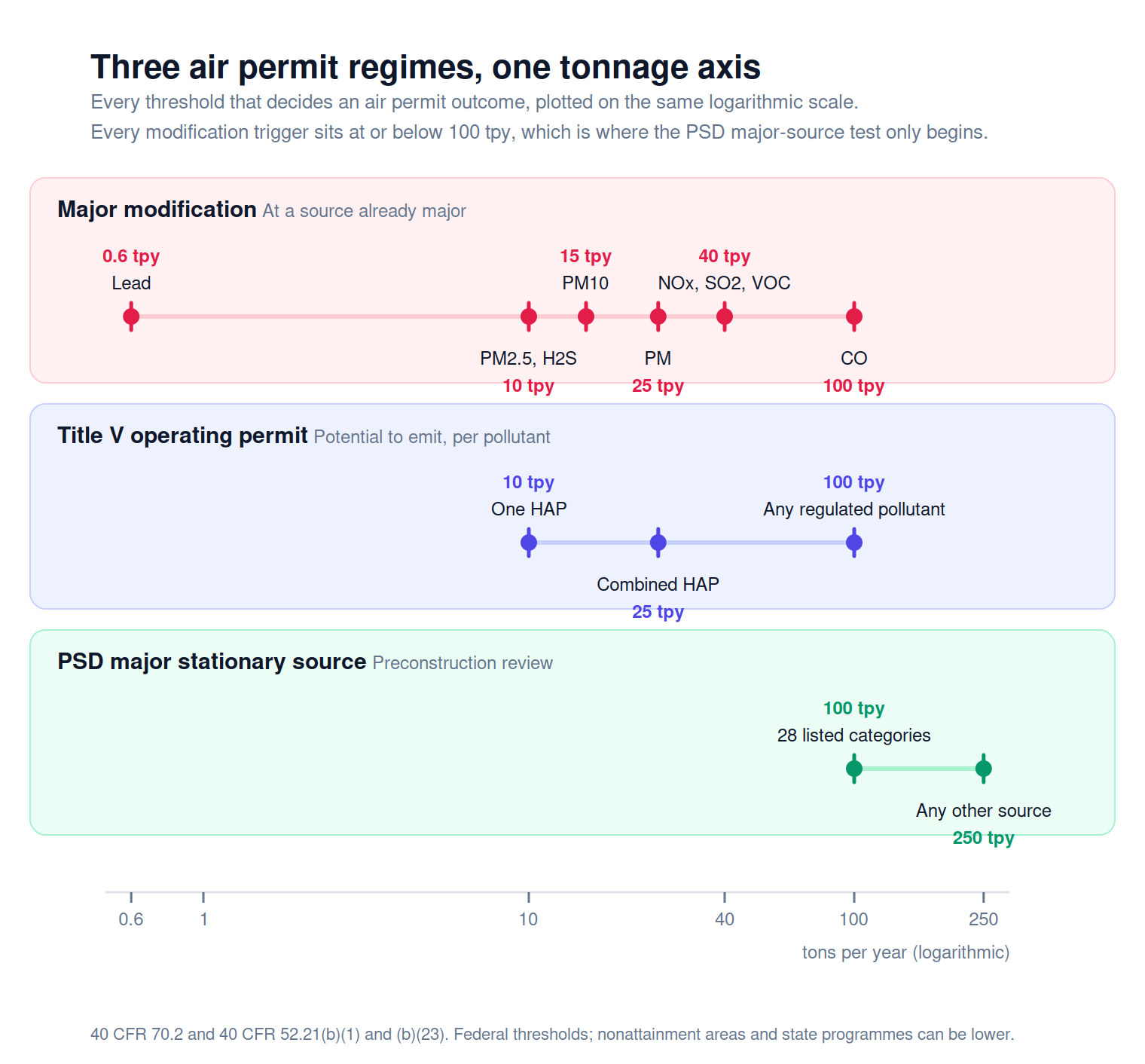
Every significant emission rate sits at or below 100 tons per year [2]. A non-listed source is not major until 250 tons per year [2]. So a facility can sit far below the PSD major-source threshold while a change at it clears a modification trigger by a wide margin.
Title V Applicability Turns on Potential to Emit
A Title V major source is defined by capacity rather than by history [1]. The rule sets three separate tests, and crossing any one of them is enough [1]. A fourth family of thresholds sits below 100 tpy in nonattainment areas, reaching 50 tpy for VOC or NOx in Serious ozone areas and 10 tpy in Extreme ones [1].
| Test | Threshold |
|---|---|
| Any air pollutant subject to regulation | 100 tpy |
| Any single listed hazardous air pollutant | 10 tpy |
| Any combination of listed hazardous air pollutants | 25 tpy |
Thresholds from 40 CFR 70.2, “major source.” [1]
Fugitive emissions are excluded from the 100 tpy determination unless the source falls in one of the listed categories [1]. That exclusion changes the arithmetic for facilities whose largest release paths are not stacks.
Methane sits outside those three tests in a way that surprises operators who track it closely. EPA exempts methane from the definition of volatile organic compounds as negligibly photochemically reactive [3]. It counts instead inside the aggregate group of six greenhouse gases, alongside carbon dioxide and nitrous oxide [1]. That aggregate is subject to regulation only at 100,000 tons per year of carbon dioxide equivalent [1].
So a facility’s methane inventory and its permit arithmetic are different quantities built from the same equipment list. The overlap is the equipment and the operating states, not the pollutant.
Oil and Gas Wells Are Not Aggregated With Each Other
Upstream operators get a carve-out written directly into the definition [1]. Emissions from any oil or gas exploration or production well, with its associated equipment, are not aggregated with other similar units [1]. The bar on aggregating sits inside the hazardous-air-pollutant major source test, and applies to that determination [1]. The same non-aggregation applies to pipeline compressor and pump stations [1].
That rule holds whether or not the units share a contiguous area or common control [1]. Without it, a large multi-well development would aggregate into a major source almost immediately.
The Quarter-Mile Test Decides What Counts as One Site
Two oil and gas sites are treated as adjacent if they share a surface site, or sit within a quarter mile and share equipment [1]. The rule states that as a sufficient condition a State program may adopt, not as the only way sites can be aggregated [1]. States may adopt that adjacency provision for oil and gas extraction specifically [1]. They are also adjacent on surface sites within a quarter mile that share equipment [1]. Shared equipment includes produced fluids storage tanks, phase separators, natural gas dehydrators and emission control devices [1].
Distance alone does not aggregate two sites [1]. The sharing of equipment is the operative condition, which makes a tie-in decision a permitting decision.
PSD Review Applies to Construction, Not Operation
PSD is a preconstruction program, and its thresholds sit at a different level from Title V [2]. A major stationary source emits, or can emit, 100 tons per year of a regulated NSR pollutant across a list of named categories [2]. Petroleum refineries are among those categories [2]. Any other stationary source becomes major at 250 tons per year [2].
The Significant Emission Rates Are Much Lower
For an existing major source, the question is whether a change produces a significant net emissions increase [2]. Those rates are far below the major source thresholds [2].
| Pollutant | Significant rate |
|---|---|
| Carbon monoxide | 100 tpy |
| Nitrogen oxides | 40 tpy |
| Sulfur dioxide | 40 tpy |
| Ozone (as VOC or NOx) | 40 tpy |
| Particulate matter | 25 tpy |
| PM10 | 15 tpy |
| PM2.5 (direct) | 10 tpy |
| Hydrogen sulfide | 10 tpy |
| Lead | 0.6 tpy |
Significant emission rates from 40 CFR 52.21(b)(23) [2].
A 40 tpy NOx trigger is a small number next to a 250 tpy major source threshold. The practical consequence is that once a facility is major, modest additions can pull it into full review.
The three tests take one emissions figure and return three different answers, so they are worth running together rather than in sequence.
The screener compares a potential to emit you supply against the federal thresholds and names the section behind each verdict [1][2]. It does not calculate potential to emit, which is the facility-specific part this post argues is where the real uncertainty lives.
Permit by Rule and General Permits Cover Standardized Sources
Not every source needs an individually drafted permit, and the rules provide a standardized route [4]. A permitting authority may issue a general permit covering numerous similar sources, after public notice and an opportunity to participate [4]. The general permit has to meet every requirement applicable to other Part 70 permits and must state the criteria by which a source qualifies [4].
Qualifying is the operator’s risk to carry [4]. A source later determined not to qualify is subject to enforcement for operating without a Part 70 permit [4]. Permit by rule is the state-level version of the same idea, offering pre-set conditions a qualifying source can claim without a bespoke application.
Every Threshold Is Compared Against a Calculated Number
The thresholds are fixed and public, so the contested part of an application is the emissions estimate. Many estimates start from AP-42, whose general equation multiplies an activity rate by an emission factor and then applies a control efficiency [3]. EPA treats a factor as the average of whatever acceptable-quality test data existed when it was compiled [3]. The result describes a population of facilities rather than any one of them [3].
What the Factor Was Never Built to Cover
AP-42 factors describe equipment running normally, and EPA says so in its own introduction [3]. The underlying tests run at normal operating conditions [3]. Conditions that drive short-term swings stay outside both the test program and its evaluation [3]. Units also get tested more often when new and when believed to be running properly, which EPA notes can bias the resulting factor [3].
A permit number built that way describes the facility working as designed. Whether that is the right basis depends on what the permit is being asked to bound.
Where a Mechanistic Estimate Changes the Answer
EPA does not recommend using an AP-42 factor as a source-specific permit limit or for a compliance determination [3]. What the factors do cover, and what each one assumes, is set out in AP-42 Emission Factors by Source Type, and What They Assume. Because a factor is an average of a range, about half of the sources it describes emit more than it [3]. A permit limit set at the factor would put half of comparable sources in noncompliance, which EPA states directly [3].
That splits the permit question in two. EPA says factors may be appropriate for applicability determinations and for setting operating permit fees [3]. The screen is where an average is good enough, and the limit is where it stops being.
A mechanistic model simulates the equipment and the process instead of multiplying an activity by a constant [5]. The Mechanistic Air Emissions Simulator is a physics-based simulator of that kind, developed by CSU and UT Austin through the EEMDL initiative [6]. It produces a probability distribution rather than a single point estimate [6]. A facility can then be placed within that range instead of at someone else’s average.
TetraSoft provides commercial and academic access to MAES through a special license with Colorado State University [6]. The platform runs the simulation in the cloud and covers project setup, equipment configuration and results analysis [6]. It is sold as a subscription, with plans for operators, consultants and academic users [6]. That puts a mechanistic estimate within reach of a permitting team directly, rather than only as a commissioned study.
A stuck dump valve or an open thief hatch has no factor to look up. Inventories that model those states land above inventories that do not. In Colorado’s Denver-Julesburg Basin, a measurement-informed inventory came in at 1.16 times the total operators reported to the state [7]. That ratio describes reported emissions rather than potential to emit, so it indicates direction and not a multiplier for an applicability screen.
Two companion posts test the same estimate from the other side. Why Satellites Show About 2x More Methane Than Inventories compares a reported inventory against atmospheric observation. Glycol Pumps: 90% of Uncontrolled TEG Dehydrator Emissions isolates one component where the assumed and modelled values diverge.
Frequently Asked Questions
How long does a Title V permit last?
Permits are issued for a fixed term of five years for affected sources [4]. For all other sources the term must not exceed five years [4]. The term is set by the permitting authority within that ceiling [4]. Renewal therefore lands on a predictable cycle rather than an open-ended one.
What exactly does potential to emit mean?
The maximum capacity of a stationary source to emit a pollutant under its physical and operational design [1]. A limitation on that capacity counts as part of the design only if it is enforceable by the Administrator [1]. Control equipment, restricted operating hours, and caps on material throughput can all serve as such limits [1]. An unenforceable operating practice does not reduce potential to emit, however consistently it is followed.
What is the permit shield?
A provision stating that complying with the permit counts as complying with the applicable requirements it identifies [4]. It only covers requirements specifically identified in the permit [4]. It also covers requirements the authority has determined in writing do not apply, where the permit records that determination [4]. A permit that does not expressly state a shield exists is presumed not to have one [4].
Does a Title V permit authorize construction?
No, Title V and PSD sit at different points in a project’s life. PSD is a preconstruction review aimed at new major sources and major modifications [2]. Title V is an operating permit that collects applicable requirements for a source already built [4]. A project can need both, in sequence.
Why would two identical facilities get different permit outcomes?
Because applicability is decided on potential to emit, and that number is calculated rather than measured [3]. Two engineers can reach different totals from the same equipment list by choosing different factors or control assumptions. EPA’s factors carry a letter rating describing data quality, not the fit to a specific site [3]. The threshold is fixed, so all the movement sits in the input.
The screener above compares a figure you already have against the thresholds, and it deliberately does not produce that figure.
If your potential to emit lands near 100 or 250 tons per year, the estimate is worth more scrutiny than the threshold.
MAES is available on subscription, and the plans begin with a free trial [6]. The same simulator produced the Denver-Julesburg measurement-informed inventory cited above [7]. See the plans and start a free trial to build a permit estimate on a physics-based model rather than an average.
Talk to us instead if you would rather have the estimate produced for you as a study.
References
- 40 CFR 70.2, Definitions, current as of July 29, 2026. Electronic Code of Federal Regulations, Title 40, Part 70. https://www.ecfr.gov/current/title-40/chapter-I/subchapter-C/part-70/section-70.2
- 40 CFR 52.21, Prevention of significant deterioration of air quality, current as of July 29, 2026. Electronic Code of Federal Regulations, Title 40, Part 52. https://www.ecfr.gov/current/title-40/chapter-I/subchapter-C/part-52/subpart-A/section-52.21
- EPA AP-42, Introduction to AP-42 Volume I, Fifth Edition, January 1995. United States Environmental Protection Agency, Compilation of Air Pollutant Emission Factors. https://www.epa.gov/sites/default/files/2020-09/documents/c00s00.pdf
- 40 CFR 70.6, Permit content, current as of July 29, 2026. Electronic Code of Federal Regulations, Title 40, Part 70. https://www.ecfr.gov/current/title-40/chapter-I/subchapter-C/part-70/section-70.6
- Mollel et al., ACS ES&T Air 2025, 2, 723-735, DOI 10.1021/acsestair.4c00168. Using Prototypical Oil and Gas Sites to Model Methane Emissions in Colorado’s Denver-Julesburg Basin Using a Mechanistic Emission Estimation Tool. https://doi.org/10.1021/acsestair.4c00168
- TetraSoft, MAES Platform. https://tetrasoftco.com/maes-platform/maes-landing.html
- Santos et al., ACS ES&T Air 2025, 2, 1598-1611, DOI 10.1021/acsestair.5c00089. Using Measurement-Informed Inventory to Assess Emissions in the Denver-Julesburg Basin. https://doi.org/10.1021/acsestair.5c00089
Interactive tool
Air permit threshold screener
Three federal regimes sit at different levels and test different quantities. Choose what your figure represents, and only the tests that apply to it are screened.
Potential to emittons per year
Title V operating permit
BelowBelow every Title V major-source test on the figures entered
100 tpy any regulated pollutant · 10 tpy one HAP · 25 tpy combined HAP
40 CFR 70.2PSD major stationary source
BelowBelow the 250 tpy PSD major-source threshold for any other source
Preconstruction review. Compared against the highest single pollutant, not the total.
40 CFR 52.21(b)(1)(i)(a)Major modification
Not screenedNot screened: this test is decided on the increase a change produces
Compares the increase a change produces, not the facility total.
40 CFR 52.21(b)(2)(i) · rates at 40 CFR 52.21(b)(23)(i)What this screen assumes
- Potential to emit is the maximum capacity of the source under its physical and operational design. A limit reduces it only where it is enforceable by the Administrator. 40 CFR 70.2
- Fugitive emissions count toward the Title V 100 tpy determination only for the listed source categories, so a facility whose main release paths are not stacks can screen differently on countable emissions alone. 40 CFR 70.2
- Nonattainment areas apply lower thresholds for the pollutant in nonattainment, and a state programme may be more stringent than the federal floor. This screen is the federal floor only. 40 CFR 70.2
The 28 source categories at the 100 tpy PSD threshold
- Fossil fuel-fired steam electric plants over 250 MMBtu/hr
- Coal cleaning plants (with thermal dryers)
- Kraft pulp mills
- Portland cement plants
- Primary zinc smelters
- Iron and steel mill plants
- Primary aluminum ore reduction plants
- Primary copper smelters
- Municipal incinerators over 50 tons of refuse per day
- Hydrofluoric, sulfuric, and nitric acid plants
- Petroleum refineries
- Lime plants
- Phosphate rock processing plants
- Coke oven batteries
- Sulfur recovery plants
- Carbon black plants (furnace process)
- Primary lead smelters
- Fuel conversion plants
- Sintering plants
- Secondary metal production plants
- Chemical process plants
- Fossil-fuel boilers over 250 MMBtu/hr
- Petroleum storage and transfer units over 300,000 barrels
- Taconite ore processing plants
- Glass fiber processing plants
- Charcoal production plants
Thresholds from 40 CFR 70.2 and 40 CFR 52.21. A starting point, not a permit determination. It does not calculate potential to emit, does not net contemporaneous increases and decreases, and a state programme may be more stringent. Nothing leaves your browser.
Comments
0Share your thoughts. All comments are moderated before appearing.
No comments yet. Be the first to share your thoughts!