If you report greenhouse gases for oil and gas equipment, one of your emission totals stopped being a calculation in 2025 [1]. The equipment is natural gas pneumatic devices, the valve controllers that vent gas as they operate, and they are this post’s subject [2]. An emissions calculator totals them by multiplying a device count by a default emission factor, an industry average measured on somebody else’s equipment. Under 40 CFR part 98 subpart W that lookup is now last of four permitted methods, and banned outright at metered sites [2]. Below are the four methods in the rule’s own order, the factor table behind the lookup, and what to do when a measurement disagrees.
Quick Answer: An emissions calculator computes activity multiplied by an emission factor, reduced by a control efficiency. For natural gas pneumatic devices, 40 CFR part 98 subpart W now sets out four permitted ways to reach that one number and ranks them [2]. They are alternatives for the same quantity, not methods for different quantities [2]. The first three measure the site’s own gas in three different situations [2]. The fourth looks the answer up in the rule’s own factor table, table W-1 [3]. Where a gas flow meter already sits on the supply line feeding the devices, it has already measured what they vent [2]. The rule therefore requires the meter reading and forbids the lookup [2]. The 2024 final rule also rebuilt table W-1 itself, and the old and current factors are compared in the chart further down [4].
What an Emissions Calculator Multiplies
The arithmetic is not the hard part and never was. Emissions equal an activity rate times an emission factor, less whatever a control device is credited with removing [5]. Every calculator sold for this job computes that line.
What differs between calculators is which factor they reach for and whether they tell you.
Activity Times a Factor, and a Factor Is Not a Measurement
An emission factor is a ratio derived from a sample of sources that are not yours [5]. It does not carry the conditions of that sample so much as average them away. EPA says the causes of between-source variability are “seldom included in emission test reports used to develop AP-42 factors” [5]. The design, age and maintenance history behind each measurement never enter the published number. What survives is the average, and roughly half the sources in a category emit more than it [5].
That is a reasonable way to build a national inventory. It is a much weaker way to describe one site. No single publication owns emission factors [5]. AP-42 is EPA’s general compilation across industries [5]. Subpart W publishes its own factors for this one reporting programme in table W-1, and states and operators derive others again [3]. How AP-42’s factors are built and rated is covered in AP-42 Emission Factors by Source Type, and What They Assume.
The Units Are Where It Goes Wrong
Factors are published in whatever unit the activity was measured in, which gives combustion sources three different conventions [5]. Natural gas combustion is per million standard cubic feet of gas burned, and turbines and flares are per million Btu of fuel input [5]. Engines add a third basis, per unit of power output [5].
Pneumatic devices under subpart W add a fourth convention to those three [3]. Its population factors are in standard cubic feet of whole gas per hour per device [3]. Turning that into a mass needs a methane mole fraction and a molar volume as well [3]. A spreadsheet that mixes two of these conventions produces a number with no unit at all.
The Four Methods Subpart W Ranks, and Why the Default Is Last
Subpart W gives natural gas pneumatic devices four calculation methods, and the order is the rule’s own rather than a preference [1]. They descend from measuring your own gas to looking up somebody else’s average.
Calculation Method 1: the supply-line meter. A continuous flow meter on the natural gas supply line feeding the devices, read as a cumulative annual volume [2]. A device that vents directly to the atmosphere releases the supply gas it is fed, so on a metered supply line the meter has already counted the emissions. That is why possession of the meter, rather than any election by the operator, is what triggers this method from reporting year 2025: the estimate is redundant beside a measurement the site is already taking [1].
Calculation Method 2: measurement at the vent. Measure the volumetric flow rate at the devices’ own vents, then scale by the hours each was in service [2]. Not every device need be measured in one year, because the rule runs on a multi-year measurement cycle [4]. A site derives its own emission factor from those measurements instead of taking the published one [4].
Calculation Method 3: monitor the intermittents for malfunctions. Open only to onshore production and to gathering and boosting, this method splits the population in two [1]. Every intermittent bleed device is monitored for malfunction using the same survey methods the rule uses for leaks [2]. Continuous high and low bleed devices are then either measured or taken from the table [1]. It exists because what an intermittent device emits is dominated by whether a valve is stuck.
Calculation Method 4: the default population factors. Table W-1 is the rule’s own lookup table of default factors, one row per industry segment and device type, each giving a venting rate in standard cubic feet of whole gas per hour per device [3]. Method 4 uses it directly: count the devices by type, multiply by your segment’s factor, multiply by hours in service [3]. It is the only one of the four that requires no measurement at all. It is also the one an emissions calculator performs.
The first and the last are where this post concentrates, because they decide whether a calculator may be used. Methods 2 and 3 are elections an operator makes [1]. Method 1 is imposed by hardware already on the site, and Method 4 is what the rule shuts off once any other method applies [1].
Where the rule bars the default factors, the honest output is no number at all. That refusal is the whole of the change.
A Flow Meter Removes the Choice
The trigger is having the meter, not electing to use it [2]. The rule covers a meter “dedicated to any one or combination of natural gas pneumatic devices” vented directly to the atmosphere [2]. Where one is present, it reads “you must use” Calculation Method 1 for those devices [2]. Beginning in reporting year 2025 that is a requirement rather than an option [1].
EPA is separately reconsidering whether to suspend mandatory Subpart W reporting through reporting year 2034. What that proposal would switch off, and the state rules that would outlive it, is covered in What Is Subpart W Suspension? State Rules Still Apply. The obligation to report is therefore less settled than the method order within it.
Election closes the door too [1]. EPA states that Method 4 may not be used for devices reporters are required or elect to measure [1]. That covers Calculation Methods 1 through 3 alike [1]. A site that measures some devices cannot fall back to the table for the ones it measured.
The Table Itself Was Replaced
The same rulemaking rebuilt the factors [4]. Before it, a reporter went not to one table but to a lettered family of them, W-1A through W-1E [4]. Table W-1A held the population factors for onshore production and for gathering and boosting [4]. It covered much more than pneumatic devices: pneumatic pumps sat in it, and so did gathering pipelines, published per mile by pipeline material [4]. Table W-1E was a different kind of table altogether [4]. It held leaker emission factors for the same two segments, derived from EPA’s 1995 equipment-leak protocol [4]. A leaker factor applies per component found leaking, not per device installed [4].
The amendment removed all five and added a single table W-1, “Default Whole Gas Population Emission Factors” [4]. It is organised by industry segment and source type, covering production, gathering and boosting, processing, transmission compression, storage and distribution together [3]. One caution for anyone tracing a citation across the change: the leaker factors did not move into W-1 [4]. W-1E’s contents became table W-2 instead [4]. A document saying W-1 replaced all five is pointing at the wrong table for part of what was removed. For onshore production and for gathering and boosting, the pneumatic device values moved a long way, and not all in the same direction [3]. The chart below sets the removed factors against the current ones for all three device types [3]. The table beneath it gives the same figures as numbers [3].
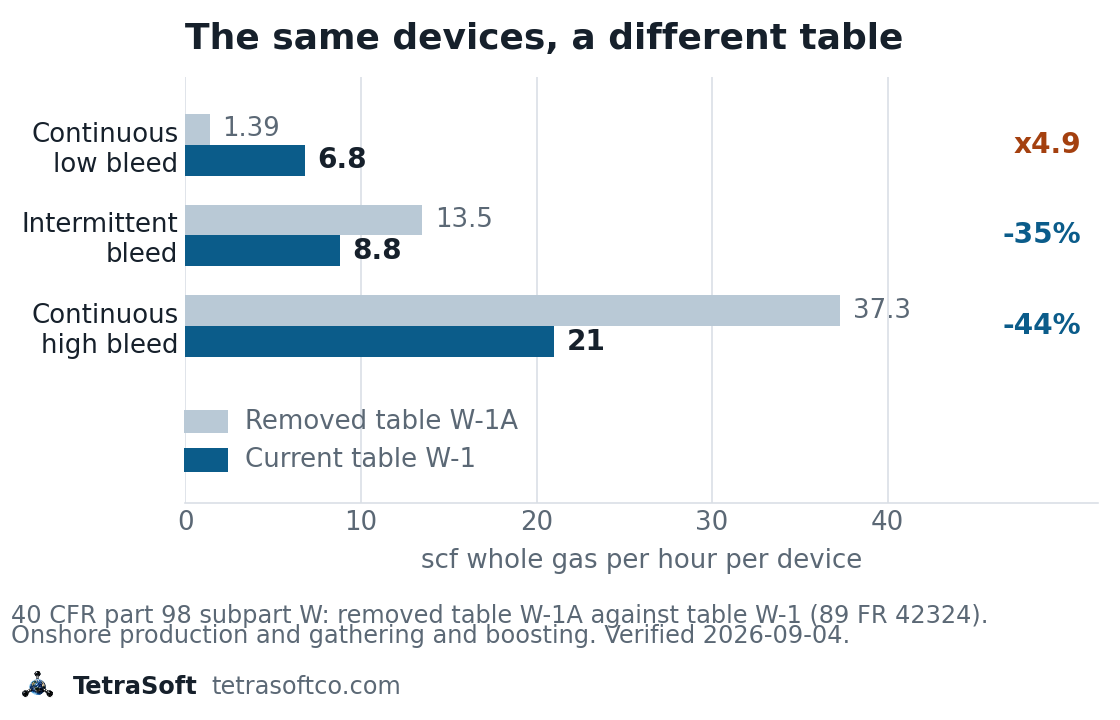
The same devices, two tables, and the error changes sign depending on which devices a site actually has. [3]
A calculator still carrying the removed table is not slightly stale. On a low-bleed population it is wrong by a factor of 4.9, and it is wrong in the direction of under-reporting.
| Device | Removed table W-1A | Current table W-1 | Change |
|---|---|---|---|
| Continuous high bleed | 37.3 | 21 | down 44 per cent |
| Intermittent bleed | 13.5 | 8.8 | down 35 per cent |
| Continuous low bleed | 1.39 | 6.8 | up 4.9 times |
Onshore production and gathering and boosting, scf whole gas per hour per device.
When the Calculator and the Measurement Disagree
The author of the defaults demoted them [1]. EPA demoted the factors it publishes itself, which is the clearest available signal that a calculator total is not expected to match a measurement [1]. The agency that writes the population factors is the party that put them last in the order [1]. An agency that considered its own defaults sufficient would not require a meter to override them.
A Gap Is Not an Attribution
Measured totals and factor-built totals routinely disagree, and the disagreement on its own tells you very little. It does not say which source category is responsible, or whether the factor or the activity count is the part that is wrong.
Where that disagreement has been measured at scale is covered in Why Satellites Show About 2x More Methane Than Inventories. Closing a gap needs a model of the site that can be checked against a measurement, not a larger factor.
What a Measurement-Informed Inventory Adds
A Measurement-Informed Inventory replaces the population factor with a site-specific modelled estimate reconciled against field measurement. MAES is a mechanistic emissions model developed at CSU and UT Austin, which TetraSoft uses through a partnership with CSU [6].
It does not certify a monitor, does not file your report, and cannot turn a default factor into a measurement. Nothing here removes the obligation to use Calculation Method 1 where the rule requires it [2].
What it changes is the substitution this whole post is about. A default factor answers what a device of this type usually emits. A mechanistic model answers what this equipment, at these conditions, would be expected to emit across a range of operating and failure states.
The method order and the factor revision point the same way. The rule now prefers measurement over the category average, and those averages themselves moved by up to a factor of five [4].
An operator with measurements and a model can reconcile the two. That reconciliation is what a Measurement-Informed Inventory is, and it is what the MAES Platform is built to produce. Getting it wrong costs the difference between a number that survives a reviewer and one that has to be redone after filing.
Frequently Asked Questions
What does an emissions calculator actually compute?
Activity multiplied by an emission factor, reduced by any control efficiency [5]. The activity is yours, the factor is a population average someone else measured, and the control efficiency is usually assumed. Only the first of the three describes your equipment.
Are default emission factors still allowed under Subpart W?
Yes, as Calculation Method 4, but only where none of the first three methods applies [1]. EPA states that Method 4 may not be used for devices a reporter is required or elects to measure under Calculation Methods 1 to 3 [1]. Where those methods do not apply, Method 4 multiplies the table W-1 population factor by the device count and the hours in service [3].
When does a flow meter make measurement mandatory?
40 CFR 98.233(a) covers a continuous flow meter on the supply line dedicated to devices vented directly to the atmosphere [2]. Where you have one, you must use Calculation Method 1 for those devices [2]. Having the meter is what triggers it, not electing to use it.
Did the pneumatic device emission factors change?
Substantially [4]. The 2024 final rule removed tables W-1A through W-1E and added table W-1 [4]. For onshore production, continuous high bleed fell from 37.3 to 21 scf per hour per device [3]. Intermittent bleed fell from 13.5 to 8.8, and continuous low bleed rose from 1.39 to 6.8 [3].
Is a calculator result good enough for a permit or a buyer?
It depends who is receiving it and what they compare it against. A default-factor total is a category average applied to your site. It carries no information about your site beyond the count of things on it, and it will not reconcile against a measurement that disagrees.
Interested in building a Measurement-Informed Inventory for your operations? Contact us to learn about our MAES-based estimation services.
References
- 40 CFR part 98, subpart W, table W-1. Default Whole Gas Population Emission Factors. US Code of Federal Regulations, as promulgated at 89 FR 42324.
- 40 CFR 98.233(a). Calculating GHG emissions, natural gas pneumatic device venting. US Code of Federal Regulations.
- EPA, Subpart W Final Amendments Effective for RY2025. US Environmental Protection Agency, Greenhouse Gas Reporting Program briefing, December 2024.
- 89 FR 42062, 14 May 2024. EPA, Greenhouse Gas Reporting Rule: Revisions and Confidentiality Determinations for Petroleum and Natural Gas Systems. Final rule, docket EPA-HQ-OAR-2023-0234. Tables W-1A through W-1E removed and table W-1 added at 89 FR 42324.
- EPA, AP-42: Compilation of Air Emissions Factors. US Environmental Protection Agency, Office of Air Quality Planning and Standards.
- Mollel et al., 2025, ACS ES&T Air, 2, 723-735, DOI 10.1021/acsestair.4c00168. “Using Prototypical Oil and Gas Sites to Model Methane Emissions in Colorado’s Denver-Julesburg Basin Using a Mechanistic Emission Estimation Tool.” https://doi.org/10.1021/acsestair.4c00168
Disclosure: Arthur Santos, the author of this post, is a co-author of the Mollel et al. (2025) study cited here.
This post is for informational purposes only and does not constitute legal or compliance advice. Consult qualified legal counsel or a compliance professional for guidance specific to your operations and jurisdiction.
Interactive tool
Which Subpart W method may you use?
The default factors are Calculation Method 4, and Method 4 is the last one in the order. This works out which method governs your devices, and gives the default-factor answer only where that method is the lawful one.
How these devices are handled
Device counts
Methane vented
108.0t/yr
- Method that governs
- Calculation Method 4
- Whole gas
- 6,785,496 scf/yr
- CO2e
- 3,240 t/yr
By device type
| Device | Factor | Count | scf/yr |
|---|---|---|---|
| Continuous high bleed | 21 | 4 | 735,840 |
| Continuous low bleed | 6.8 | 20 | 1,191,360 |
| Intermittent bleed | 8.8 | 60 | 4,625,280 |
| Pneumatic pumps | 13.3 | 2 | 233,016 |
The default population emission factors in table W-1, multiplied by device count and time in service.
Factors from 40 CFR part 98, subpart W, table W-1, as promulgated at 89 FR 42324. Method order from 40 CFR 98.233(a) and EPA, Subpart W Final Amendments Effective for RY2025, which states that Calculation Method 4 may not be used for devices a reporter is required or elects to measure under Methods 1 to 3. The Greenhouse Gas Reporting Program is under reconsideration and reporting deadlines have moved, so treat the obligation as current rather than settled. This does not compute Methods 1, 2 or 3, which need measurements this tool does not have. Nothing leaves your browser.
Comments
0Share your thoughts. All comments are moderated before appearing.
No comments yet. Be the first to share your thoughts!