The Inflation Reduction Act created the first federal charge on methane emissions from oil and gas facilities [1]. Two laws passed in 2025 changed what that charge is, and neither of them repealed it [1]. Congress disapproved the rule EPA wrote to implement the charge, and a separate law moved the charge’s effective date from 2024 to 2034 [1]. The distinction matters because the statute still stands while the machinery to run it does not. Reporting under the greenhouse gas rule has its own separate timetable, and its next deadline falls this year [2].
Quick Answer: The Inflation Reduction Act added Clean Air Act section 136, a charge on methane from oil and gas facilities [1]. It reaches facilities reporting over 25,000 metric tons of CO2 equivalent [1]. Congress disapproved EPA’s implementing rule on 14 March 2025 [1]. P.L. 119-21 then moved the effective date to 2034, at a starting rate of 1,500 dollars per metric ton [1]. Section 136 was not repealed [1].
What the Inflation Reduction Act Set Up for Methane
The Act built a charge on top of a reporting program that already existed. The Inflation Reduction Act is P.L. 117-169, signed on 16 August 2022, and it added section 136 to the Clean Air Act [1]. Section 136 directs EPA to impose a waste emissions charge on methane from oil and gas facilities [1].
The charge reaches those reporting more than 25,000 metric tons of CO2 equivalent a year under GHGRP Subpart W [1].
Nine segments fall inside it [1]. They are offshore and onshore production, gas processing, transmission compression and underground storage [1]. The rest are liquefied natural gas storage, LNG import and export equipment, gathering and boosting, and transmission pipelines [1]. Natural gas distribution sits outside the charge [1].
The charge is not levied on all reported methane [1]. Section 136 sets an emissions intensity threshold per segment, expressed as a share of the natural gas sent to sale [1]. Only emissions above that threshold would be charged [1].
| Segment | Threshold, share of natural gas sent to sale |
|---|---|
| Production facilities | 0.20 per cent |
| Non-production facilities | 0.05 per cent |
| Transmission facilities | 0.11 per cent |
Thresholds are set in the statute itself, not in the rule Congress disapproved.
How the Charge Was Meant to Be Calculated
The rate was scheduled to climb for two years and then hold [1]. It began at 900 dollars per metric ton for 2024, rose to 1,200 dollars for 2025, and reached 1,500 dollars for 2026 and after [1]. Those figures apply to the tonnes above a facility’s threshold rather than to its whole reported total.
EPA published the machinery for that calculation in November 2024 [3]. The rule was titled Waste Emissions Charge for Petroleum and Natural Gas Systems: Procedures for Facilitating Compliance, Including Netting and Exemptions [3]. Netting and exemptions were the substance of it, which is a useful signal about where the difficulty sat.
Netting mattered because a company with several facilities in one segment would not necessarily be charged facility by facility. That rule is the one Congress later disapproved, so the procedures it set out no longer operate [4].
The Money That Came With the Charge
The Act paired the charge with funding, and the pairing was deliberate. It provided 850 million dollars in grants for facilities subject to the charge [1]. A further 700 million dollars was aimed at marginal conventional wells [1].
Marginal wells are the hardest case for a per-tonne charge. An intensity threshold expressed as a share of gas sent to sale is harder to clear when the denominator is small.
That subsidy is gone [1]. P.L. 119-21 repealed the section 136 funding provisions and rescinded any unobligated money [1]. The charge was rescheduled and the help was withdrawn, which is not a symmetrical outcome.
What the Two 2025 Laws Actually Did
Two separate 2025 laws did two different things, and conflating them is the common error.
Congress disapproved EPA’s waste emissions charge rule under the Congressional Review Act through H.J.Res. 35, enacted as P.L. 119-2 on 14 March 2025 [1]. A disapproved rule cannot be reissued in substantially the same form [1].
EPA then removed the regulations from the Code of Federal Regulations [4]. That revocation published on 19 May 2025 [4]. The agency states that the regulation no longer has any force of law [5].
P.L. 119-21, signed on 4 July 2025, then amended the statute itself [1]. It moved the charge’s effective date from 2024 to 2034 [1]. It left the rate schedule alone, so the first charge falls in a year the statute already priced at 1,500 dollars [1].
A Disapproval and an Amendment Are Different Things
The two actions leave different things standing, and only one of them touched the statute. The March disapproval removed the implementation framework. The July amendment moved the date and the price [1].
Attributing both to one event is the mistake to avoid. A reader told only that Congress repealed the methane fee in early 2025 learns half of it. The charge itself was rescheduled to 2034 nearly four months later.
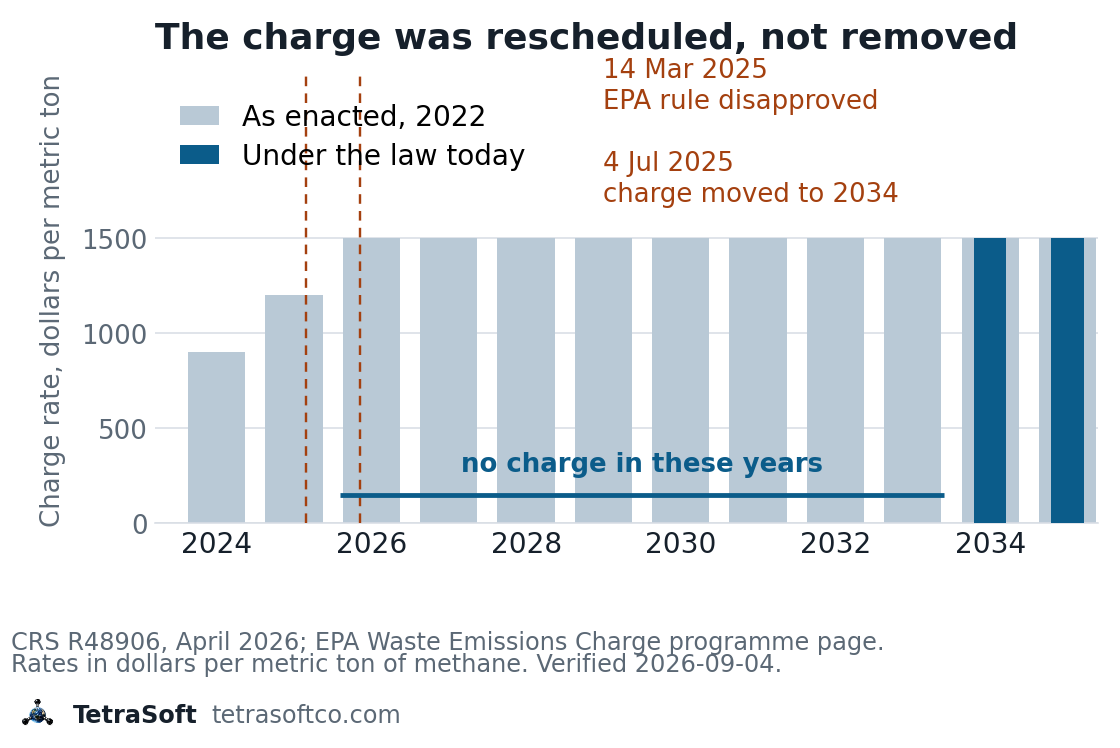
Ten reporting years now sit between the disapproval and the first year the charge could apply.
What Survives, Provision by Provision
Reading the provisions separately gives a clearer answer than reading the headlines. The statutory charge, the implementing rule and the funding each ended up in a different state [1].
| Provision | State in 2026 | What changed it |
|---|---|---|
| Clean Air Act section 136 charge | On the books, effective 2034 | P.L. 119-21, 4 July 2025 |
| Charge rate at first application | 1,500 dollars per metric ton | Original IRA schedule, not amended |
| Intensity thresholds by segment | Unchanged in statute | Not amended |
| EPA implementing rule | Disapproved, removed from the CFR | P.L. 119-2, then 90 FR 21225 |
| Netting and exemption procedures | Gone with the rule | P.L. 119-2, then 90 FR 21225 |
| 850 million dollar facility grants | Repealed, unobligated funds rescinded | P.L. 119-21, 4 July 2025 |
| 700 million dollars for marginal wells | Repealed, unobligated funds rescinded | P.L. 119-21, 4 July 2025 |
| GHGRP Subpart W reporting | In force; the proposal would drop distribution after 2024 and suspend the rest to 2034 | 90 FR 44591 proposed 16 September 2025 |
Every row was changed by a different instrument, which is why a single headline cannot carry the answer.
Section 136 also carries a conditional exemption tied to Clean Air Act section 111 standards [1]. The exemption applies once section 111 regulations are in effect in all states and deliver equivalent or greater emissions reductions [1]. Offshore production facilities cannot use it [1].
Those section 111 standards are the OOOOb and OOOOc rules, which EPA reconsidered in a final rule on 4 April 2026. Their scope is covered in EPA OOOOb Explained: Who It Covers and What It Requires.
What Still Binds an Operator in 2026
The charge sleeps, and the reporting that would feed it does not [2]. EPA proposed on 16 September 2025 to remove greenhouse gas reporting obligations for most source categories [6]. The same proposal would suspend the remaining Subpart W segments until reporting year 2034 [6].
Three things are worth continuing regardless of the charge’s status. Subpart W reporting still binds the facilities it always bound, and the reconsideration of it is a proposal rather than a repeal. The 25,000 tonne applicability test still keys off that reported data, so the reporting record is what a revived charge would be assessed on.
The statute itself was never repealed, only its implementing rule and its start date [1]. An operator with nine years of consistent intensity data is in a different position in 2034 than one starting then.
One larger change did land in 2026, and it sits underneath all of this. EPA rescinded the greenhouse gas endangerment finding in a final rule published on 18 February 2026 [7]. That finding is the predicate for motor-vehicle greenhouse gas standards rather than for section 136, which Congress wrote directly into the Clean Air Act. The methane charge therefore survives the rescission, and its 2034 date is unchanged by it.
That proposal has not been finalised. What EPA did finalise was narrower and more immediate [2].
Reporting year 2025 reports were due on 31 March 2026 [2]. EPA moved that deadline to 30 October 2026 [2]. The agency said the rule changes only the deadline and that it anticipates addressing the rest of the proposed rescission in later actions [2]. The move is covered in GHGRP Subpart W Deadline Moved to October 2026.
An operator reading only that the methane fee was repealed would draw the wrong conclusion about this year. What remains required is covered in GHGRP Subpart W Reporting in 2026: What Is Still Required.
The Reported Number Is Still the Basis
An emissions intensity is not a measurement. It is a ratio whose numerator comes from emission factors applied to equipment counts, which makes it a modelling result. The threshold test in section 136 therefore asks a modelling question rather than a metering one.
That distinction has a measured consequence. Zavala-Araiza et al. (2017) found that super-emitters in natural gas infrastructure are caused by abnormal process conditions [8]. The finding was published in Nature Communications [8]. Emission factors describe normal operation, so a stream of abnormal events is exactly what a factor-based total is least able to carry.
Where a Measurement-Informed Inventory Fits
A Measurement-Informed Inventory addresses the modelled quantity the threshold test reads. MAES is a mechanistic emissions model developed at CSU and UT Austin, which TetraSoft uses through a partnership with CSU [9]. It simulates a facility from its equipment and operating conditions [9]. It generates an expected emission range rather than a single value [9].
Combining that model with field measurement produces a Measurement-Informed Inventory. Santos et al. (2025) applied that approach to the Denver-Julesburg Basin in ACS ES&T Air [10]. MAES does not file a Subpart W report, and it does not predict whether Congress will restore the charge. It does not tell an operator what the charge will be either.
What the MAES platform addresses is the number the threshold test reads. An operator whose intensity sits near 0.20 per cent is being judged on a modelled quantity. Putting a defensible range around that number is the work.
Getting it wrong is priced in the statute. At 1,500 dollars per metric ton, every 1,000 Mcf of methane above the threshold is roughly 19 metric tons and about 29,000 dollars. Ten reporting years will pass before that arithmetic is tested.
Frequently Asked Questions
Does a disapproved rule mean EPA can never write another one?
Not never, but not the same one. A rule disapproved under the Congressional Review Act cannot be reissued in substantially the same form [1]. Any future framework would have to differ materially from the 2024 rule.
Are reporting years before 2034 exposed to the charge?
Not under the statute as amended. P.L. 119-21 changed the effective date from 2024 to 2034 [1]. Years already reported sit before that date and are not reached by it.
Is the 25,000 metric ton test applied per facility or per company?
Per facility, as the greenhouse gas reporting rule defines one. Section 136 reaches facilities that report more than 25,000 metric tons of CO2 equivalent a year [1]. An operator can therefore hold facilities on both sides of the test.
Does the section 111 exemption matter while the charge is dormant?
Not in practice, because an exemption only operates against a charge that applies. Its trigger sits in the future, since it requires section 111 standards in force nationwide at equivalent or greater stringency [1]. Offshore production facilities are excluded from it regardless [1].
Did the Inflation Reduction Act change anything else for oil and gas emissions?
Yes, most visibly the section 45Q credit for capturing carbon dioxide [11]. The Act raised it to as much as 85 dollars per metric ton for geologic storage [11]. Enhanced oil recovery reached 60 dollars under that law, both subject to wage and apprenticeship conditions [11]. It also cut the minimum annual capture thresholds and set a construction-start deadline of 1 January 2033 [11]. P.L. 119-21 later raised enhanced oil recovery to the same 85 dollars, for equipment placed in service after 4 July 2025 [12].
What happened to the netting rules operators were planning around?
They went with the rule that contained them [4]. EPA’s 2024 rule was titled Procedures for Facilitating Compliance, Including Netting and Exemptions, and the disapproval revoked it in full [3]. Any future framework would have to define netting again, and it could not do so in substantially the same terms.
Is Subpart W reporting still required this year?
Yes, and the deadline moved rather than disappeared [2]. EPA extended the reporting year 2025 deadline from 31 March 2026 to 30 October 2026 [2]. A separate proposal to suspend most Subpart W segments until 2034 was published in September 2025 and has not been finalised [6].
Should an operator stop tracking methane until 2034?
That is a business judgement rather than a compliance one, and the reporting record is the thing to weigh. Each reporting year adds to a record that a future framework, a state program, or a gas buyer can read. A methodology improved in 2032 does not improve the years already filed.
Interested in building a Measurement-Informed Inventory for your operations? Contact us to learn about our MAES-based estimation services.
References
- Congressional Research Service, Inflation Reduction Act Methane Emissions Charge: Overview and Considerations for Policymakers, R48906, April 2026. https://www.everycrsreport.com/reports/R48906.html
- U.S. Environmental Protection Agency, Waste Emissions Charge program page, verified September 2026. https://www.epa.gov/inflation-reduction-act/waste-emissions-charge
- 89 FR 91094, November 18, 2024. Waste Emissions Charge for Petroleum and Natural Gas Systems: Procedures for Facilitating Compliance, Including Netting and Exemptions. https://www.federalregister.gov/documents/2024/11/18/2024-26643/waste-emissions-charge-for-petroleum-and-natural-gas-systems-procedures-for-facilitating-compliance
- 90 FR 21225, May 19, 2025. Congressional Review Act Revocation of Waste Emissions Charge for Petroleum and Natural Gas Systems: Procedures for Facilitating Compliance, Including Netting and Exemptions.
- 90 FR 44591, September 16, 2025. Reconsideration of the Greenhouse Gas Reporting Program (proposed rule).
- 91 FR 9712, February 27, 2026. Extending the Reporting Deadline Under the Greenhouse Gas Reporting Rule for 2025.
- Zavala-Araiza et al., Nature Communications, 8, 14012, 2017. “Super-emitters in natural gas infrastructure are caused by abnormal process conditions.” https://doi.org/10.1038/ncomms14012
- Mollel et al., 2025, ACS ES&T Air, 2, 723-735, DOI 10.1021/acsestair.4c00168. “Using Prototypical Oil and Gas Sites to Model Methane Emissions in Colorado’s Denver-Julesburg Basin Using a Mechanistic Emission Estimation Tool.” https://doi.org/10.1021/acsestair.4c00168
- Santos et al., 2025, ACS ES&T Air, 2, 1598-1611, DOI 10.1021/acsestair.5c00089. “Using Measurement-Informed Inventory to Assess Emissions in the Denver-Julesburg Basin.” https://doi.org/10.1021/acsestair.5c00089
- Congressional Research Service, The Section 45Q Tax Credit for Carbon Sequestration, IF11455, August 2023. https://www.everycrsreport.com/reports/IF11455.html
- Public Law 119-21, One Big Beautiful Bill Act, signed 4 July 2025. https://www.congress.gov/119/plaws/publ21/PLAW-119publ21.htm
- 91 FR 7686, February 18, 2026. Rescission of the Greenhouse Gas Endangerment Finding and Motor Vehicle Greenhouse Gas Emission Standards Under the Clean Air Act. https://www.federalregister.gov/documents/2026/02/18/2026-03157/rescission-of-the-greenhouse-gas-endangerment-finding-and-motor-vehicle-greenhouse-gas-emission
This post is for informational purposes only and does not constitute legal or compliance advice. Consult qualified legal counsel or a compliance professional for guidance specific to your operations and jurisdiction.
Interactive tool
Waste emissions charge exposure
What Clean Air Act section 136 would charge a facility, on its own reported figures. Prefilled with an illustrative production facility.
Not collectible today. EPA's implementing rule was disapproved on 14 March 2025 and revoked from the CFR at 90 FR 21225, published 19 May 2025. The charge does not reach any reporting year before 2034.
Charge if section 136 applied
$1,812,365 per reporting year
Above threshold
- Methane intensity
- 1.460%
- Threshold
- 192 t
- Above threshold
- 1,208 t
In scope: reports above 25,000 t CO2e.
Thresholds, the 25,000 t CO2e scope test and the $1,500 rate are set in Clean Air Act section 136. Because EPA's implementing rule was disapproved, no authoritative method currently exists for turning a Subpart W filing into a charge. This tool states its own basis: gas sent to sale is converted to the methane mass it represents at 379.49 cubic feet per pound-mole, and the intensity is reported methane over that mass. Treat the output as the statutory percentages applied to your figures, not as a determination. Nothing leaves your browser.
Comments
0Share your thoughts. All comments are moderated before appearing.
No comments yet. Be the first to share your thoughts!