New Mexico’s ozone season runs from May 1 through October 31 of each year [1]. The governing rule, 20.2.82 NMAC (Oil and Gas Sector: Ozone Precursor Pollutants), applies to oil and gas production, processing, transmission, and storage facilities statewide [1]. During the ozone window, the rule imposes stricter LDAR survey frequencies and tighter controls on storage vessels and other regulated equipment [1].
For compliance teams managing New Mexico well sites, these seasonal obligations add survey deadlines on top of year-round requirements. Operators who have not confirmed their survey schedule should run through the following checklist before September.
This post is for informational purposes only and does not constitute legal or compliance advice. Consult qualified legal counsel or a compliance professional for guidance specific to your operations and jurisdiction.
What 20.2.82 NMAC Requires During Ozone Season
20.2.82 NMAC splits its obligations into year-round baselines and ozone-season additions, with the seasonal layer imposing tighter LDAR schedules and control-device verification from May through October [1]. A facility that passes its annual LDAR survey can still fall short during the ozone window if it misses a quarterly deadline. Year-round, the rule sets baseline emission control requirements for storage vessels, pneumatic controllers, compressors, and dehydrators [1]. The ozone-season provisions layer additional frequency and inspection requirements on top of those baselines [1].
NMED enforcement actions under 20.2.82 have increased since 2023 [2]. Penalty history is publicly available on the agency’s enforcement records page [2].
Quarterly LDAR Surveys Are the Most Demanding Ozone-Season Requirement
The most operationally demanding ozone-season requirement is the LDAR survey schedule. For many facility types, 20.2.82 NMAC requires quarterly LDAR surveys during ozone season [3]. Annual surveys alone are insufficient for ozone-season compliance at facilities that trigger the quarterly tier [3].
Facilities with emissions above specified VOC thresholds must conduct OGI or EPA Method 21 surveys quarterly during ozone season [3]. The first survey must be completed by June 30, with subsequent surveys at intervals not exceeding 90 days [3]. Large compressor stations and processing plants face monthly LDAR survey requirements year-round [3]. The ozone-season quarters carry heightened scrutiny from NMED inspectors.
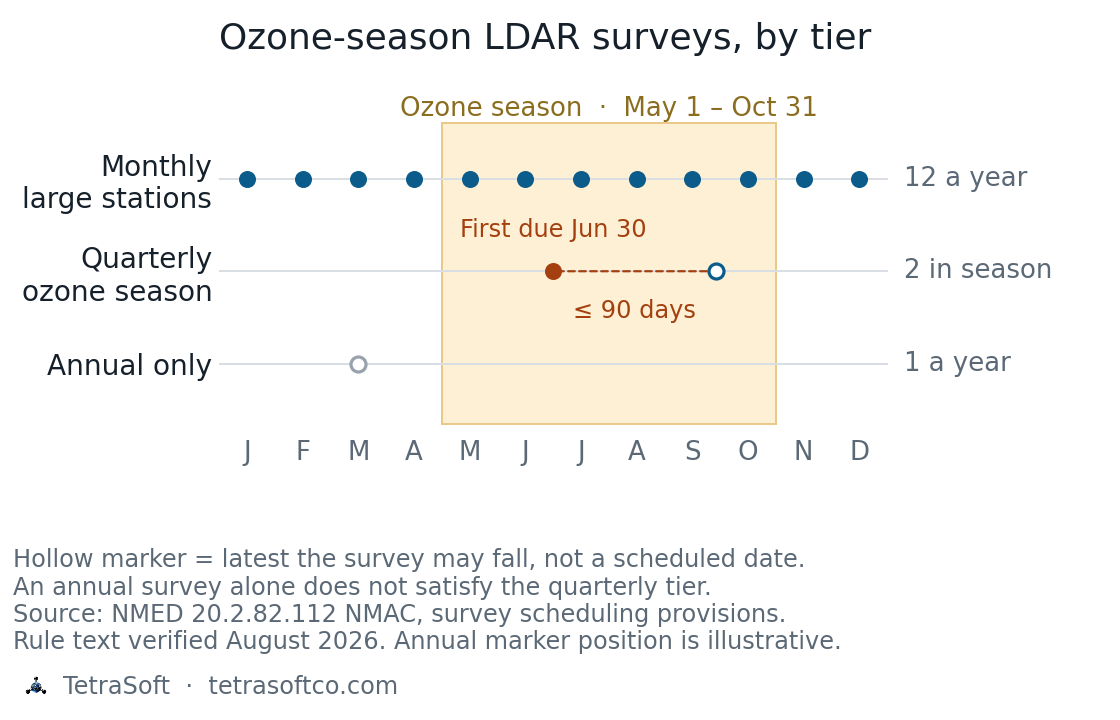
Figure 1. Survey obligations by LDAR tier under 20.2.82.112 NMAC. The annual marker’s position is illustrative; the rule sets no date for it.
Operators should confirm which LDAR tier each facility falls into based on its potential-to-emit (PTE) and its equipment inventory. A facility that added equipment or increased throughput since the last annual review may have crossed into a higher LDAR tier, and that change may not yet be reflected in its survey schedule.
What Does 20.2.82 Require for Storage Vessels, Pneumatic Controllers, and Compressors?
Storage vessels, pneumatic controllers, and compressors each carry year-round requirements under 20.2.82, with ozone-season inspections focused on control device uptime and inventory accuracy [1]. Ozone-season inspections focus on whether VRUs and combustion devices on tanks above 2 tpy uncontrolled VOC emissions are operating continuously [4]. A VRU that was down for maintenance during an ozone-season month creates a compliance gap that NMED can identify through production records and inspection reports.
NMED 20.2.82.108 NMAC establishes emission standards for pneumatic controllers at oil and gas facilities [5]. New Mexico requires all new and modified pneumatic controllers at oil and gas facilities to be zero-emitting or routed to a control device [5]. Existing high-bleed controllers must be replaced or retrofitted on the schedule specified in the rule [5]. During ozone season, inspectors verify that pneumatic controller inventories match reported configurations and that no high-bleed devices remain in service past their replacement deadline.
Centrifugal and reciprocating compressors at oil and gas facilities are subject to rod packing and seal replacement schedules [6]. Monitoring and recordkeeping requirements apply year-round but face more frequent verification during ozone season.
For operators managing New Mexico facilities and tracking NMOCD permit status, the NMOCD Permitting: Find and Map New Mexico Drilling Permits post covers how to locate active permits by operator and location.
BLM Methane Rule Adds a Second Compliance Layer on Federal and Tribal Lands
New Mexico Permian Basin operators on federal acreage may face a second layer of compliance, depending on enforcement status. The Bureau of Land Management finalized an updated Methane and Waste Prevention Rule (43 CFR Part 3179) in 2024, but the rule’s enforcement status is uncertain and subject to potential repeal or stay under the current administration [7]. If enforced, the rule imposes its own LDAR, pneumatic device, and flaring requirements [7]. Where both programs apply, operators must meet whichever standard is stricter.
The BLM rule’s LDAR requirements and NMED’s quarterly ozone-season surveys often align on timing [7].
The two programs use different leak definitions and repair timelines [7]. An operator who satisfies the BLM survey schedule may still miss an NMED repair deadline. The reverse is also true if the two programs are tracked separately.
Approximately 36% of New Mexico’s active oil and gas wells are on federal or tribal land [8]. That share concentrates in Lea and Eddy counties [8].
Operators with mixed federal and state/fee leases need to track which wells fall under dual jurisdiction. Both programs’ requirements must be met at each facility [7]. We cover these dual-jurisdiction updates in our newsletter.
For a broader view of New Mexico well locations and federal land status, the NMOCD Well Search: Map Every New Mexico Oil & Gas Well post maps every active well by operator and location.
Ozone-Season Compliance Checklist: What to Verify Now
Compliance teams managing ozone-season obligations under 20.2.82 should verify the following items before September.
LDAR survey schedule. Confirm that every facility subject to quarterly LDAR has completed its Q2 and Q3 surveys on schedule (by June 30 and September 30, respectively) [3]. Verify that survey records include the date, method (OGI or Method 21), surveyor identification, and leak/no-leak findings for each component surveyed [3].
Leak repair documentation. Confirm that repairs for ozone-season leaks were completed within the rule’s timeframe [3]. Verify that a repair re-survey was conducted and documented [3]. Delayed repairs require a delay-of-repair justification that meets the rule’s criteria [3].
Storage vessel control device uptime. Verify that VRUs and combustion devices on tanks above the 2 tpy uncontrolled VOC threshold have operated continuously during ozone season [4]. Document any downtime events, the duration, the cause, and the corrective action taken.
Pneumatic controller inventory. Confirm that the facility’s pneumatic controller inventory matches the reported configuration and that no high-bleed devices remain in service past their required replacement date [5]. Cross-check the field inventory against the most recent AVO (audio, visual, olfactory) or OGI survey results.
BLM dual-jurisdiction tracking (federal leases only). For facilities on federal or tribal land, confirm that both NMED and BLM survey schedules and repair timelines have been met [7]. A single compliance calendar that maps both programs’ deadlines to each facility is the most reliable way to avoid gaps.
Recordkeeping for NMED inspection readiness. NMED inspectors can request records on-site [1]. Confirm that LDAR survey logs, repair records, pneumatic controller inventories, and storage vessel control device uptime records are current [1]. Each record must be accessible on-site or producible within the timeframe the rule specifies [1].
Frequently Asked Questions
Do LDAR survey tiers differ for wellpads vs. compressor stations under 20.2.82 NMAC?
LDAR survey tiers under 20.2.82 NMAC are based on a facility’s potential-to-emit (PTE) and equipment inventory [3]. The tier assignment does not depend on whether a facility is classified as a wellpad or compressor station [3]. Large compressor stations often trigger monthly LDAR survey requirements year-round due to higher PTE [3]. Wellpads with fewer emission sources typically fall into quarterly or annual survey tiers [3]. Operators should verify each facility’s PTE classification individually rather than assuming a single tier applies across all facility types.
What happens if an LDAR survey is missed during ozone season?
A missed quarterly LDAR survey during ozone season is a citable violation under 20.2.82 NMAC [3]. NMED can issue a notice of violation and assess penalties based on the number of facilities and survey periods affected [2]. Operators who discover a missed survey should complete it promptly and document the delay with a written explanation.
Does 20.2.82 NMAC apply to midstream facilities?
NMED 20.2.82 NMAC covers oil and natural gas production, processing, transmission, and storage facilities [1]. Midstream facilities, including gas processing plants and compressor stations, fall within scope [1]. The LDAR tier and survey frequency for each facility depend on its potential-to-emit and equipment inventory, not on upstream or midstream classification [3].
Has NMED increased enforcement of ozone-season rules?
NMED enforcement of 20.2.82 NMAC has increased since 2023 [2]. Recent ozone-season actions have cited LDAR survey gaps and equipment-level violations, including pneumatic controller inventory discrepancies and storage vessel control device downtime [2]. Operators can search the NMED Air Quality Bureau’s public records by county and facility type to review specific actions [2]. Penalty amounts vary based on the number of facilities affected and the duration of each violation [2].
Never miss an ONGAEIR or GHGRP deadline. Subscribe for compliance updates and regulatory news.
References
- NMED 20.2.82 NMAC, “Oil and Gas Sector: Ozone Precursor Pollutants,” New Mexico Environment Department, effective 2022. Full rule text available at env.nm.gov.
- NMED Air Quality Bureau enforcement records, publicly available at env.nm.gov.
- NMED 20.2.82.112 NMAC, LDAR survey scheduling, repair, and recordkeeping provisions.
- NMED 20.2.82.109 NMAC, storage vessel provisions.
- NMED 20.2.82.108 NMAC, pneumatic controller provisions.
- NMED 20.2.82.110 NMAC, compressor provisions.
- BLM 43 CFR Part 3179, “Waste Prevention, Production Subject to Royalties, and Resource Conservation,” Bureau of Land Management, 2024 final rule; enforcement status uncertain as of August 2026.
- BLM and NMOCD well data, federal/tribal land well proportions. Public data accessed August 2026.
Comments
0Share your thoughts. All comments are moderated before appearing.
No comments yet. Be the first to share your thoughts!