NMOCD permitting is how New Mexico approves an oil or gas well before drilling, through the Oil Conservation Division’s Application for Permit to Drill [1]. An operator files the Form C-101 in the OCD’s online system, and the division reviews spacing, location, and casing before approval [1]. Once approved, that permit rides the well’s API number through spud, production, and eventual plugging [1]. Those approval, spud, and plug dates sit in separate OCD lookups, so tracking one permit means opening several systems [1]. TetraSoft Atlas, a subscription data platform, draws that permit and lifecycle history onto one New Mexico map, so a well opens with its permit dates [2].
Quick Answer: New Mexico’s OCD approves roughly 3,000 to 3,400 drilling permits a year, each tied to a well’s API number and lifecycle dates. Atlas maps every permitted New Mexico well and opens its permit and lifecycle history from one search [2].
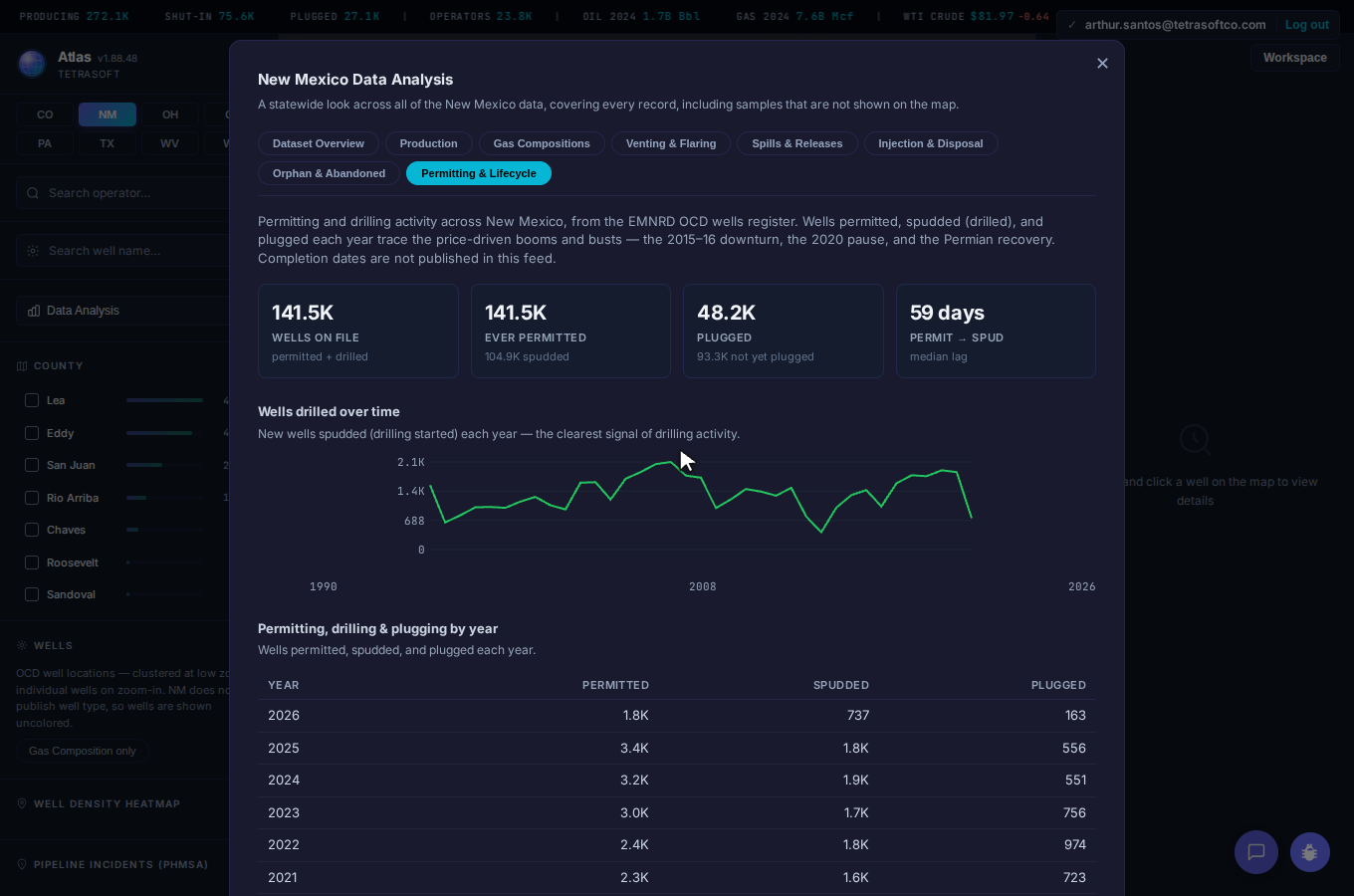
New Mexico wells permitted, spudded, and plugged by year, from the EMNRD OCD wells feed. [2]
What NMOCD Permitting Requires Before a Well Is Drilled
NMOCD permitting starts with the Application for Permit to Drill, the Form C-101 an operator files before spudding a well [1]. The Oil Conservation Division reviews well spacing, surface location, and the casing and cementing plan against state rules [1]. Operators file through the OCD’s online permitting and reporting system [1]. Approved New Mexico drilling permits become public record [1].
A permit is approval to drill, not proof of a drilled well. Approvals can lapse before a rig ever arrives, which is why the OCD also tracks an APD expiration and cancellation date [1]. The permit is the first step in a longer lifecycle, not the whole story.
How a Permit Becomes a Well Record
Once the OCD approves the C-101, the well receives its API number, the identifier every later record hangs on [1]. Production, spills, and plugging all report against that same number [1]. Reading that number is covered in the API well number lookup guide. The permit and the well are two views of one API.
How to Find a New Mexico Drilling Permit on One Map
TetraSoft Atlas maps every permitted New Mexico well and opens its permit and lifecycle record beside the map [2]. You search by operator, county, or well name, then click a well to read its permit tab [2]. Any of the three fields works [2]. The same wells are covered in the NMOCD well search guide.
The permit tab lists the permit type, current status, permit approved date, spud date, and last production date [2]. It also carries the APD expiration and cancellation dates, the temporary abandonment date, and the plug and site-released dates [2]. Completion dates are not published in the OCD wells feed, so the tab does not show them [1]. You can read any well’s permit history on the map without a single agency login [2].
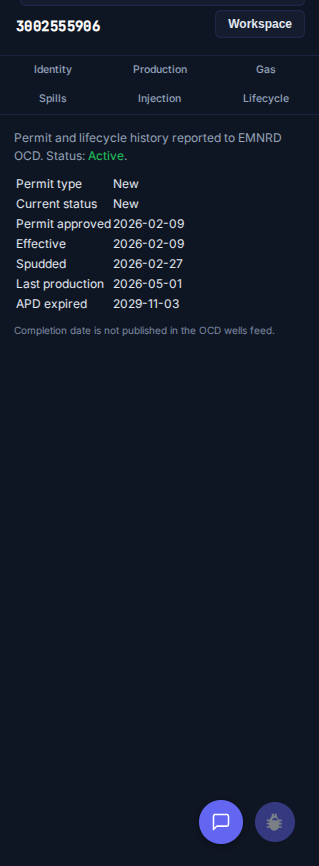
A New Mexico well’s permit and lifecycle record: permit approved, spud, last production, and APD expiration dates on one tab. [2]
New Mexico Approves More Permits Than It Drills Each Year
New Mexico approves far more drilling permits each year than operators drill wells. The OCD approved about 3,220 drilling permits in 2024 and about 3,360 in 2025. New Mexico operators spudded roughly 1,870 wells in 2024, well below the permits approved that year. Atlas charts all three counts, wells permitted, spudded, and plugged, in one statewide view [2].
That gap surprised me. New Mexico approves close to twice as many permits as it drills in a year, which shows how many approvals sit in inventory. The yearly counts trace the 2015 downturn, the 2020 pause, and the Permian recovery that followed [2].
Lea and Eddy counties drive most of that permitting, the New Mexico share of the Permian Basin [1]. San Juan county in the northwest adds the older gas country [1]. Wells that reach the end of that lifecycle, plugged or orphaned, appear on the same platform, mapped in the abandoned gas wells guide.
Frequently Asked Questions
How long does a New Mexico drilling permit stay valid?
A New Mexico APD does not stay open indefinitely; the OCD records an APD expiration date and can cancel a permit [1]. If drilling does not begin in time, the approval can lapse before a rig reaches the site. Atlas shows each well’s APD expiration and cancellation dates on its permit tab [2].
Does TetraSoft Atlas replace the OCD online permitting system?
No. The OCD’s online system is where operators file and amend permits, and Atlas does not submit filings [1]. Atlas maps the approved permits and their lifecycle dates so you can read them without opening the agency portal [2]. You still file through the OCD when you need to submit a permit [1]. To look up New Mexico drilling permits at the source, the OCD links a Permit and Application Search from its statistics page [3].
How many drilling permits does New Mexico issue each year?
New Mexico’s OCD approved roughly 3,000 to 3,400 drilling permits a year over the last several years. The median gap from permit approval to spud runs about two months, so approvals lead drilling. The count moves with oil prices, so it changes year to year.
What is the difference between a permitted well and a spudded well?
A permitted well has an approved permit to drill; a spudded well is one a rig has actually begun drilling [1]. Not every approved permit is drilled, and some expire first. Atlas shows both the permit approved date and the spud date on the same well [2].
How much does TetraSoft Atlas cost?
Atlas is priced by team size, from a single seat up to 15, with larger teams on request. Every plan starts with a seven-day free trial, and you can cancel anytime. For current plans and prices, see the Atlas pricing page.
Tracking a New Mexico permit should not mean three OCD tabs and a manual reconcile. Atlas puts every permitted well and its lifecycle dates on one map, with the statewide permitting trend a click away, refreshed monthly from OCD records [2]. Start your free 7-day trial.
This post is for informational purposes only and does not constitute legal or compliance advice. Consult qualified legal counsel or a compliance professional for guidance specific to your operations and jurisdiction.
References
- New Mexico Energy, Minerals and Natural Resources Department, Oil Conservation Division (EMNRD OCD, also called NMOCD) public oil and gas records.
- TetraSoft Atlas, New Mexico oil and gas dataset and product features. https://tetrasoftco.com/atlas-landing.html#pricing
- New Mexico Energy, Minerals and Natural Resources Department, Oil Conservation Division, OCD Statistics (Data Searches, and Information: Permit and Application Search), accessed 28 September 2026. https://www.emnrd.nm.gov/ocd/ocd-data/statistics/
Comments
0Share your thoughts. All comments are moderated before appearing.
No comments yet. Be the first to share your thoughts!