OOOOb does not set a single survey schedule for oil and gas sites [1]. It sets six, and the one that applies to a site is decided by the equipment standing on that site [1]. A repair clock that runs at two different speeds runs alongside it, and every detection starts one [1].
Choosing a tool comes down to two questions: does it record equipment at component level, and can it reconstruct a past site state. OOOOb and OOOOc both face potential repeal or administrative stay, so everything below describes the rule as written rather than as a fixed obligation.
What OOOOb Requires as Written
As written, OOOOb requires scheduled leak surveys, repairs inside fixed deadlines, and records proving both [1]. Who the standard covers and which sites it reaches is set out in EPA OOOOb Explained: Who It Covers and What It Requires. The subpart covers crude oil and natural gas facilities constructed after December 6, 2022 [2]. The fugitive emissions provisions are the ones that generate recurring work.
Survey Frequency Depends on What Equipment Is at the Site
The rule sorts sites into categories and assigns each a different monitoring cadence [1]. Single wellhead only well sites and small well sites require at least quarterly surveys using audio, visual, and olfactory methods [1]. Multi-wellhead only well sites require quarterly AVO surveys plus semiannual optical gas imaging or Method 21 surveys, spaced four to seven months apart [1].
The cadence tightens once certain equipment is present [1]. Well sites and centralized production facilities move to a tighter tier based on the equipment they hold [1]. That tier covers controlled storage vessels, control devices, gas-driven process controllers or pumps, or two or more other pieces of major equipment [1].
Those sites require bimonthly AVO and quarterly OGI or Method 21 [1]. Compressor stations go further still, at monthly AVO and quarterly OGI or Method 21 [1]. Sites on the Alaska North Slope run annually instead, spaced nine to thirteen months apart [1].
You cannot know a site’s survey obligation without an accurate, current inventory of the equipment on it. Adding a single control device or a gas-driven pump can move a site from quarterly to bimonthly. The equipment record is therefore the compliance record, not a separate asset register.
The six cadences line up like this [1].
| Site category | AVO survey | OGI or Method 21 survey |
|---|---|---|
| Single wellhead only well site | Quarterly | Not required |
| Small well site | Quarterly | Not required |
| Multi-wellhead only well site | Quarterly | Semiannual, 4 to 7 months apart |
| Well site or central production facility with major equipment | Bimonthly | Quarterly, at least 60 days apart |
| Compressor station | Monthly | Quarterly, at least 60 days apart |
| Alaska North Slope site | No separate AVO tier | Annual, 9 to 13 months apart |
The tool below pairs the cadence with the repair clock for any site category.
Two Repair Clocks Run at Different Speeds
Detection starts a clock whose length depends on how the leak was found [1]. A first repair attempt is due within 15 calendar days of an AVO detection [1]. The deadline is 30 calendar days when the detection came from OGI or Method 21 [1]. Final repair follows the same split, at 15 and 30 calendar days after that first attempt [1].
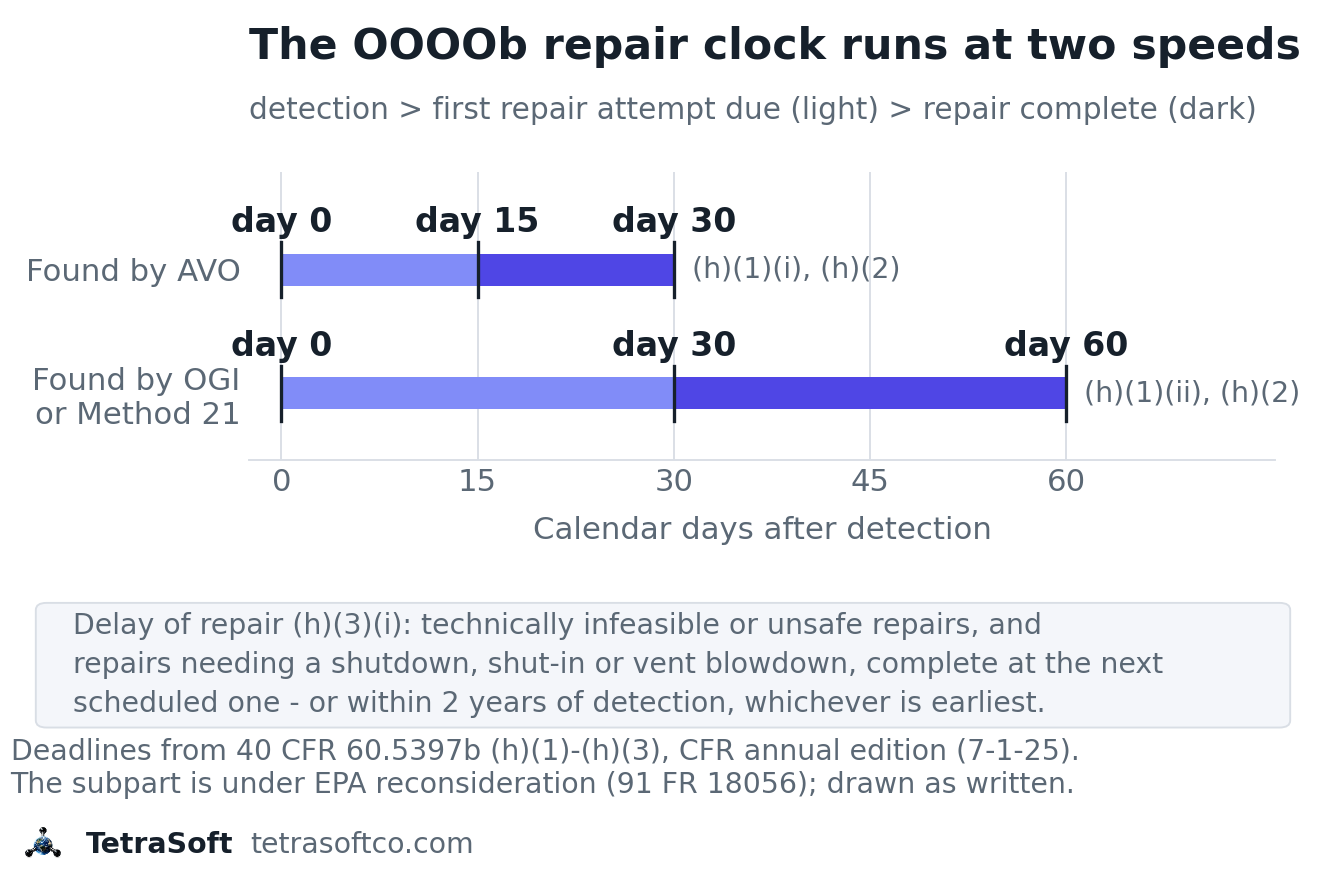
The same leak carries a 15 or a 30 day first attempt deadline depending only on how it was found, and the completion clock doubles the same way. [1]
Delay of repair is permitted in defined circumstances [1]. Where a repair is technically infeasible or unsafe during operation, it may wait for the next scheduled shutdown, shut-in, or vent blowdown [1]. It must happen within two years of detection if that comes first [1]. Tracking that means tracking a two-year horizon per component, against a maintenance schedule.
What to Look for in Emissions Compliance Software
Two properties matter more than any feature list. The first is whether the underlying record is the component or the site. The second is whether the tool can reconstruct what a site looked like on a past date.
Is the Underlying Record the Component or the Site?
A tool that models a site as one row cannot compute the site’s survey frequency. It also cannot tell you which component started a repair clock. Ask what the underlying record actually is.
The same distinction matters beyond OOOOb. Subpart W methods produce unit-level totals without a component breakdown, which is why component-level attribution has to come from the model rather than the report [3]. Our analysis of TEG dehydrator emissions showed how much a single unit-level number can hide.
Your Records Must Reconstruct a Past Site State
OOOOb requires a written fugitive emissions monitoring plan, and that plan must itself specify which records you keep and for how long [1]. It must also state repair schedules and the procedures used to verify that a repair worked [1]. Reporting and recordkeeping then run through the general provisions at section 60.5420b [1].
Retention is the easy half. A defensible record shows what the site looked like when a survey was performed, not only what it looks like now. Tools that overwrite site state in place make that history hard to reconstruct.
Both properties are testable in a demo, and the test is more useful than a feature list. Ask the vendor to show each one on their own data rather than describe it. Each question below maps to an obligation in the rule rather than to a product category.
| Ask the vendor to show you | What it actually tests | The obligation behind it |
|---|---|---|
| A site whose survey frequency changed after equipment was added | Whether frequency is derived from the equipment record or set by hand | Adding one control device or gas-driven pump moves a site from quarterly to bimonthly |
| The component list as it stood on a survey date twelve months ago | Whether site state is versioned or overwritten in place | Records must show what the site looked like when the survey was performed |
| One leak found by AVO beside one found by OGI | Whether the two repair clocks are modeled separately | First attempt is due at 15 days for AVO and 30 days for OGI or Method 21 |
| A repair that was deferred rather than completed | Whether delay of repair carries its outer limit | A deferred repair must still complete within two years of detection, whichever comes first |
| Where the monitoring plan’s retention terms are enforced | Whether the plan is a document or a control | The plan must state which records are kept and for how long |
A tool that cannot show the first two is not tracking OOOOb, whatever else the feature list carries.
The point where a spreadsheet stops working is not a site count. It is where you can no longer rebuild a past site state by hand. One site with stable equipment stays manageable for years. A portfolio whose equipment moves crosses that line well before it becomes large.
Component-Level Modeling Answers Both Questions
MAES models the physical processes inside equipment rather than multiplying an equipment count by a lookup table value [4]. Factor methods assume average throughput, no equipment failures, and stable gas composition [4].
MAES is the Mechanistic Air Emissions Simulator [5]. Its methodology was developed at CSU-METEC [4]. TetraSoft uses it through a partnership with CSU [4]. It is a physics-based model, not a machine learning one [5].
The model works from an equipment inventory, gas composition, and operating parameters [4]. It represents the things that go wrong as well, including stuck dump valves, pressure relief events, and thief hatches left open [4]. It generates an expected emission range for a facility rather than a single value [5]. A site is described by the equipment actually installed on it, at component level [6].
That granularity is the same granularity OOOOb keys its survey frequencies to. A site definition listing controlled storage vessels, control devices, and gas-driven pumps individually already contains what a frequency determination needs. The quantification and the compliance categorization can then draw on one description of the site instead of two.
MAES models and quantifies emissions from these sources, and survey dispatch is not one of its functions. Operators generally pair an inventory model with whatever they use to dispatch and log field surveys. Our standing post on OOOOb/c status for existing sources tracks where each rule sits.
Frequently Asked Questions
Does OOOOb compliance require software?
No specific tool is mandated anywhere in the rule [1]. What the rule requires is a written monitoring plan, surveys at the applicable frequency, repairs inside the deadlines, and records supporting all of it [1]. A single site is manageable by hand, and the case for tooling grows with portfolio size and equipment variety.
Is OOOOb still in effect while EPA reconsiders it?
The rule is on the books and its future is genuinely in question. EPA published a reconsideration in April 2026, and repeal or a stay remains possible [7]. Treat the status as something to re-check before it drives a spending decision.
How is OOOOb different from Subpart W reporting?
They answer different questions and are not substitutes. OOOOb is a performance standard governing what you must monitor, repair, and control at covered facilities [2]. Subpart W is a greenhouse gas reporting program that quantifies annual emissions from petroleum and natural gas systems [3]. EPA is reconsidering whether to suspend Subpart W reporting for RY2025 through RY2034.
Can one equipment inventory serve both OOOOb and Subpart W?
The underlying physical equipment is the same, so the inventory can be shared. What differs is what each program does with it. Maintaining two separate equipment lists is how the two records drift apart.
Regulatory requirements in this sector move faster than most compliance calendars. Subscribe for compliance updates and regulatory news.
This post is for informational purposes only and does not constitute legal or compliance advice. Consult qualified legal counsel or a compliance professional for guidance specific to your operations and jurisdiction.
References
- 40 CFR 60.5397b, What GHG and VOC standards apply to fugitive emissions components affected facilities. https://www.ecfr.gov/current/title-40/chapter-I/subchapter-C/part-60/section-60.5397b
- 40 CFR Part 60, Subpart OOOOb, Standards of Performance for Crude Oil and Natural Gas Facilities for Which Construction, Modification or Reconstruction Commenced After December 6, 2022. https://www.ecfr.gov/current/title-40/chapter-I/subchapter-C/part-60/subpart-OOOOb
- 40 CFR Part 98, Subpart W, Mandatory Greenhouse Gas Reporting: Petroleum and Natural Gas Systems. https://www.ecfr.gov/current/title-40/chapter-I/subchapter-C/part-98/subpart-W
- EPA, Reconsideration of Standards of Performance for New, Reconstructed, and Modified Sources and Emissions Guidelines for Existing Sources: Oil and Natural Gas Sector Climate Review. 91 FR 18056, published April 9, 2026, effective June 8, 2026.
- Mdigo et al., Mechanistic Modeling of TEG Dehydrator Emissions in Oil and Gas Industry, Fuels 7(2), 21, 2026, DOI:10.3390/fuels7020021, EEMDL (UT Austin, Colorado State University, Colorado School of Mines).
- Santos et al., Using Measurement-Informed Inventory to Assess Emissions in the Denver-Julesburg Basin, ACS ES&T Air 2, 1598-1611, 2025, DOI:10.1021/acsestair.5c00089.
- TetraSoft, MAES Platform. https://tetrasoftco.com/maes-platform/maes-landing.html
Interactive tool
OOOOb survey and repair-clock scheduler
The survey cadence is set by what stands on the site; the repair deadline is set by how the leak was found. Pick both and read the schedule the rule assigns, with the paragraph each number comes from.
Survey cadence
Bimonthly AVO + quarterly OGI
- Bimonthly audio, visual and olfactory survey · (g)(1)(iv)(E)
- Quarterly OGI or Method 21 survey, consecutive surveys at least 60 calendar days apart · (g)(1)(iv)(F)
Repair clock
OGI or Method 21 detectionFirst attempt within 30 calendar days of detection ((h)(1)(ii)); repair complete no later than 30 calendar days after the first attempt ((h)(2)).
- Thief hatches and other openings on storage vessels, and all separator dump valves, are visually inspected in conjunction with each survey.
- The quarterly OGI requirement is waived for a quarter whose average month temperature is below 0°F for two of its three months, but never for two consecutive quarters ((g)(4)).
What counts as major production equipment
Any one of these puts a well site or centralized production facility on the bimonthly-AVO, quarterly-OGI tier ((g)(1)(iv)(A)-(D)):
- One or more controlled storage vessels or tank batteries
- One or more control devices
- One or more natural gas-driven process controllers or pumps
- Two or more other pieces of major production and processing equipment
When a repair can wait
- A repair that is technically infeasible, needs a vent blowdown, a compressor station or well shutdown, a well shut-in, or is unsafe during operation completes at the next scheduled shutdown, shut-in or scheduled vent blowdown, or within 2 years of detection, whichever is earliest ((h)(3)(i)).
- An unavailable replacement part must be ordered within 10 calendar days of the first attempt, and the repair completed no later than 30 calendar days after receipt unless it requires a shutdown ((h)(3)(ii)).
- Every repaired component is resurveyed to confirm the repair worked ((h)(4)).
Frequencies and deadlines from 40 CFR 60.5397b, monitoring frequency at (g) and repairs at (h), read against the CFR annual edition (7-1-25). OOOOb is under EPA reconsideration (91 FR 18056, April 9, 2026). This tool describes the rule as written. A starting point, not a compliance determination. Nothing leaves your browser.
Comments
0Share your thoughts. All comments are moderated before appearing.
No comments yet. Be the first to share your thoughts!