A carbon credit is a serialised registry unit representing one metric tonne of carbon dioxide equivalent reduced or removed against a baseline [1]. In oil and gas methane the projects are avoidance rather than removal, meaning gas that would have escaped and did not.
Two project types dominate the sector: plugging orphaned or marginal wells that vent gas [2], and repairing leaks at producing assets [9]. The credit count is set by the baseline estimate rather than by the field work, which surprises most first-time sellers. A credit is the difference between what a source would have emitted and what it emits after the work. Published leak rates for unplugged wells span more than an order of magnitude, so the assumed baseline decides the volume [3].
Quick Answer: Oil and gas methane credits come from plugging orphaned or marginal wells and from leak repair at producing assets [2]. One credit equals one metric tonne of CO2 equivalent [1]. Fossil methane converts at a 100-year GWP of 30 under AR5 [4]. Avoided annual emissions are multiplied by a 20-year crediting period and issued when the well is plugged [5]. The rates a project might assume run from 7.5 grams an hour, which most wells fall below, to a 198 gram national mean [3].
Two Project Types Produce Oil and Gas Methane Credits
Oil and gas methane crediting splits into stopping a well venting and stopping equipment leaking. The two are accounted for differently, because plugging is permanent and a repair can fail again. Roughly 3.6 million abandoned wells in the United States emit 0.23 to 2.6 teragrams of methane a year [3]. That range is the market’s supply side.
The American Carbon Registry published the first dedicated methodology in May 2023, covering the United States and Canada [5]. The registry made that version inactive on 9 May 2025, to update requirements so they applied consistently across diverse sites [5].
Version 2.0 remains in development, and ACR still gives 2026 as the publication target [6]. The update had not opened for public comment or entered scientific peer review by 9 September 2026 [6]. ACR continues to accept project listings until version 2.0 publishes, and those projects must validate against the new version [6].
The Climate Action Reserve is separately developing an early plugging protocol for marginal wells in the United States [7]. Its public comment draft was released on 14 September 2026, with comments open through 14 October 2026 [7].
Public Money Is Already Plugging These Wells at Scale
The largest plugging program in the country is federal, and the Interior Department reports it supported 6,443 jobs and $934.5 million in economic contribution over FY22 and FY23 [8]. Section 40601 of the Bipartisan Infrastructure Law provides 4.677 billion dollars for orphaned well plugging, remediation and restoration [8]. Of that, 4.275 billion dollars goes to states for wells on state and private land [8].
The program is well past pilot scale [8]. States and federal bureaus reported 9,002 orphaned wells plugged with those funds through 30 June 2024 [8]. The work continues against an inventory of 141,959 documented orphan wells reported by 29 states as of 31 December 2023 [8].
The unmeasured population is larger than the measured one [8]. The Interstate Oil and Gas Compact Commission estimates a further 250,000 to 740,000 undocumented orphaned wells [8]. Undocumented wells cannot be credited, because a project has to identify the source it is abating.
What Additionality Requires When a Grant Would Have Paid
A credit has to fund something that would not have happened anyway [1]. A well already scheduled for plugging under a state grant fails that test on its face. The size of the federal program therefore narrows the crediting pool rather than widening it.
The remaining pool is the wells public money is not reaching. That is a smaller and less well characterised set than the headline well count suggests.
Leak repair at producing assets sits on firmer ground with buyers. The Integrity Council for the Voluntary Carbon Market has awarded its high-integrity CCP label to AM0023 version 4.0 [9]. That methodology covers leak detection and repair across the gas value chain [9]. Well plugging sits a step behind it, with methodologies in active revision at both registries.
How Many Credits One Avoided Leak Is Worth
The arithmetic starts short: a leak rate times hours of operation, converted from methane mass to carbon dioxide equivalent. A well leaking 13 grams of methane an hour releases about 114 kilograms a year [3]. At a global warming potential of 30, that is roughly 3.4 tonnes of CO2 equivalent a year [4].
Which Global Warming Potential Applies to Vented Methane
Vented methane from a well or a leaking component takes the fossil value, not the general one [4]. The fossil figure includes extra radiative forcing from carbon dioxide formed when that methane oxidises [4].
| 100-year GWP | AR4 | AR5 | AR6 |
|---|---|---|---|
| Methane, non-fossil | 25 | 28 | 27.0 |
| Methane, fossil | not given | 30 | 29.8 |
Moving one project from AR4 to AR5 fossil raises its credit count by a fifth [4]. No molecule changed.
How Many Years a Plugged Well Is Credited For
A plugged well is credited for decades at once, not year by year [5]. Under the inactive version 1.0, the American Carbon Registry set a single non-renewable crediting period of twenty years [5]. Credits for all twenty years are eligible for issuance in the year the well is plugged [5]. The methodology’s Equation 2 multiplies the annual avoided emissions by 20 directly [5].
| Methodology | Crediting period | Baseline treatment |
|---|---|---|
| American Carbon Registry (v1.0, inactive) | 20 years | Measured rate held flat |
| CarbonPath | 50 years | Measured rate held flat |
| BCarbon | 20 years | Declines from the last production rate |
| Open Carbon Protocol | 20 years | Declines at a rate set by emitter class |
The American Carbon Registry row is from its own methodology; the other three rows are as characterised in the Payne Institute’s review. [10] CarbonPath sets the longer period against a lower starting rate, because it credits a measured current leak rate rather than a leak potential [10]. BCarbon instead forecasts from the last known production rate and takes a probability-weighted average of two leak scenarios [10]. Open Carbon Protocol assigns its decline rate by emitter class rather than well by well [10].
That version also applied a haircut: projects had to take a 5 per cent uncertainty deduction from quantified reductions [5]. Eligibility separately requires sampling precision within 10 per cent of the mean at 90 per cent confidence [5]. The estimator below applies both to a rate you supply.
The Baseline Estimate Decides the Credit Volume
Baseline choice moves credit volumes further than any other input in a methane project. RMI’s technical explainer identifies four approaches in use across methodologies [2]. They are flat-rate extrapolation of a current measurement, terminal decline, decline curve modelling, and volumetric analysis [2]. Its verdict is blunt: all of them involve uncertainty [2].
A Payne Institute study of 14,000 wells put terminal decline rates between 2.9 and 9.4 per cent [10]. The band is a 20th-to-80th percentile spread around a 6.4 per cent average, not an absolute range [10]. Open Carbon Protocol assigns 4.9 to 7.3 per cent by emitter class, and BCarbon sets the rate well by well [10].
A Single Visit Cannot Pin a Rate That Moves
The measurements feeding those baselines are less stable than a single number suggests. A 2025 study measured one orphaned well near Hobbs, New Mexico at 9.00 kilograms of methane an hour during a controlled venting operation [3]. That was 71 per cent above the 5.3 kilograms measured at the same well seven months earlier [3].
Venting an orphaned well is how its potential emissions get calculated for crediting under registry guidance [3]. The 9.00 figure is therefore a crediting input rather than the rate the well leaks when left alone. That same well’s persistent leak, through its surface casing, was 0.43 to 0.67 kilograms an hour [3]. A baseline drawn from the vent is more than an order of magnitude above the one drawn from the leak.
The authors conclude that wells need periodic revisits for accurate annual estimates [3]. Under a flat-rate method, the earlier visit would have set the baseline for all twenty credited years. One afternoon of fieldwork would have priced two decades of the asset.
Population averages fare worse than a single visit, because the distribution they average is skewed. Most abandoned wells emit under 7.5 grams of methane an hour [3]. The commonly cited average is about 13 grams, and the estimated US mean is 198 [3]. Those three assumptions turn one plugged well into 37, 65 or 989 issued credits [3].
A 26-fold spread on the headline product is not a rounding problem. It is why registries push toward well-specific measurement. Background on how these wells are identified sits in Abandoned Gas Wells: What They Are and Where to Find Them.
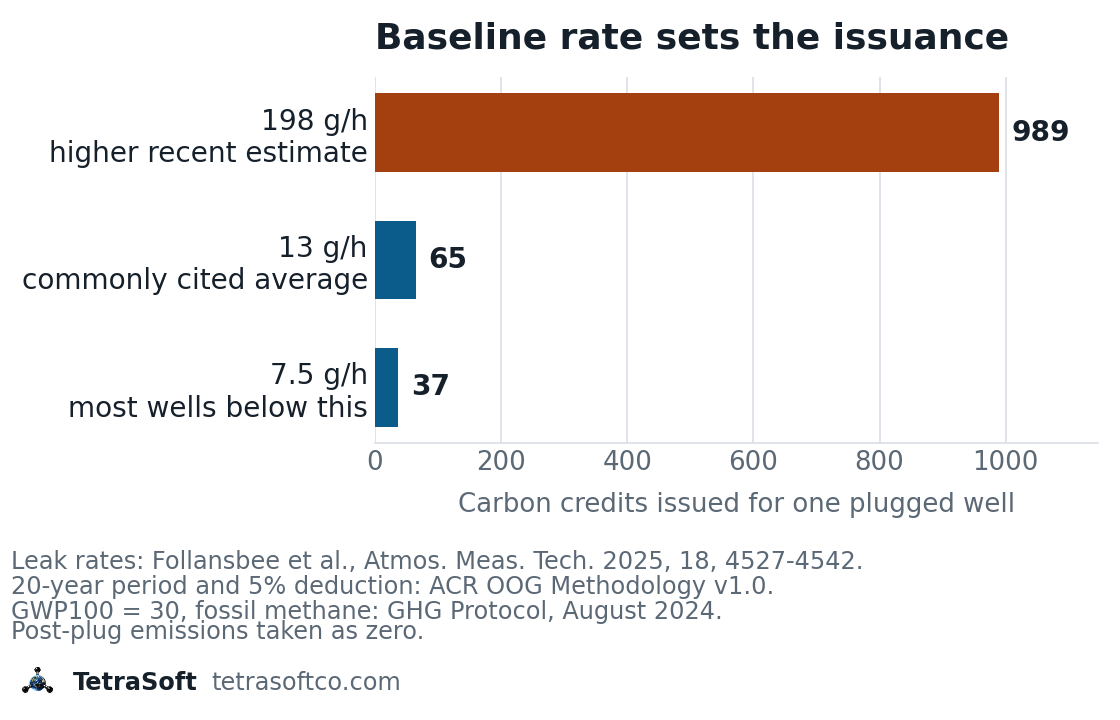
Figure 1. One well, three assumed baseline rates, three very different issuances [3].
Method matters as much as frequency. The same 2025 study reports 15 per cent accuracy when dispersion parameters are determined on site, against a standard practice of assuming a stability class [3].
A baseline is not a measurement. It is a claim about what a source would have emitted, which makes it a modelling problem rather than a sampling one.
Read the registry’s two numbers together. The registry’s own eligibility bar is a sampled mean good to 10 per cent at 90 per cent confidence [5]. The well near Hobbs moved 71 per cent between two visits seven months apart [3]. One visit cannot demonstrate that precision on a source that moves that far.
Where a Modelled Range Fits
What clears the bar is a distribution rather than a single number. MAES does not model an orphaned well, so the plugging case is not its job. It models producing facilities, which is the other half of this market.
MAES is a mechanistic emissions model developed at CSU and UT Austin [11]. TetraSoft uses it through a partnership with CSU [11]. It generates an expected emission range for operating equipment [11].
A Measurement-Informed Inventory anchors that range to field measurement [11]. Neither half produces one alone. Your 989-credit well and your 37-credit well may be the same well [3]. The difference is which baseline you can defend when a validator asks.
What the Federal Measurement Program Found
Federal pre-plugging measurements found most orphaned wells barely leaking and a minority carrying the mass [8]. It is the largest such dataset I have found published [INFERENCE - the cited report does not claim primacy, and I found no source that does]. Methane detection tests were made at 1,446 wells before plugging, and about a quarter produced detectable quantities [8].
Roughly 85 per cent were leaking less than 1 gram of methane an hour [8]. Roughly 90 per cent were leaking less than 10 grams an hour [8].
The averages sit nowhere near those figures [8]. Wells with detectable methane averaged about 296 grams an hour [8]. Across the whole 1,446-well dataset the average was about 70 grams an hour [8].
An average of 70 against a majority under 1 is the shape of the problem. The mean describes a population almost none of whose members resemble it.
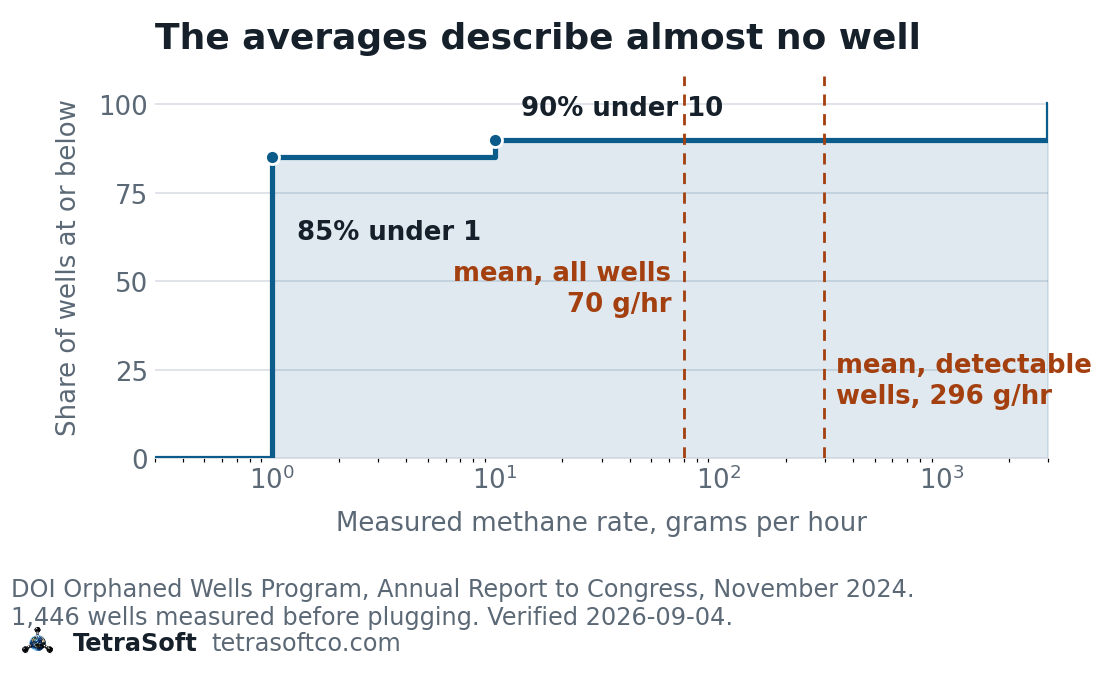
Figure 2. Most wells emit almost nothing; the averages are set by the few that do not. [8]
Why a Population Average Cannot Set a Baseline
A skewed distribution makes the average the wrong statistic to credit against. Applying 70 grams an hour to a well leaking under 1 would issue credits for abatement that never occurred. Applying it to a 296 gram well would under-issue against real abatement.
Well-specific measurement is the only route that survives either direction. It is also what the registries have been moving toward.
Frequently Asked Questions
Why is the crediting period twenty years?
The American Carbon Registry set a single non-renewable period of twenty years [5]. That length reflects Enverus oilfield data showing that wells states currently classify as orphaned last produced 17 years ago on average [5]. The registry says it will update the methodology as data on well degradation and decline curves improves [5].
Can an operator sell credits for methane it is already required to control?
No. Registry methodologies apply a regulatory surplus test, which excludes reductions that law already compels. A repair mandated by a federal or state rule is not additional, so it cannot be credited. The same abatement can still appear in an emissions inventory, because reporting and issuance are separate systems.
Do carbon credits count toward GHGRP or OGMP 2.0 reporting?
No. A carbon credit is issued by a registry only after independent third-party validation and verification [9]. Selling a credit does not change the inventory figure, and reporting an inventory does not create a credit. The reporting side is covered in OGMP 2.0 Level 4 and Level 5 Reporting Explained.
What happens to credits already issued under a methodology that is later withdrawn?
They remain valid. When the American Carbon Registry made its orphaned well methodology inactive, it said issued credits were unaffected [5]. Projects holding approved measurement method forms could complete verification under the withdrawn version [5]. Withdrawal closes a methodology to new entrants rather than reversing past issuance.
Does a plugged well need monitoring after the credits are issued?
That is the permanence question, and it is why plugging is treated differently from repair. Under version 1.0 the American Carbon Registry issued all twenty years of credits in the year the well was plugged [5]. Issuing decades of credits at once puts the weight on the pre-plugging measurement rather than on later monitoring.
This post is for informational purposes only and does not constitute legal or compliance advice. Consult qualified legal counsel or a compliance professional for guidance specific to your operations and jurisdiction.
Screening the well population is where a plugging project starts. TetraSoft Atlas, a subscription data platform, maps New Mexico’s 3,095 orphaned and abandoned wells from NMOCD records [12]. Of those, 497 are true orphans with no responsible operator [12]. Each well carries its status and its operator, so a candidate list can be filtered before anyone drives out [12]. Contact us to see the inventory behind a candidate list.
Disclosure: Arthur Santos, the author of this post, is lead author of the Santos et al. (2025) study cited here.
References
- Integrity Council for the Voluntary Carbon Market. Core Carbon Principles, Assessment Framework and Assessment Procedure, Version 1.1, 15 May 2024. Glossary definition of “carbon credit”. https://icvcm.org/wp-content/uploads/2024/02/CCP-Book-V1.1-FINAL-LowRes-15May24.pdf
- RMI. Technical Explainer: Orphaned Oil and Gas Well Carbon Credits. 31 March 2026. https://rmi.org/resources/technical-explainer-orphaned-oil-and-gas-well-carbon-credits/
- Follansbee, E., Lee, J. E., Dubey, M. L., Dooley, J. F., Shuck, C., Minschwaner, K., Santos, A., Biraud, S. C., and Dubey, M. K. “Orphaned oil and gas well methane emission rates quantified using Gaussian plume inversions of ambient observations.” Atmospheric Measurement Techniques, 18, 4527-4542, 2025. https://doi.org/10.5194/amt-18-4527-2025
- Greenhouse Gas Protocol. Global Warming Potential Values. August 2024. https://ghgprotocol.org/sites/default/files/2024-08/Global-Warming-Potential-Values%20%28August%202024%29.pdf
- American Carbon Registry. Methodology for the Quantification, Monitoring, Reporting and Verification of Greenhouse Gas Emission Reductions and Removals from Plugging Orphaned Oil and Gas Wells in the US and Canada, Version 1.0. Published 24 May 2023; made inactive 9 May 2025. https://acrcarbon.org/wp-content/uploads/2023/05/ACR-OOG-v1.0-2024-04-19.pdf
- American Carbon Registry. Plugging Orphaned Oil and Gas Wells, Version 2.0 (in development). https://acrcarbon.org/methodology/plugging-orphaned-oil-and-gas-wells-2/. Accessed 9 September 2026.
- Climate Action Reserve. U.S. Early Plugging of Marginal Oil and Gas Wells Protocol (in development). https://climateactionreserve.org/how/protocols/waste/early-plugging-of-marginal-oil-and-gas-wells/dev/. Accessed 9 September 2026.
- U.S. Department of the Interior, Orphaned Wells Program Annual Report to Congress, November 2024. Orphaned Wells Program Office, Bipartisan Infrastructure Law Section 40601. https://www.doi.gov/sites/default/files/documents/2024-11/fy-2024-owpo-annual-congressional-reportfinal-publishing.pdf
- Integrity Council for the Voluntary Carbon Market. Core Carbon Principles and CCP Assessment Status. https://icvcm.org/assessment-status/
- Handler, B. Orphan Well Carbon Crediting Methodologies: A Review of Quantification Practices and Proposal to Incorporate Leak Forecasting. Payne Institute for Public Policy, Colorado School of Mines, Commentary, 25 June 2026. https://payneinstitute.mines.edu/orphan-well-carbon-crediting-methodologies-a-review-of-quantification-practices-and-proposal-to-incorporate-leak-forecasting-2/
- Santos, A., Mollel, W., Duggan, G. P., Hodshire, A., Vora, P., and Zimmerle, D. “Using Measurement-Informed Inventory to Assess Emissions in the Denver-Julesburg Basin.” ACS ES&T Air, 2025, 2 (8), 1598-1611. https://doi.org/10.1021/acsestair.5c00089
- TetraSoft Atlas, New Mexico orphaned and abandoned well inventory, from EMNRD OCD (NMOCD) records. https://www.tetrasoftco.com/atlas
Interactive tool
Methane abatement credit estimator
Enter a measured leak rate. The three settings beside it are conventions, not measurements, and they move the result further than the plugging work does.
Credits issued
65
tonnes CO2e over 20 credited years
Enter a leak rate above zero and a whole number of wells.
The same settings, applied to three published population rates
| Baseline rate | Basis | Credits |
|---|---|---|
| 7.5 g/h | Most abandoned wells below | 37 |
| 13 g/h | Commonly cited average | 65 |
| 198 g/h | Higher recent estimate | 989 |
Follansbee et al., Atmospheric Measurement Techniques 2025, 18, 4527-4542
What this estimate assumes
- Emissions after plugging are taken as zero, the PP term in the registry's Equation 2. A leaking plug is a permanence question, not a baseline one. American Carbon Registry, Plugging Orphaned Oil and Gas Wells Methodology v1.0
- The leak rate is held flat across the whole crediting period, which is how the flat-rate methodologies treat it. A decline method returns less. American Carbon Registry, Plugging Orphaned Oil and Gas Wells Methodology v1.0
- Vented well gas is fossil methane, so it takes the fossil GWP row rather than the more familiar non-fossil value. Greenhouse Gas Protocol, Global Warming Potential Values, August 2024
- Eligibility separately requires sampling precision within 10% of the mean at 90% confidence. That is a gate on the measurement, not a factor in this arithmetic. American Carbon Registry, Plugging Orphaned Oil and Gas Wells Methodology v1.0
An estimate of issuance under a flat-rate methodology, not a project valuation and not a verification. A registry, a validator and a buyer each apply their own tests. Nothing leaves your browser.
Comments
0Share your thoughts. All comments are moderated before appearing.
No comments yet. Be the first to share your thoughts!