Capturing carbon dioxide only cuts emissions if the gas then stays out of the atmosphere. Injecting it into deep rock formations is one way to keep it there. EPA describes Class VI wells as wells that “inject carbon dioxide for long-term storage to reduce emissions to the atmosphere.” [1] The carbon dioxide can come from steel and cement plants, ethanol and hydrogen production, power plants, or directly from the air [1].
A federal tax credit, section 45Q, pays $17 a tonne in 2025 and 2026 for facilities placed in service after 2022, adjusted for inflation afterwards [2]. Projects meeting its wage and apprenticeship rules, or begun before those rules applied, earn five times that [2].
A well injecting carbon dioxide specifically for geologic storage needs a Class VI permit [3]. The permit sits in the Underground Injection Control (UIC) program, whose main goal is protecting underground sources of drinking water [1]. Earning one means filing a long, technical application. EPA’s own auditors found that two-thirds of the final decisions estimated for 2024 were expected to miss the agency’s two-year goal [4].
This post is for developers, operators and their advisers preparing an application. The guide covers what the application must contain, how EPA reviews it stage by stage, and why reviews overrun. The last section covers what changes in the six states that issue their own Class VI permits.
Quick Answer: A Class VI application must supply what EPA’s rule lists in twenty-one items at 40 CFR 146.82(a), some only at the Director’s request [5]. They include a site characterization, five project plans and a demonstration of financial responsibility [5]. EPA reviews it in stages: completeness, technical review, a draft permit, public comment, then a final decision [1]. North Dakota, Wyoming, Louisiana, West Virginia, Arizona and Texas issue their own Class VI permits [6]. In those states Class VI reports still go to EPA electronically [7].
This post is for informational purposes only and does not constitute legal or compliance advice. Consult qualified legal counsel or a compliance professional for guidance specific to your operations and jurisdiction.
What a Class VI Application Must Put in Front of the Permitting Authority
The application includes a site characterization, a well design and six standing commitments, all filed before a permit to construct the well issues [5]. The rule calls the official who reviews it the Director [8]. Where there is no approved state or tribal program, “Director” means the EPA Regional Administrator [8]. In a state with an approved program, it normally means the state director [8].
The contents are set by 40 CFR 146.82, a section of EPA’s UIC technical rules [5]. Section 146.82 lists what the Director must consider before authorizing a Class VI well [5]. Its twenty-one categories include maps, geologic data, construction plans, the five project plans and financial responsibility [5].
The applicant files a map of the area of review showing the wells, boreholes, mines and other features of public record inside it [5]. Producing wells, abandoned wells, dry holes, deep stratigraphic boreholes, mines and water wells all appear on it [5]. Cross-sections, formation properties, fault orientations, geomechanical data, the seismic history and baseline geochemistry come with it [5].
Siting is the gate underneath all of it. The injection zone must have enough areal extent, thickness, porosity and permeability to receive the total anticipated volume of carbon dioxide [9]. The confining zone above it must be free of transmissive faults or fractures, and able to hold that volume without fracturing [9]. Where the geology will not support that demonstration, no amount of planning substitutes for it.
The demonstration is built from field data. For the injection and confining zones, the rule lists geologic cores, outcrop data, seismic surveys and well logs as field data the application may use [5].
During drilling and construction, the operator must run a required suite of logs and take cores of the injection zone and confining system [10]. A pressure fall-off test and a pump or injectivity test follow [10]. Where existing data are lacking, EPA’s guidance says they will likely come from testing the finished well or from drilling a stratigraphic test well [11].
Six commitments travel with the geology [5]. Four are plans: area of review and corrective action, testing and monitoring, injection well plugging, and post-injection site care and site closure [5]. An emergency and remedial response plan is the fifth, and a demonstration of financial responsibility is the sixth [5].
Each of the five plan sections carries the same sentence [12]. The requirement to maintain and implement the plan is directly enforceable whether or not it is a permit condition [12].
The financial instrument has to cover four activities [13]. Those are corrective action, injection well plugging, post-injection site care and site closure, and emergency and remedial response [13]. The Director approves the demonstration before the permit issues, and the operator adjusts its cost estimate for inflation every year [13].
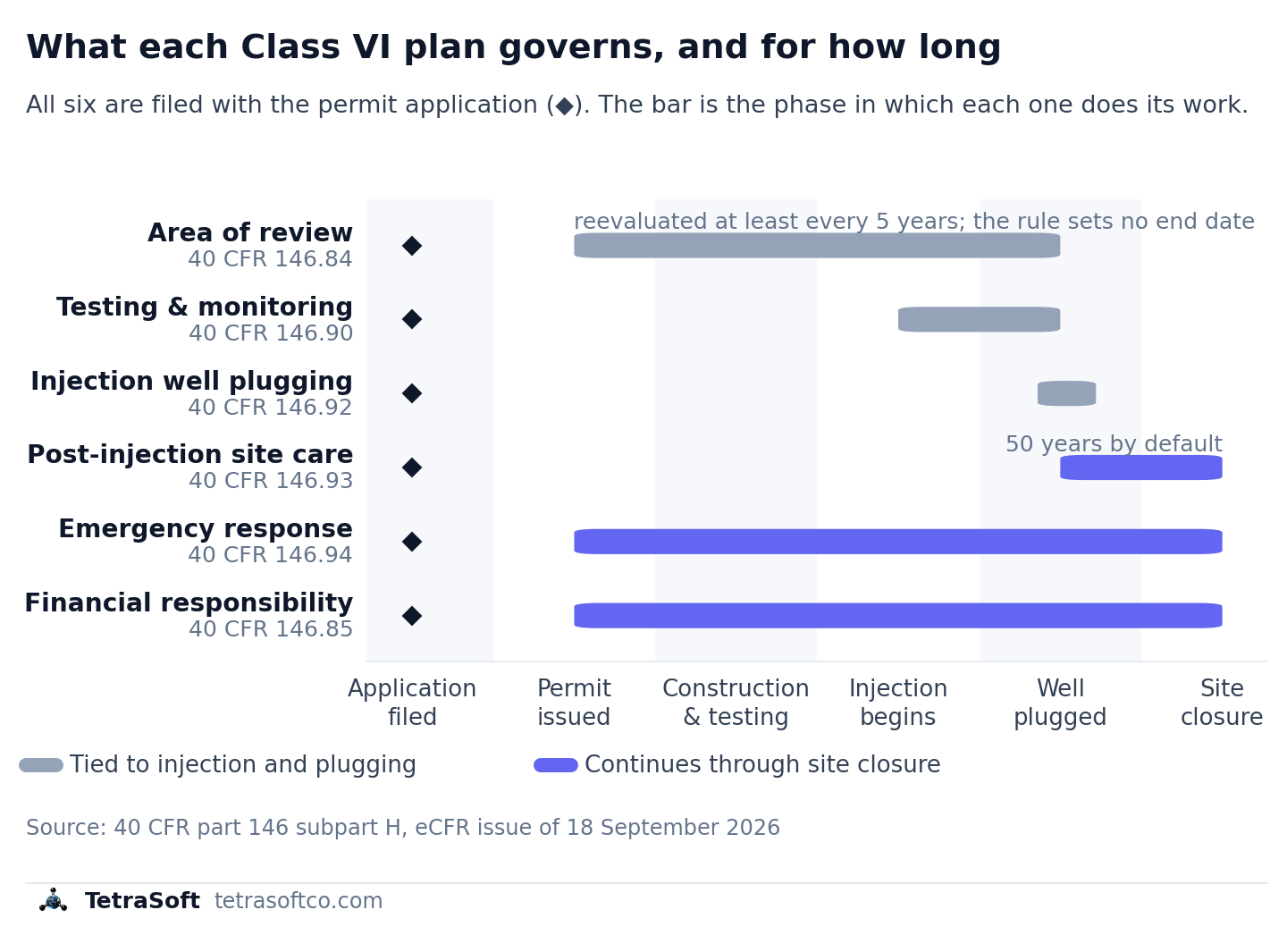
Post-injection site care, emergency response and financial responsibility run through site closure, fifty years past injection by default. [14] Testing, monitoring and plugging continue until the well is plugged. [12]
The Area of Review Is Where Applications Stall
The area of review is not a fixed radius [15]. The boundary encloses the region where underground sources of drinking water may be endangered by the injection [15]. Inside it the applicant must identify all penetrations, including wells and underground mines, that may reach the confining zone [15].
Active and abandoned wells count, and so do underground mines [15]. Each well needs its own description: type, construction, date drilled, location, depth, and the record of plugging or completion [15]. The applicant then determines which abandoned wells were plugged in a way that will actually stop carbon dioxide moving [15].
That determination is not made once [15]. The reevaluation repeats at a fixed frequency that cannot exceed five years, inside a boundary the model redraws each time [15]. Corrective action follows on all wells the reevaluation finds need it [15].
No records platform delineates an area of review for anyone. Section 146.84, the rule’s area of review and corrective action section, requires the boundary to be delineated by computational modeling [15]. The model must predict how far the carbon dioxide plume and its pressure front will spread [15]. That is reservoir engineering rather than a database query.
The tabulation underneath it is the other kind of work, and it is where state record systems bite.
Across state lines, TetraSoft Atlas, our subscription well-records platform, shows well status and operator records for seven of eight states. In New Mexico the map shows each well’s location and production, but not its status or operator name [16]. We plan to expand Atlas to every US state [17].
A penetration missed at application is one the technical review may find instead. The gap comes back as a formal request for additional information.
Whether an old wellbore was plugged in a way that holds is a separate search. Abandoned Gas Wells: What They Are and Where to Find Them covers where those records sit.
The Plans You File Are the Ones You Live Under
A Class VI permit does not run for a fixed term [18]. The permit runs for the operating life of the facility and the post-injection site care period [18]. That period lasts at least fifty years after injection unless the Director approves a different one, and continues until drinking water is no longer endangered [14]. No other well class has a UIC permit term that includes a post-injection site care period [18].
The rule sets minimum intervals inside that span, and the Director can require more frequent testing [19]. External mechanical integrity has to be demonstrated at least once a year until the well is plugged [19]. A pressure fall-off test is due at least every five years, and corrosion monitoring runs quarterly [19]. Routine reports are due semi-annually [7].
The tool below turns three project numbers into the schedule those minimum intervals produce.
How EPA Reviews the Application, Stage by Stage
EPA reviews a Class VI application in named steps, and the technical review is not the first [1]. The completeness review comes first [1]. That step decides whether the application is complete; whether the project is sound is the technical review’s question [1]. An application has no effective date until the Regional Administrator notifies the applicant in writing that it is complete [20].
| Stage | What it decides | The clock |
|---|---|---|
| Completeness review | Whether the application contains everything the rule requires | Typically 30 days where no Notice of Deficiency is needed |
| Notice of Deficiency | What is missing before the application can be deemed complete | Runs until the applicant supplies it |
| Technical review | Whether the project can be built and operated without endangering drinking water | No fixed period; EPA’s project decision schedule sets target dates, within a 24-month goal |
| Request for additional information | Questions raised during the technical review | EPA asks for a response within 30 days, or an alternative timeline |
| Draft permit and public comment | The conditions the well would operate under | At least 30 days of public comment |
| Final permit decision | Whether the permit issues, with responses to the comments | Effective 30 days after notice is served, unless 40 CFR 124.15(b) sets another date |
The six review steps, with the intervals EPA’s rules and its Class VI page attach to them. [1] [21] [22]
The technical review then examines each element of the application, in a review EPA describes as multidisciplinary [23]. The reviewers draw on geology, hydrogeology, modeling, well engineering, finance and risk analysis [23]. Questions raised during it go out as formal requests for additional information, and slow answers extend the overall review [1].
If the technical review finds the application meets the Class VI Rule, a draft permit follows [1]. The draft carries the project plans as enforceable permit conditions [1]. EPA then prepares the final permit with a document responding to the comments received [1].
Public notice of the draft permit must allow at least 30 days for comment [21]. The final decision then takes effect 30 days after notice of it is served, unless the decision names a later date or review is requested [22]. The decision takes effect immediately if no comment asked for a change [22].
A Permit Is Not an Authorization to Inject
Holding the permit lets an operator build the well, not use it [1]. The permittee constructs the well and runs the pre-operational testing the permit requires [1]. The test results go in before anything is injected [1]. So does the final area of review, recomputed on the data the logging and testing actually produced [5].
The Director then issues an authorization to inject [1]. Where the new data changes the permit conditions, the phase becomes a major modification instead, with a further public comment period [1]. A thin site characterization makes a second comment period this late more likely.
Two Years Is the Goal, and EPA’s Auditors Measured the Miss
EPA told Congress in October 2022 that a complete Class VI application should yield a permit in about two years [23]. The Agency repeated that as a 24-month goal in December 2023 guidance to its regions [4]. The estimate was not measured on Class VI permits, for which EPA had limited timing data [23]. The figure came from Class I permits, which are similar in regulatory structure and in the site-specific data they demand [23].
In a July 2025 report, EPA’s Office of Inspector General measured that goal against the tracker as it stood in December 2023 [4]. Of 36 applications with estimated final decisions in 2024, 24, or nearly 67 percent, were expected to land beyond 24 months [4]. Their estimated issue dates ran from 30 to 374 days past the goal, averaging 212 days [4]. Three regions told the auditors they lacked the budget, staff or technical capacity to meet it [4].
The completeness step slips too, although EPA says completeness determinations typically take 30 days [1]. Of 138 applications under review in May 2024, EPA had made completeness determinations on 136 [4]. Forty percent of those determinations took longer than the 30 days the rule specifies [4]. An application not yet deemed complete has no effective date, so its technical review has not begun.
EPA’s own Class VI permit tracker covers the applications currently under review at EPA itself [24]. Projects in the six primacy states have transferred to those states and are not tracked there [24]. An applicant watches the queue of whoever holds the program.
What Changes When a State Issues the Permit Instead of EPA
Primacy moves who issues the permit, not the technical bar [25]. Once EPA approves a state program, it suspends the issuance of federal permits for the activities that program covers [26].
Six states issue their own Class VI permits today [6]. North Dakota gained primacy in 2018 and Wyoming in 2020 [6]. Louisiana followed in February 2024, West Virginia in March 2025, Arizona in October 2025 and Texas in December 2025 [6].
UIC Well Classes: Class II, Class VI, and Where to Look shows where each state’s permits are filed. A state program need not copy the federal provisions word for word [27]. The state must establish requirements at least as stringent as the ones it replaces [27].
Trading is not allowed either [27]. A state may not make one requirement more lenient as a tradeoff for making another more stringent [27]. A state may instead go further in both directions, adopting requirements more stringent or more extensive than the federal floor [26].
Some Procedural Rules Carry Over, and the Federal Appeal Does Not
Only selected paragraphs of the federal permitting procedure in part 124 follow the program into the state [27]. A state program must have legal authority for the application, draft permit and fact sheet provisions of 40 CFR part 124 [27]. Public notice, comments and hearing requests, hearings, and the response to comments are on the same list [27]. That list is where a state’s public comment period comes from [27].
Several part 124 provisions are absent from it, including the permit effective-date rule and the appeal to the Environmental Appeals Board [27]. An EPA-issued Class VI permit is appealed by petitioning the Environmental Appeals Board within 30 days of the final decision notice [28]. That route belongs to EPA-issued permits. A state-issued Class VI permit is challenged through that state’s own administrative and judicial process instead.
You Still File With EPA in a Primacy State
Electronic submission to EPA survives primacy [7]. Owners and operators must submit all reports, submittals and notifications under the Class VI rules to EPA electronically [7]. EPA’s Geologic Sequestration Data Tool is the system that satisfies it [1]. Users reach it with a Login.gov account registered with EPA [29].
Primacy does not move this obligation, and it is easy to miss. An operator in a primacy state deals with two systems rather than one.
Frequently Asked Questions
Do I need a separate Class VI permit for every well?
Yes. EPA requires an individual application and permit for each Class VI well, not one per project [24]. Its public tracker groups wells by project for ease of viewing [24]. A four-well storage project is four applications.
What does a Notice of Deficiency mean for my application?
A Notice of Deficiency means EPA has found required information missing, and the application is not complete until you supply it [1]. Until EPA confirms completeness in writing, the application has no effective date [20]. EPA also asks applicants not to revise a submitted application without its direction [1].
Can the post-injection site care period be shorter than 50 years?
Yes, by two routes: an alternative timeframe approved during permitting, or later monitoring showing non-endangerment, which lets the Director authorize earlier closure [14]. The Director may approve an alternative timeframe, in consultation with EPA, where site-specific data support it [14].
What is EPA primacy for Class VI wells?
Primacy means a state runs the Class VI permit program in place of EPA, once EPA approves it [26]. EPA then suspends federal permits for the activities that program covers [26]. State rules must be at least as stringent, and operators still submit Class VI reports to EPA electronically [27]. [7]
What are Class II wells, and how do they differ from Class VI?
Class II wells inject fluids tied to oil and gas production, including for enhanced recovery [30]. Class VI wells inject carbon dioxide for long-term storage [3]. Storing carbon dioxide in an oil or gas reservoir as the main purpose needs Class VI once the Director finds higher risk to drinking water [31].
Get regulatory updates and emissions data insights in your inbox. Subscribe to the TetraSoft newsletter.
References
- EPA, Class VI wells used for geologic sequestration of carbon dioxide. https://www.epa.gov/uic/class-vi-wells-used-geologic-sequestration-carbon-dioxide
- 26 U.S.C. 45Q, Credit for carbon oxide sequestration. https://www.govinfo.gov/link/uscode/26/45Q?link-type=html
- 40 CFR 146.81, Applicability of the Class VI requirements. https://www.ecfr.gov/current/title-40/chapter-I/subchapter-D/part-146/subpart-H/section-146.81
- EPA Office of Inspector General, Report 25-E-0045, 28 July 2025. https://www.epa.gov/sites/default/files/oig/documents/_epaoig_20250728-25-e-0045_cert.pdf
- 40 CFR 146.82, Required Class VI permit information. https://www.ecfr.gov/current/title-40/chapter-I/subchapter-D/part-146/subpart-H/section-146.82
- 40 CFR part 147, approved Class VI programs of North Dakota, Wyoming, Louisiana, West Virginia, Arizona and Texas. https://www.ecfr.gov/current/title-40/chapter-I/subchapter-D/part-147
- 40 CFR 146.91, Reporting requirements. https://www.ecfr.gov/current/title-40/chapter-I/subchapter-D/part-146/subpart-H/section-146.91
- 40 CFR 144.3, Definitions. https://www.ecfr.gov/current/title-40/section-144.3
- 40 CFR 146.83, Minimum criteria for siting. https://www.ecfr.gov/current/title-40/chapter-I/subchapter-D/part-146/subpart-H/section-146.83
- 40 CFR 146.87, Logging, sampling, and testing prior to injection well operation. https://www.ecfr.gov/current/title-40/section-146.87
- EPA, Site Characterization Guidance for Class VI Wells, EPA 816-R-13-004. https://www.epa.gov/sites/default/files/2015-07/documents/epa816r13004.pdf
- 40 CFR part 146 subpart H, Criteria and Standards Applicable to Class VI Wells. https://www.ecfr.gov/current/title-40/chapter-I/subchapter-D/part-146/subpart-H
- 40 CFR 146.85, Financial responsibility. https://www.ecfr.gov/current/title-40/chapter-I/subchapter-D/part-146/subpart-H/section-146.85
- 40 CFR 146.93, Post-injection site care and site closure. https://www.ecfr.gov/current/title-40/chapter-I/subchapter-D/part-146/subpart-H/section-146.93
- 40 CFR 146.84, Area of review and corrective action. https://www.ecfr.gov/current/title-40/chapter-I/subchapter-D/part-146/subpart-H/section-146.84
- TetraSoft Atlas, New Mexico well panel checked 30 September 2026. The panel shows API, county, location and production; the operator name and status are in the data but not displayed. https://www.tetrasoftco.com/atlas-landing.html
- TetraSoft Atlas, well and injection records across eight states. https://www.tetrasoftco.com/atlas-landing.html
- 40 CFR 144.36, Duration of permits. https://www.ecfr.gov/current/title-40/chapter-I/subchapter-D/part-144/subpart-D/section-144.36
- 40 CFR 146.90, Testing and monitoring requirements. https://www.ecfr.gov/current/title-40/chapter-I/subchapter-D/part-146/subpart-H/section-146.90
- 40 CFR 124.3, Application for a permit. https://www.ecfr.gov/current/title-40/chapter-I/subchapter-D/part-124/subpart-A/section-124.3
- 40 CFR 124.10, Public notice of permit actions and public comment period. https://www.ecfr.gov/current/title-40/chapter-I/subchapter-D/part-124/subpart-A/section-124.10
- 40 CFR 124.15, Issuance and effective date of permit. https://www.ecfr.gov/current/title-40/chapter-I/subchapter-D/part-124/subpart-A/section-124.15
- EPA, Class VI Permitting Report to Congress, October 2022. https://www.epa.gov/system/files/documents/2022-11/EPA%20Class%20VI%20Permitting%20Report%20to%20Congress.pdf
- EPA, UIC Class VI Permit Tracker, 28 September 2026. https://www.epa.gov/uic/current-class-vi-projects-under-review-epa
- EPA, Class VI final rule, 75 FR 77230, 10 December 2010. https://www.federalregister.gov/d/2010-29954
- 40 CFR 145.1, Purpose and scope of State UIC program requirements. https://www.ecfr.gov/current/title-40/chapter-I/subchapter-D/part-145/subpart-A/section-145.1
- 40 CFR 145.11, Requirements for permitting under a State UIC program. https://www.ecfr.gov/current/title-40/chapter-I/subchapter-D/part-145/subpart-B/section-145.11
- 40 CFR 124.19, Appeal of a final permit decision to the Environmental Appeals Board. https://www.ecfr.gov/current/title-40/chapter-I/subchapter-D/part-124/subpart-A/section-124.19
- EPA, GSDT Troubleshooting Guide, May 2026. https://www.epa.gov/system/files/documents/2026-05/gsdt-troubleshooting-guide-may-2026.pdf
- 40 CFR 144.6, Classification of wells. https://www.ecfr.gov/current/title-40/section-144.6
- 40 CFR 144.19, Transitioning from Class II to Class VI. https://www.ecfr.gov/current/title-40/section-144.19
Interactive tool
Class VI compliance clock
A Class VI permit is issued for the operating life of the facility and the post-injection site care period. Enter three numbers and the schedule the regulation fixes falls out.
Permit obligations run to
2097
70 years from first injection, covering 20 years of injection and 50 years of post-injection site care.
40 CFR 144.36(a)
Dates the regulation sets
- 2032 First area of review reevaluation, at the latest then 2037, 2042, 2047 on a five-year schedule 40 CFR 146.84(e)
- 2047 Injection ceases, well plugged plugging report due within 60 days of plugging 40 CFR 146.92(d)
- 2097 Post-injection site care ends, on the 50-year default site closure may come sooner only on an approved non-endangerment demonstration 40 CFR 146.93(b)(1)
- 2097 Notice of intent for site closure, at least 120 days ahead monitoring wells are plugged only after the Director authorizes closure 40 CFR 146.93(d)
How many of each, across the injection period
- 20 External mechanical integrity demonstrations at least one a year until the well is plugged 40 CFR 146.90(e)
- 4 Pressure fall-off tests at least one every five years 40 CFR 146.90(f)
- 4 Area of review reevaluations during injection at a fixed frequency not exceeding five years 40 CFR 146.84(e)
- 40 Semi-annual reports during injection two a year 40 CFR 146.91(a)
- 80 Corrosion monitoring checks during injection quarterly 40 CFR 146.90(c)
Intervals from 40 CFR part 146 subpart H and 40 CFR 144.36, current as of 18 September 2026. A reading of the fixed intervals, not a compliance schedule. Your permit and approved project plans may set shorter frequencies, and the financial instrument required at 40 CFR 146.85(a)(2) must cover every one of these activities. Nothing leaves your browser.
Comments
0Share your thoughts. All comments are moderated before appearing.
No comments yet. Be the first to share your thoughts!