A UIC well is an injection well regulated under the EPA’s Underground Injection Control program, which sorts injection wells into six classes [1]. Class II is the oil and gas class, used exclusively to inject fluids associated with oil and natural gas production [1]. Approximately 180,000 Class II wells operate in the United States, so Class II is what most people mean by “UIC well.” [2] Finding a specific one is harder than it sounds, since most states run the program themselves and publish the records separately [3]. Oklahoma’s UIC wells sit on one map in TetraSoft Atlas, a subscription data platform, each carrying its operator, county, and permitted volumes.
Quick Answer: A UIC well is an injection well under EPA’s Underground Injection Control program, divided into six classes [1]. Class II covers oil and gas fluids, and approximately 180,000 operate nationwide [2]. Most states hold primacy and publish their own records, so you search a state agency rather than EPA [3]. TetraSoft Atlas maps Oklahoma’s 10,003 UIC wells with operator, county, and permitted volumes attached.
What a UIC Well Is, and What the Six Classes Cover
The class number tells you what goes down the well, not how deep it goes. Class I takes hazardous and non-hazardous waste into deep, isolated rock formations [1]. Class II is reserved for fluids tied to oil and natural gas production [1]. Class III injects fluids that dissolve and extract minerals [1].
The remaining three classes rarely appear in an oil and gas search. Class IV covers shallow wells injecting hazardous or radioactive waste into or above a drinking water source [1]. Class V handles non-hazardous fluids, and most Class V wells dispose of waste into or above underground sources of drinking water [1]. Class VI is the carbon storage class, injecting CO2 into subsurface rock for long-term geologic sequestration [1].
Class VI Is the One to Watch
Class VI is newer than the rest and tracks the growth of carbon capture projects [1]. A Class VI permit is not interchangeable with a Class II permit, even when the same operator drills both [1]. Check the class before assuming a CO2 injection well falls under the state’s oil and gas rules.
The practical difference is who issues the permit. For most well classes a state with primacy has held it for decades. Class VI primacy is granted state by state, and recently. In a state without it the permit comes from EPA rather than the state agency [3].
Six States Issue Their Own Class VI Permits
EPA does not publish a single list of the states holding Class VI primacy, so the table below is built from the Federal Register rule that granted each one. Dates are the rule’s effective date, which is the date the state’s authority began.
| State | Federal Register rule | Effective |
|---|---|---|
| North Dakota | 83 FR 17758 | 24 April 2018 |
| Wyoming | 85 FR 64053 | 9 October 2020 |
| Louisiana | 89 FR 703 | 5 February 2024 |
| West Virginia | 90 FR 10691 | 28 March 2025 |
| Arizona | 90 FR 44327 | 15 October 2025 |
| Texas | 90 FR 51021 | 15 December 2025 |
Colorado is the next one pending. EPA proposed approving its application on 19 March 2026 and the comment period closed on 4 May 2026, with no final rule as of this writing [5]. A proposal grants nothing, so a Class VI well in Colorado is still an EPA permit until that rule is final.
Two details are worth carrying. Arizona’s grant covers Classes I through VI together rather than Class VI alone, which is why it is easy to miss in a search for Class VI primacy [6]. And North Dakota, not Wyoming, was first, by two and a half years, a point several published summaries get backwards.
Everywhere else, including every state that appears in the record counts further down this page, a Class VI permit is issued by EPA [3].
Most UIC Wells Push Oil, Not Waste
Enhanced recovery, not disposal, accounts for the bulk of Class II wells [2]. EPA puts enhanced recovery wells at as much as 80 percent of the total Class II count [2]. Those wells push brine, freshwater, steam, polymers, or carbon dioxide into oil-bearing formations to recover residual oil [2]. Disposal wells make up about 20 percent, taking brines separated from hydrocarbons at the surface back underground [2].
That ratio runs against the way injection wells usually get discussed.
The third Class II type is small and easy to miss.
Hydrocarbon storage wells inject liquid hydrocarbons into formations such as salt caverns, generally as part of the Strategic Petroleum Reserve [2]. More than 100 of them operate nationwide [2].
Where to Find UIC Well Records
Start with the state, not EPA, because most states run their own UIC program [3]. EPA has approved primacy programs for thirty-one states and three territories [3]. Primacy can also split by class, so a state may run Class II while EPA keeps the others [3]. Confirm which agency holds your state’s Class II program before you go hunting for a record.
TetraSoft Atlas puts a state’s UIC wells on the same map as its producing wells [4]. Oklahoma carries 10,003 UIC wells drawn from Oklahoma Corporation Commission records. Each well carries its operator, operator number, county, and permitted volume and pressure figures. You can switch the layer on during a free trial and check a county yourself [4].
Those permit figures are the ones that answer a disposal question. One Alfalfa County well on the layer is permitted at 1,000 barrels and 2,400 psi. Both figures are present on about 99 percent of the Oklahoma UIC wells. The injection formation is thinner, recorded on roughly two-thirds of them.
Check that formation coverage before you group the layer by target zone.
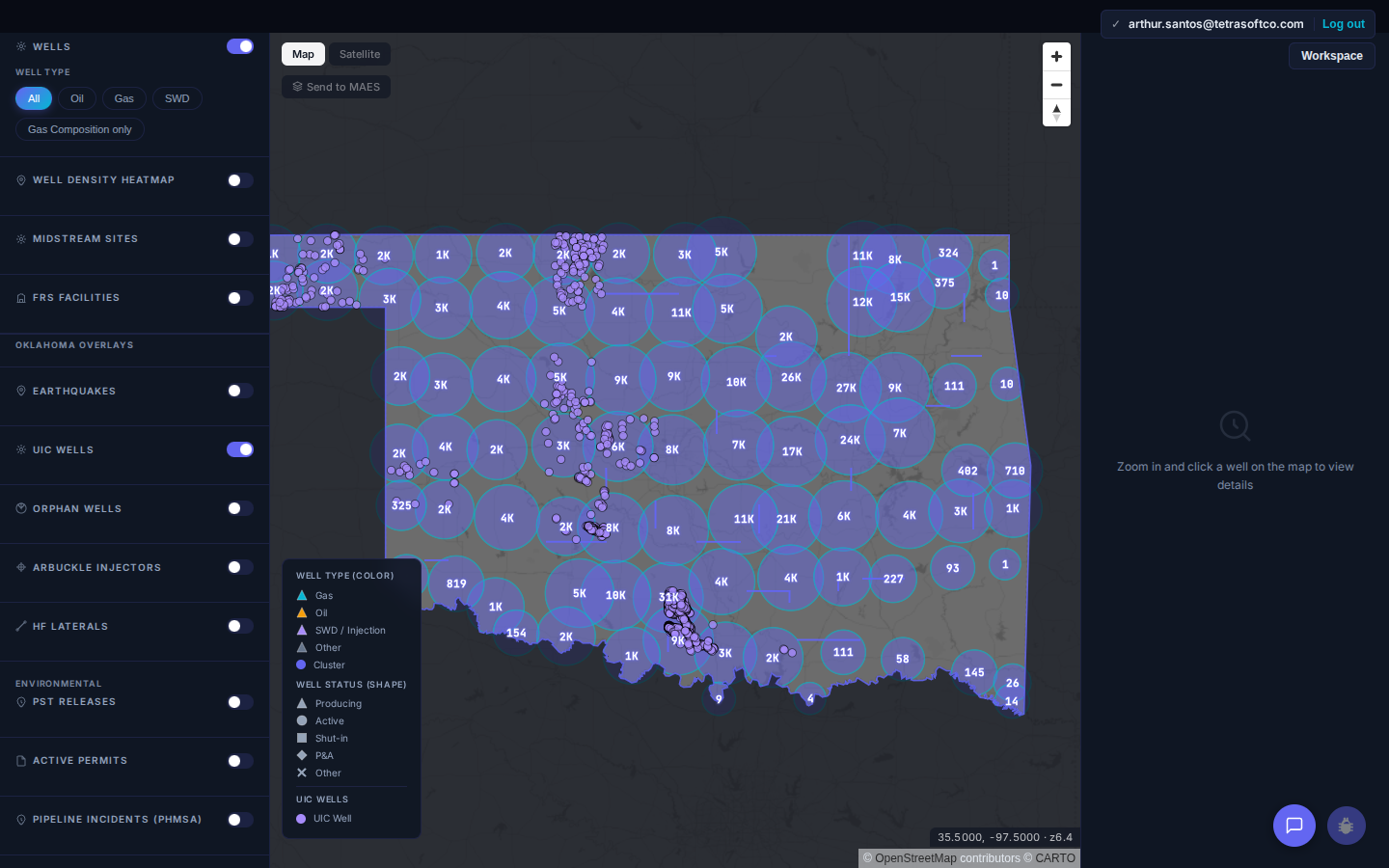
The UIC Wells overlay switched on over Oklahoma, with the state’s other record layers listed beside it.
Zoom In and the Wells Separate
Individual UIC wells resolve as you zoom toward a county [4]. The statewide view draws a sample of the layer, and a closer view fills in the wells inside the frame [4]. Oklahoma also keeps separate overlays for orphan wells and Arbuckle injectors. For wells that were plugged or left behind instead of permitted for injection, see the abandoned gas wells guide.
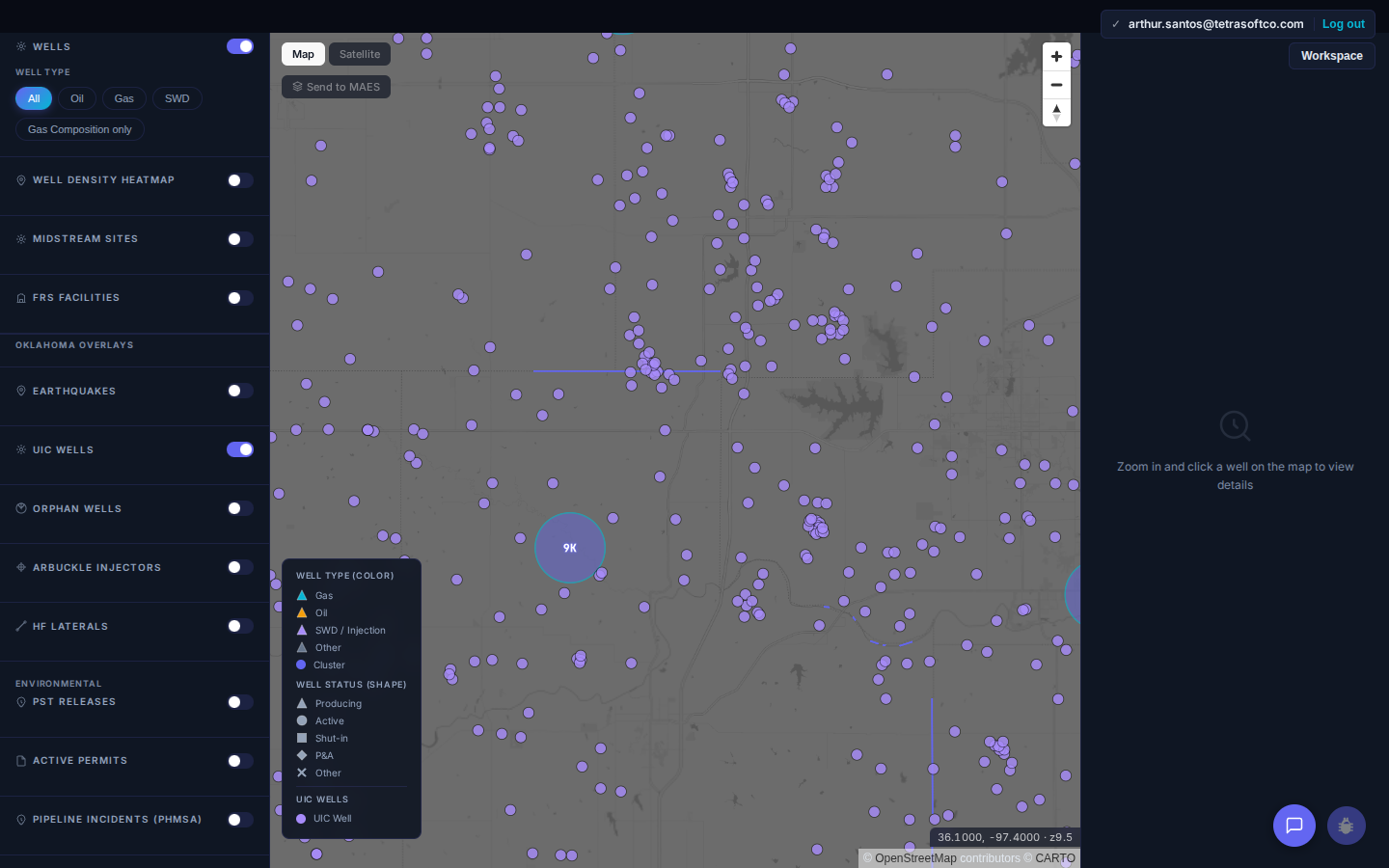
At county scale the individual UIC wells separate out across north-central Oklahoma.
Six More States Carry Their Own Injection Records
Six states beyond Oklahoma carry injection records of their own. Texas holds the largest set of them. Atlas carries Railroad Commission injection histories for 23,986 Texas wells, reaching back to 1966. Each year on a well records the volume injected, its unit, and the average and maximum injection pressure.
The history hangs off the well rather than a separate layer. You open the well and read its injection tab instead of switching an overlay on. Finding the well itself is covered in the RRC wellbore query guide.
New Mexico reports on a different form, and the detail follows the form. Atlas carries C-115 injection records for 5,556 New Mexico wells covering 2006 through 2026. The C-115 form breaks the volume into water, carbon dioxide, and gas separately, where Texas reports a single volume with its unit. The split is worth having when you are trying to tell enhanced recovery from disposal.
The NMOCD well search guide covers finding the well first.
Neither state labels its wells with an EPA class number. The class has to come from the permit rather than the map.
Three more states put their injection wells on a switchable layer. West Virginia carries 2,045 of them and Wyoming 4,369. Pennsylvania holds the largest set at 14,609, of which 9,522 carry coordinates and reach the map.
Each layer separates the two jobs a Class II well does. Wells taking waste underground are colored apart from wells injecting to drive recovery at nearby wells. Enhanced recovery and disposal are the two purposes that account for almost every Class II well [2]. Gas storage wells sit outside both layers in all three states, following each agency’s own well-type definitions.
Count the mapped wells rather than the recorded ones when the state is Pennsylvania.
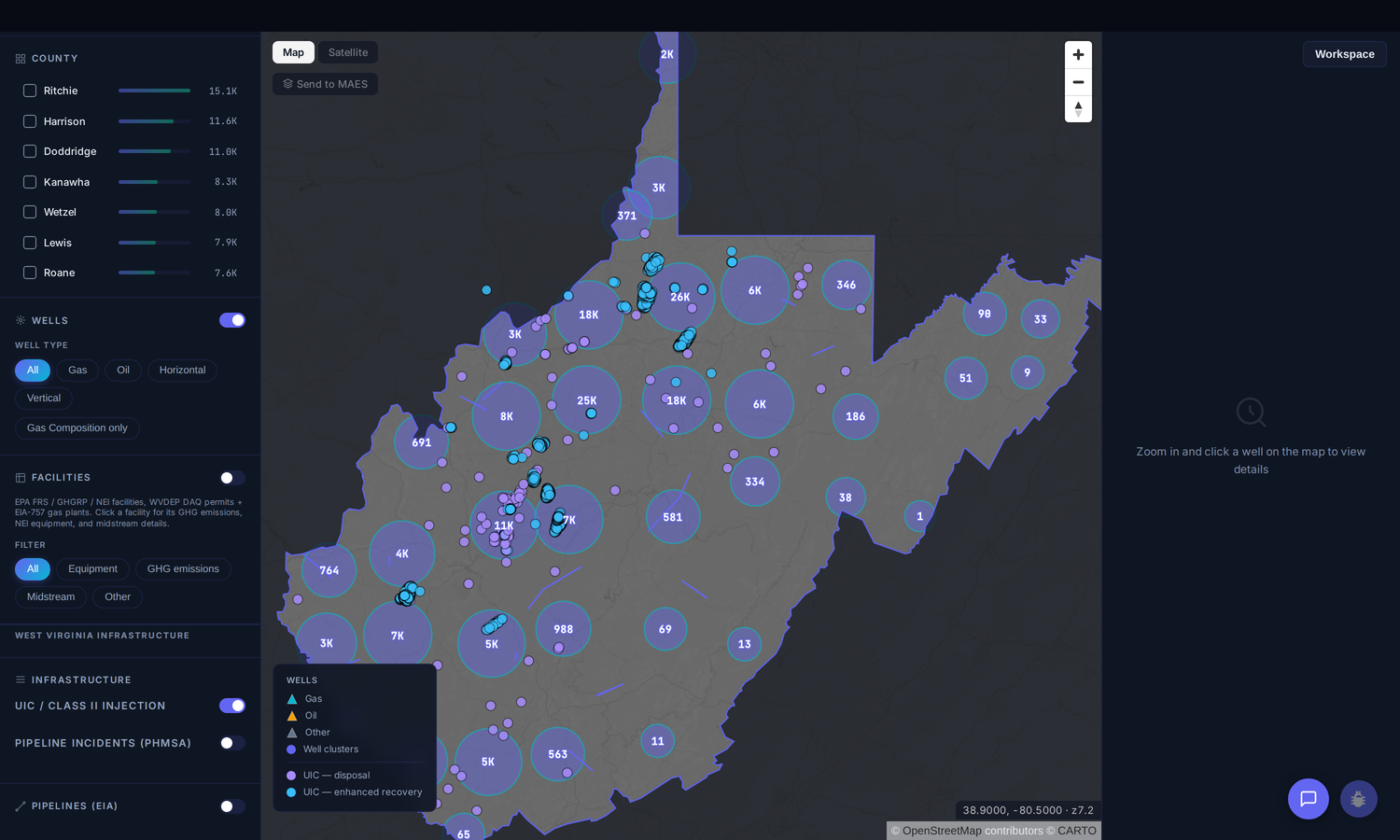
West Virginia’s Class II layer switched on, with waste disposal and enhanced recovery colored apart.
Colorado draws its layer from one ECMC status code covering waste disposal and secondary recovery together. That single code is why Colorado’s 693 wells render in one color rather than two. Every one of them carries coordinates, so the record count and the map count agree.
Each Colorado well also carries a class code, shown exactly as ECMC recorded it. Read that code against ECMC’s own documentation rather than what its letters resemble.
Frequently Asked Questions
Do UIC wells show up in an ordinary well search?
Often not, because agencies keep injection wells in a separate record set from producing wells. TetraSoft Atlas keeps Oklahoma’s UIC wells as their own map layer beside the producing-well layer. Switch the layer on rather than expecting a standard well search to return them.
Is a saltwater disposal well the same as a UIC well?
A saltwater disposal well is one kind of UIC well, specifically a Class II disposal well [2]. It takes brines separated from hydrocarbons at the surface and returns them underground [2]. Disposal is about 20 percent of Class II, so the two terms are not interchangeable [2].
Does EPA hold the permit file for my state’s injection wells?
Often not, since thirty-one states and three territories hold approved primacy programs [3]. In those places the state agency issues the permit and keeps the file. EPA runs the program directly where no approved program exists [3]. Two tribal nations also hold Class II primacy [3].
How do I find the operator of an injection well near me?
Search the state agency’s well records by county or by API number. Oklahoma’s records are walked through in the OCC Oklahoma oil and gas guide. Reading the identifier itself helps, and the API well number lookup guide breaks the digits down.
How much does TetraSoft Atlas cost?
TetraSoft Atlas offers three plans, from individual analysts to large operator teams [4]. All paid plans include a 7-day free trial, and cancelling before day 7 costs nothing [4]. For current plans and prices, see the Atlas pricing page [4].
TetraSoft Atlas puts a state’s permitted injection wells on the same map as everything else it produces [4]. Start your free 7-day trial.
This post is for informational purposes only and does not constitute legal or compliance advice. Consult qualified legal counsel or a compliance professional for guidance specific to your operations and jurisdiction.
References
- United States Environmental Protection Agency (EPA), Underground Injection Control Well Classes. https://www.epa.gov/uic/underground-injection-control-well-classes
- United States Environmental Protection Agency (EPA), Class II Oil and Gas Related Injection Wells. https://www.epa.gov/uic/class-ii-oil-and-gas-related-injection-wells
- United States Environmental Protection Agency (EPA), Primary Enforcement Authority for the Underground Injection Control Program. https://www.epa.gov/uic/primary-enforcement-authority-underground-injection-control-program
- TetraSoft Atlas, Oklahoma oil and gas dataset and product features. https://tetrasoftco.com/atlas-landing.html#pricing
- Colorado Underground Injection Control Program; Class VI Primacy. Proposed rule, 91 FR 13266, 19 March 2026; comment period closed 4 May 2026. https://www.federalregister.gov/documents/2026/03/19/2026-05453/colorado-underground-injection-control-program-class-vi-primacy
- Arizona Underground Injection Control (UIC) Program; Class I-VI Primacy. Final rule, 90 FR 44327, 15 September 2025, effective 15 October 2025. https://www.federalregister.gov/documents/2025/09/15/2025-17769/arizona-underground-injection-control-uic-program-class-i-vi-primacy
Comments
0Share your thoughts. All comments are moderated before appearing.
No comments yet. Be the first to share your thoughts!