A division order is the document that tells you what share of a well’s revenue the payor intends to send you. Its economic content is a single number, the decimal interest, usually carried to eight places. That decimal comes from three figures the owner already holds: net acres, unit acres, and the lease royalty rate. The formula is net mineral acres divided by unit acres, multiplied by the royalty rate. Forty net mineral acres in a 640 acre unit at a three-sixteenths royalty therefore gives 0.01171875 [1]. Checking that number takes about a minute and almost nobody does it. A division order is not a deed and signing one does not transfer your mineral rights. The statutory detail below is Texas law, which sets out what the document may contain and when you must be paid [2].
Quick Answer: A division order states your decimal interest in a well’s proceeds and certifies title to that share [2]. It is not a deed, and signing one does not convey your mineral rights. The decimal is net mineral acres divided by unit acres, times the royalty rate. Texas limits a division order to seven specific provisions [2]. First proceeds are due within 120 days after the end of the month of first sale [2].
A Division Order Divides Proceeds, It Does Not Rewrite the Lease
A division order is an administrative instrument rather than a new bargain. Texas states what one may contain, and the list is short [2]. A division order may carry the effective date and a description of the property and type of production [2]. It may also carry the fractional or decimal interest claimed, the type of interest, and a certification of title to that share [2].
The rest of the permitted list is administrative. It covers authorization to suspend payment until a title dispute or adverse claim is resolved [2]. It also covers the payee’s name, address and taxpayer identification number [2]. The last two items are provisions for valuation and timing of settlements, and a notification that other statutory rights may be available [2].
Seven items is the whole of it [2]. Anything beyond them is the part worth reading twice, because the statute drew the line there deliberately.
Certifying Title Is Not the Same as Amending It
A division order is not a deed, a lease, or an amendment to either. The certification in it confirms the share claimed rather than conveying anything. A signature on it is a statement about what you own, not a change to what you own. Your mineral rights come from the deed and your royalty from the lease, and neither moves because you signed a payment document.
That distinction is why an added clause matters so much. A document that ratifies a lease, changes a royalty calculation, or adds a warranty is doing more than dividing proceeds. Owners in that position commonly take advice before signing.
How to Check Your Decimal Interest
For the ordinary case the arithmetic is one line. Divide your net mineral acres by the unit acres to get your share of the unit, then multiply by your royalty rate. Forty acres in a 640 acre unit is 6.25 percent of the unit, and at a three-sixteenths royalty that is a decimal of 0.01171875 [1].
Each input comes from a different document, which is where the errors enter. Net mineral acres come from the deed, unit acres from the plat or pooling declaration, and the royalty rate from the lease. A division order that disagrees with any of the three is worth a question before signature.
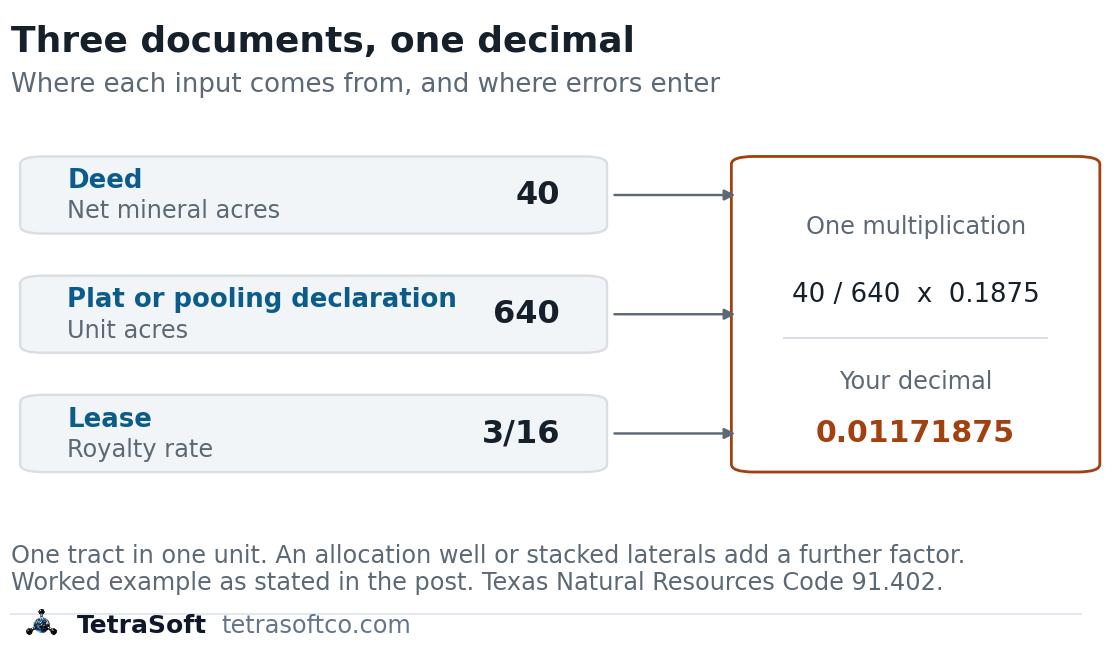
Each input is established by a different instrument, which is where a wrong decimal usually comes from. The arithmetic is one multiplication; the documents are three.
When the One Line Does Not Reproduce Your Decimal
The one line assumes one tract, one unit and one royalty rate. A well draining more than one tract divides its production among them first. A further factor then sits between your acreage and your decimal. Stacked laterals and units whose surveyed acreage is not a round number do the same.
A decimal the one line cannot reproduce is not necessarily wrong. It is a reason to ask which figures the payor used. The calculator below covers one tract pooled into one unit. It does not cover overriding royalties, non-participating royalty interests, working interests net of costs, or title questions.
A Sixth-Place Difference Is Not a Rounding Error
Small decimal differences look immaterial and are not. A gap of 0.00001 against a million dollars of unit revenue is ten dollars, and against fifty million it is five hundred [1]. The decimal does not expire, so the difference recurs for the life of the well.
Identifying the right well is part of the check. The property description on the division order should match the unit you believe you are in. In Texas the well record itself is searchable, as set out in RRC Wellbore Query: How to Find Any Texas Well Record. Where a well is identified by API number, how to read that number is covered in API Well Number Lookup: What It Is and How to Read One.
Check the Well’s Production Behind the Decimal
A correct decimal is half of a correct royalty check. The other half is the volume the well produced, and that volume is reported to the state. In Texas it is reported by each oil and gas lease rather than by individual well, so one well’s share has to be worked out from the lease total [12].
TetraSoft Atlas is our subscription platform, joining well, production, emissions and enforcement records on one map [11]. It covers Texas, Oklahoma, Pennsylvania, Ohio, West Virginia, New Mexico, Colorado and Wyoming [11]. Selecting a well shows its operator, status and reported production, so you can see whether it is still producing before you question a payment.
What Texas Law Says About Signing and Being Paid
Texas puts royalty payment on a statutory clock [2]. Proceeds from a first sale must be paid on or before 120 days after that month ends [2]. Subsequent oil is due within 60 days after the end of the calendar month in which it sold [2]. Subsequent gas is due within 90 days on the same basis [2].
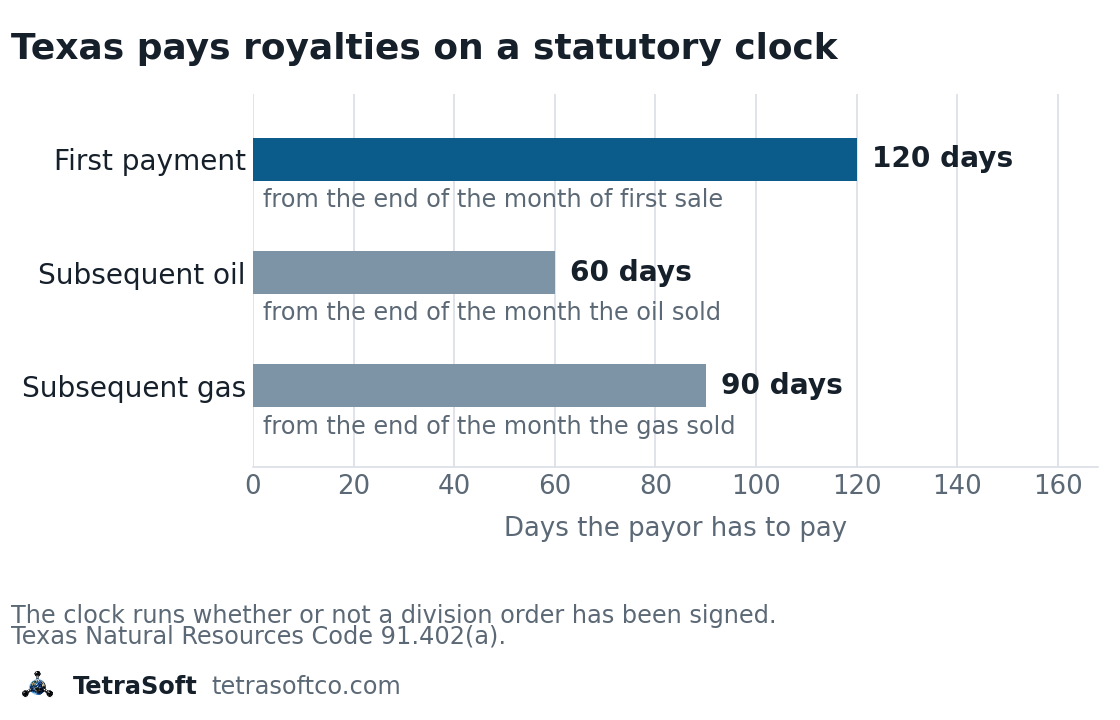
Texas statutory royalty payment deadlines and the event each runs from, under Natural Resources Code 91.402(a).
The signing question has a more precise answer than it is usually given. An owner may refuse to sign because the order contains provisions beyond those the section provides for [2]. The payor may not withhold payment solely because of that refusal [2]. If the division order contains only the statutory provisions and the owner still refuses, the payor may withhold payment without interest until it is signed [2].
The difference between those two cases is what the document contains. An owner who refuses a plain statutory division order can be held out of payment lawfully. An owner who refuses one carrying extra terms cannot be held out on that ground alone.
Title Problems Are a Separate Reason to Withhold
Payment may also be suspended for reasons that have nothing to do with signing. A dispute concerning title can support withholding [2]. So can a reasonable doubt about the payee’s ownership or authorization to sell production, or a requirement in a title opinion [2].
A suspended payment is therefore not automatically a late payment. Establishing which of the two is happening is the first useful question when a check does not arrive.
What Other States Do With the Same Question
Texas is not the general rule, which is why this post says Texas throughout. North Dakota forbids withholding royalty because an owner has not executed a division order [3]. Louisiana forbids it too, and awards double the royalties due where that was the only reason [4]. Pennsylvania allows withholding on three grounds only, and refusal to sign is not one of them [5].
New Mexico runs the other way. Refusing to execute a reasonable division or transfer order is an express excuse for nonpayment there [6]. Oklahoma is silent on refusal, and its subsequent clock runs to the last day of the second succeeding month [7]. Wyoming is silent too, but a payor who suspends must place the proceeds in a Wyoming escrow account [8].
Colorado has no division order statute, and requires a twenty day certified mail notice before any relief [9]. West Virginia’s payment deadline reaches horizontal wells only, leaving conventional wells to the lease [10]. A Texas answer therefore travels badly, and the statute to read is the one for the state the well sits in.
This post is for informational purposes only and does not constitute legal or compliance advice. Consult qualified legal counsel or a compliance professional for guidance specific to your operations and jurisdiction.
Frequently Asked Questions
Does signing a division order transfer my mineral rights?
No. A division order is not a deed and carries no conveyance among the provisions Texas permits it to contain [2]. Your ownership stays with the deed and your royalty terms with the lease. A clause going beyond the permitted seven is the case worth reading closely.
What if my division order arrives years after the well started producing?
The payment clock runs from the sale rather than from the paperwork. Texas requires first proceeds within 120 days after the end of the month of first sale [2]. A division order arriving later does not restart that period.
Does a division order expire or need re-signing?
It stays in effect until something it describes changes. A sale of the interest, a change of payor or a new well in the unit can each produce a new one. Every new document restates the decimal, which is why each is worth checking.
What should I keep after signing?
The deed, the lease and the plat or pooling declaration. Keep the division order itself alongside them. If the decimal is ever questioned, the argument is made from those documents.
Who do I ask if the decimal looks wrong?
The payor who sent it, because they derived the number. Ask which acreage figure, unit size and royalty rate they applied. A mismatch usually traces to one of those three rather than to the arithmetic.
What is the difference between a division order and a transfer order?
A division order states the decimal the payor intends to pay the current owner. A transfer order records that an interest has moved from one owner to another. The first sets the share, the second changes who receives it.
What do NPRI and ORRI mean on a division order?
An NPRI is a non-participating royalty interest, carved out of the minerals, whose holder cannot lease. An ORRI is an overriding royalty interest, carved out of the working interest and ending with the lease. Neither is computed by the ordinary net acres formula above.
Get regulatory updates and emissions data insights in your inbox. Subscribe to the TetraSoft newsletter.
References
- Texas Natural Resources Code, Section 91.402, Time for Payment of Proceeds, including subsections (a), (c) and (e). https://statutes.capitol.texas.gov/Docs/NR/htm/NR.91.htm
- Worked arithmetic from the acreage, royalty and revenue figures stated in this post. No external source.
- North Dakota Century Code 47-16-39.3, Division orders; definition, function, and operation. https://ndlegis.gov/cencode/t47c16.pdf
- Louisiana Revised Statutes 31:138.1, Division order; precedence of lease; penalties for failure to pay royalties due. https://www.legis.la.gov/legis/Law.aspx?d=87831
- Pennsylvania Oil and Gas Lease Act, 58 P.S. 35.3, subsection (e). https://www.legis.state.pa.us/WU01/LI/LI/US/HTM/1979/0/0060..HTM
- New Mexico Statutes Annotated 70-10-5, Application; penalty, subsection (D), with 70-10-3, Payment of oil and gas proceeds; time for payment. https://nmonesource.com/nmos/nmsa/en/4440/1/document.do
- Oklahoma Statutes Title 52, Sections 570.10 and 570.11, Division orders. https://oksenate.gov/sites/default/files/2019-12/os52.pdf
- Wyoming Statutes 30-5-301 through 30-5-305, Wyoming Royalty Payment Act. https://www.wyoleg.gov/statutes/compress/title30.pdf
- Colorado Revised Statutes 34-60-118.5. https://leg.colorado.gov/sites/default/files/images/olls/crs2024-title-34.pdf
- West Virginia Code 37C-1-3. https://code.wvlegislature.gov/37C-1-3/
- TetraSoft Atlas, multi-state well and operator dataset. https://www.tetrasoftco.com/atlas-landing.html
- Railroad Commission of Texas, Production Data Query System (PDQ) FAQs. https://www.rrc.texas.gov/about-us/faqs/oil-gas-faq/production-data-query-system-faqs/
Interactive tool
Division order decimal checker
Your decimal is your net mineral acres divided by the unit acres, times your royalty rate. Enter the three numbers from your deed, plat and lease, then compare against the decimal the division order states.
Your computed decimal interest
0.01171875
share of unit revenue
- 40 net mineral acres in a 640 acre unit is 6.2500 percent of the unit.
- At a 18.7500 percent royalty, that is a decimal of 0.01171875.
- Your share of the unit
- Difference from the stated decimal
- not entered
- Worth per $1,000,000 of unit revenue
- not entered
Ordinary royalty decimal for one tract pooled into a unit. It does not cover overriding royalties, non-participating royalty interests, working interests net of costs, or title questions. A mismatch is a reason to ask the payor how their number was derived.
Comments
0Share your thoughts. All comments are moderated before appearing.
No comments yet. Be the first to share your thoughts!