Methane is a central greenhouse gas question for oil and gas operators. Over a century, a tonne of fossil methane traps 29.8 times the heat of a tonne of carbon dioxide, the IPCC’s latest figure [1]. Subpart W reports convert methane with the older factor of 28 set in Part 98 [2].
In the United States, the federal rule that makes larger oil and gas facilities report it is Subpart W [3]. For reporting year 2023, 2,298 facilities with petroleum and natural gas activities reported 322 million metric tons CO2e, mostly carbon dioxide [4].
The Subpart W reports feed EPA’s national greenhouse gas inventory [5]. They also underpin the federal methane charge, which Congress has now deferred to 2034 [6].
People searching for Subpart W usually want four answers: what it is, who reports, what to report, and whether the rule is going away. This guide answers all four, in that order. It moves from the ten industry segments to the two threshold tests, the listed sources and methods, and the rule’s future.
This post is for informational purposes only and does not constitute legal or compliance advice. Consult qualified legal counsel or a compliance professional for guidance specific to your operations and jurisdiction.
Quick Answer: Subpart W is the oil and gas section of EPA’s Greenhouse Gas Reporting Program, at 40 CFR Part 98 [3]. It covers ten industry segments from production to distribution, and a facility reports once its emissions reach 25,000 metric tons CO2e a year [7]. It requires reporting, not emission controls, and a proposal to suspend it is not final.
- What Subpart W is and why it matters
- Subpart W divides the category into ten segments
- Who has to report, and the two threshold tests
- What you have to report
- Each source has prescribed calculation methods, some measurement-based
- How to comply, and whether the rule is going away
What Subpart W Is and Why It Matters
Subpart W, titled Petroleum and Natural Gas Systems, is the oil and gas subpart of 40 CFR Part 98 [3]. 40 CFR is Title 40 of the Code of Federal Regulations, the part of federal law that holds EPA’s rules [8]. Its Part 98 is the Mandatory Greenhouse Gas Reporting rule, split into lettered subparts, one per industry or source category [8].
| Subpart | Covers |
|---|---|
| A | General provisions, including who must report |
| C | General stationary fuel combustion sources |
| D | Electricity generation |
| H, Q, Y | Cement production, iron and steel, petroleum refineries |
| HH | Municipal solid waste landfills |
| NN | Suppliers of natural gas and natural gas liquids |
| RR, UU | Geologic sequestration and injection of carbon dioxide |
| W | Petroleum and natural gas systems |
A selection of Part 98’s more than 40 subparts; the full list runs from A to ZZ. [8]
For reporting year 2023, over 8,000 facilities and suppliers reported under Part 98 [9]. The program’s data are “an important resource for developing the Inventory,” the national total EPA reports each year [5]. For oil and gas, the Inventory uses Subpart W data, such as activity data and emission factors, to refine its national estimates.
It Is a Reporting Rule, Not a Control Rule
Subpart W requires you to quantify and disclose [3]. It does not require you to control or cut emissions, though some segments must run leak surveys to calculate them [3]. Control requirements make operators run leak surveys, replace venting pneumatic controllers or route tank vapors to a control device [10]. They sit in the New Source Performance Standards at 40 CFR Part 60, Subpart OOOOb, and in Subpart OOOOc, the emission guidelines for existing sources [10].
Readers who need those obligations want our explainer on NSPS OOOOb instead. Both rules are in force, and EPA extended several of their compliance deadlines in 2025 [11]. In April 2026, EPA amended their flaring provisions without changing the emission standards [12].
Other Countries Require Similar Reporting
The US is not alone in requiring facility-level greenhouse gas reports. Canada requires facilities that emit 10,000 tonnes CO2e or more a year to report [13]. Its 2025 methane amendments help meet Canada’s goal of at least a 75% cut in oil and gas methane below 2012 levels by 2030 [14]. Mexico’s hydrocarbon regulator, ASEA, has required operators to prevent and control methane emissions since 2018 [15].
The European Union goes further than Subpart W on measurement. Its methane regulation requires source-level reports and, from February 2027, site-level measurements assessed by an independent verifier [16]. Norway requires offshore operators to report methane each year to its Environment Agency [17].
The EU rule is why US operators care. From January 1, 2027, EU importers must show their gas is covered by monitoring equivalent to the EU’s own [18]. The duty covers contracts concluded or renewed on or after August 4, 2024 [18]. A Subpart W report built on default factors may help, but equivalence is judged against an EU standard requiring source- and site-level measurement.
Subpart W Divides the Category Into Ten Segments
A segment is one of the ten parts of the oil and gas chain Subpart W lists, from the wellhead to the gas main [19]. A facility is the unit that files one report, and section 98.238 defines it separately for onshore production, gathering and boosting, transmission pipelines and distribution [20]. Your segment decides which sources you list, which methods you use and which threshold test applies [7]. [21]
| # | Industry segment | Example | Threshold test |
|---|---|---|---|
| 1 | Offshore petroleum and natural gas production | A platform in federal waters | Whole facility |
| 2 | Onshore petroleum and natural gas production | Well-pads, tanks and separators | Segment sources |
| 3 | Onshore natural gas processing | A gas plant removing liquids | Whole facility |
| 4 | Onshore natural gas transmission compression | An interstate compressor station | Whole facility |
| 5 | Underground natural gas storage | A depleted-reservoir storage field | Whole facility |
| 6 | Liquefied natural gas (LNG) storage | A peak-shaving LNG tank | Whole facility |
| 7 | LNG import and export equipment | An export terminal | Whole facility |
| 8 | Natural gas distribution | A utility’s mains and meters | Segment sources |
| 9 | Onshore petroleum and natural gas gathering and boosting | Gathering lines and field compressors | Segment sources |
| 10 | Onshore natural gas transmission pipeline | An interstate pipeline system | Segment sources |
The ten segments as section 98.230(a) names them; the examples are illustrations, not rule text. [19]
A company can sit in several segments at once, and each is reported separately [20]. A producer owning gathering compression reports well-pads under the production rules and gathering assets under the gathering and boosting rules [21].
What Counts as a Facility in Onshore Production
In onshore production, a facility is all equipment on or associated with an operator’s well-pads under common ownership or control in one hydrocarbon basin [20]. The association ends where a well-pad’s stream is combined with streams from other well-pads at a point off that well-pad [20]. The basin sets the boundary [20].
Compressors, dehydrators, separators, flares and tanks on a pad, or handling its stream before it joins another pad’s off the pad, belong to its facility [20]. Drilling, completion and workover equipment that cannot move on roads under its own power counts too, through its fuel combustion [21]. Leased, rented or contracted activities count too, where they are under the operator’s common ownership or common control [20].
Who Has to Report, and the Two Threshold Tests
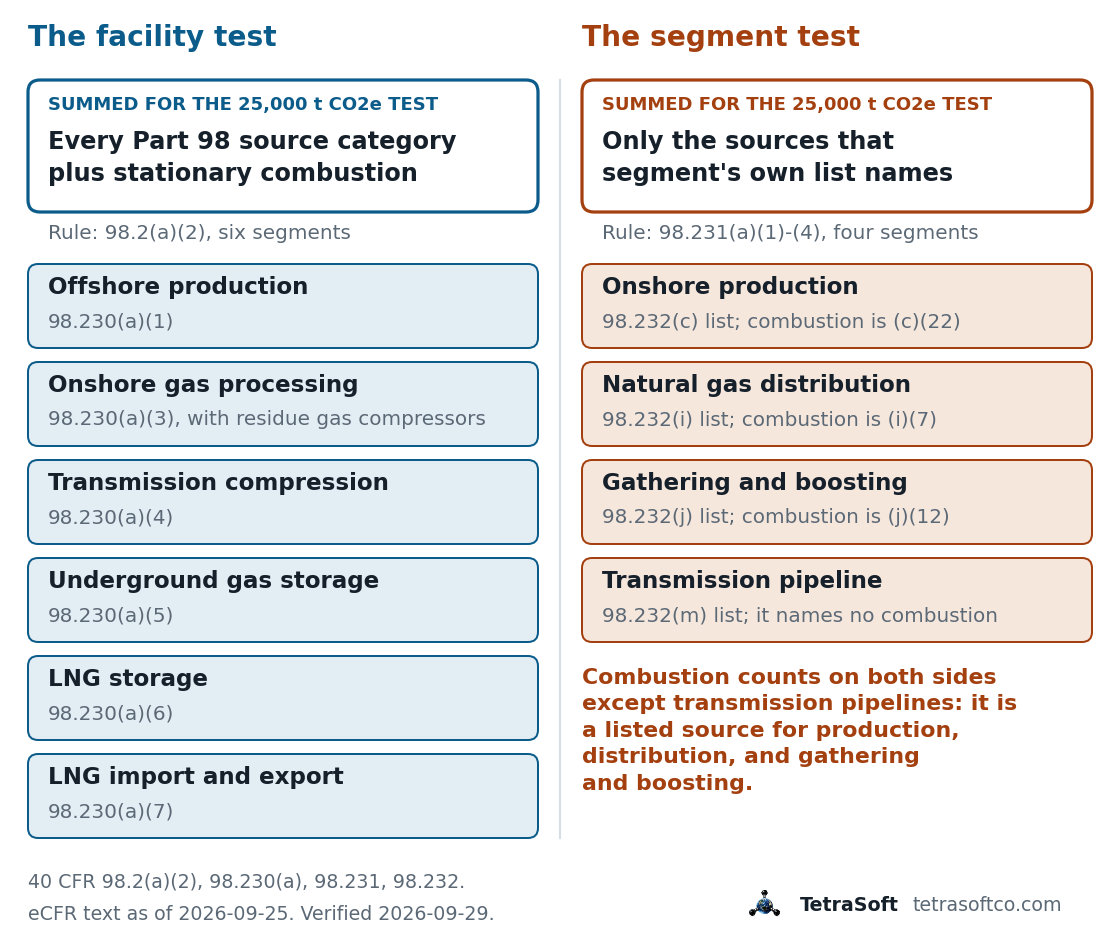
Subpart W’s headline reporting threshold is 25,000 metric tons of CO2 equivalent a year [7]. But the rule adds up that total two different ways depending on the segment, as the figure shows [7].
The Whole-Facility Test Counts Everything Part 98 Lists
Six segments use the ordinary Part 98 test: offshore production, gas processing, transmission compression, underground storage, LNG storage, and LNG import and export [7]. It reports if “combined emissions from stationary fuel combustion units, miscellaneous uses of carbonate, and all applicable source categories” reach 25,000 metric tons CO2e yearly [22]. A gas plant also counts the residue gas compression it owns or operates [7].
The Segment Test Counts Only That Segment’s Listed Sources
Four segments use a narrower test: onshore production, distribution, gathering and boosting, and transmission pipelines [7]. A production facility reports “only if emission sources specified in § 98.232(c) emit 25,000 metric tons of CO2 equivalent or more per year.” [7] Anything the segment’s list does not name stays out of the total.
Combustion is on three of those four lists, so it still counts for production, distribution, and gathering and boosting [21]. The transmission pipeline list in 98.232(m) names no combustion source [21]. Screening a pipeline system by totalling everything it burns will therefore overstate its threshold total.
Aggregation Runs to the Basin
For onshore production, and for gathering and boosting, the facility aggregates everything an operator runs in one hydrocarbon basin [20]. The threshold is therefore not applied well-pad by well-pad [20]. This point is easy to miss when the threshold is screened site by site.
A producer with 200 small well-pads in one basin, none near 25,000 metric tons CO2e, can still cross the threshold on their combined total. The same producer with pads in two basins files, or not, basin by basin.
What You Have to Report
Section 98.232(c) lists the source types for onshore production, numbered 1 to 25 with two reserved [21]. That leaves 23 reportable sources on or associated with a well-pad [21]. The tool below shows every listed source for any segment, filtered by the equipment you run.
Most Listed Sources Are the Ones You Would Expect
The list names natural gas pneumatic device venting, blowdown vent stacks, pneumatic pump venting and liquids unloading [21]. Flare stacks, storage tanks, dehydrator vents, and reciprocating and centrifugal compressor venting are named too [21]. Equipment leaks can be counted component by component, such as valves, connectors and relief valves [21]. Where no leak survey is required or elected, they are counted by major equipment, such as wellheads, separators and meters [21].
Completions Are Short Events With Widely Varying Emissions
A completion lasts hours, yet its methane varies so widely one event can matter in an annual report. During a completion, flowback first runs to open pits or tanks, then to a separator once it carries enough gas [23]. Allen and colleagues measured 27 completion flowbacks at 0.01 to 17 metric tons of methane each, mean 1.7, versus EPA’s then-estimate of 81 metric tons [24].
In drilling, Caulton and colleagues measured methane averaging 34 grams a second per well [25]. At the seven pads measured, that was two to three orders of magnitude above EPA’s estimates for the phase [25]. Subpart W reaches drilling only through two listed sources: drilling mud degassing and the combustion of drilling equipment [21].
Completions are still required reporting [21]. Section 98.232(c) lists gas well completions and workovers without hydraulic fracturing [21]. It also lists well completions and workovers with hydraulic fracturing, at a gas to oil ratio of 300 scf per stock tank barrel or more [21]. Associated gas venting and flaring, other large release events, drilling mud degassing and crankcase vents are listed too [21].
Other Segments Carry Their Own Lists
The source list is per segment, not universal [21]. Processing uses 98.232(d), distribution 98.232(i), gathering and boosting 98.232(j), and transmission pipelines 98.232(m) [21]. Applying the production list to a midstream asset produces a confidently wrong report, because the sources genuinely differ.
Each Source Has Prescribed Calculation Methods, Some Measurement-Based
Section 98.233 specifies how to calculate each source type [23]. For several sources it requires a specific method in set conditions and lets you choose among the rest [23]. For some sources, measurement data you already have must be used; elsewhere a default factor is one permitted method [23].
What the Order of Methods Means in Practice
Measurements you already hold decide your method, and natural gas pneumatic devices show it most clearly. “If you have a continuous flow meter on the natural gas supply line dedicated to” venting pneumatic devices, you must use the metered method [23]. The meter removes the choice. Without a meter you may elect to measure each vent, or another listed method, including default population factors [23].
Those factors sit in table W-1, the rule’s default whole gas population emission factors, which cover several segments beyond onshore production [23]. Drilling mud degassing works the same way: an operator with mudlogging measurements must use them [23]. Unit-conversion pitfalls in those tables are covered in default emission factors under Subpart W.
A Factor Is Not a Measurement of Your Site
A default factor is a population average drawn from sources that are not yours [26]. It is the correct input where the rule requires it, but an average, not a measurement of your site. A measurement campaign at the same site can produce a different number without either figure being computed wrongly.
That gap is what TetraSoft’s two products work on. TetraSoft Atlas, our subscription platform for public oil and gas records, maps reported emissions beside the well and facility records it holds.
A study co-authored by TetraSoft cofounder Arthur Santos describes MAES, the Mechanistic Air Emissions Simulator, as simulating “fluid flow through equipment and equipment states.” [27] Each set of Monte Carlo runs yields “a range of emission scenarios rather than a single average.” [27] CSU and UT Austin developed MAES, and TetraSoft uses it through a partnership with CSU [28].
Where a Subpart W total and a measurement disagree, the simulation can add common failures, such as a stuck dump valve, to normal operation [27]. A simulation cannot confirm a leak; a measurement still settles that. Contact us to set a site-level range beside your Subpart W report.
How to Comply, and Whether the Rule Is Going Away
The rule still applies, though EPA has proposed ending most of it. Reports are filed each year for the previous calendar year, and section 98.237 sets the records that must be kept behind them [29]. The rule has changed repeatedly since 2024.
| Date | Action |
|---|---|
| May 14, 2024 | Final rule revising Subpart W: new sources, measurement-based methods, well-pad reporting (89 FR 42062) |
| August 29, 2024 | Notice on using advanced and emerging technologies to quantify annual facility methane emissions (89 FR 70177) |
| September 4, 2024 | Correction to that rule (89 FR 71838) |
| November 18, 2024 | EPA’s Waste Emissions Charge procedures rule, revoked in March 2025 (89 FR 91094) |
| March 14, 2025 | Congress nullifies EPA’s Waste Emissions Charge rule (Public Law 119-2); EPA removes its text May 19, 2025 (90 FR 21225) |
| March 20, 2025 | Reporting year 2024 deadline moved to May 30, 2025 (90 FR 13085) |
| July 4, 2025 | Waste Emissions Charge deferred to calendar year 2034 (Public Law 119-21) |
| September 16, 2025 | Proposal to end most of the program, including Subpart W distribution, and suspend the other Subpart W segments to 2034 (90 FR 44591) |
| September 22, 2025 | Correction to that proposal (90 FR 45367) |
| February 27, 2026 | Reporting year 2025 deadline moved to October 30, 2026 (91 FR 9712; its RIN corrected June 5, 2026, at 91 FR 34161) |
| October 14, 2026 | Reporting year 2025 deadline moved again, to March 10, 2027 (91 FR 65112) |
Selected federal actions affecting Subpart W since the 2024 revision, as published.
The 2024 revision aimed to base methane reporting on “empirical data” that would “accurately reflect total methane emissions (and waste emissions).” [26] The charge it was built to support no longer applies before 2034 [6]. Congress nullified EPA’s charge rule on March 14, 2025, and deferred the charge itself in July 2025 [30]. [6]
Reporting Year 2025 Is Due on March 10, 2027
For reporting year 2025 the deadline is March 10, 2027 [33]. EPA first moved it from March 31, 2026 to October 30, 2026 in a final rule published on February 27, 2026 [31]. It moved it again in an interim final rule published on October 14, 2026 [33]. It said it intends to consider the rest of its proposal “in one or more subsequent final actions.” [31]
EPA Has Proposed Ending Most Subpart W Reporting
In September 2025 EPA proposed to “remove program obligations for most source categories, including the distribution segment” of Subpart W [32]. It would “suspend program obligations for the remaining subpart W segments until reporting year 2034.” [32] As of September 29, 2026, no final rule has been published, and Subpart W as revised in 2024 remains in force.
Two companion pieces track the status question: what the deadline move did and did not change, and what remains required in 2026.
Frequently Asked Questions
What does Subpart W actually require?
It requires covered facilities to quantify and report greenhouse gas emissions from the sources listed for their industry segment [3]. The methods are set per source type in section 98.233, and the records behind the filing must be retained under section 98.237 [29]. It does not require any emission control [3].
Does Subpart W apply to a single well?
Only as part of a facility; a single well is judged with everything its operator runs in that basin [20]. For onshore production, all equipment tied to the wells an operator owns or operates in one basin counts as one facility [20]. The question is whether that basin total from the listed sources reaches 25,000 metric tons CO2e a year [7].
Do combustion emissions count toward the threshold?
Yes, except in the onshore natural gas transmission pipeline segment [21]. The whole-facility test counts emissions from stationary fuel combustion units [22]. Production, distribution, and gathering and boosting list combustion among their own sources; the transmission pipeline list does not [21].
Can I use default emission factors?
Yes, where section 98.233 permits them [23]. Section 98.233 requires a specific method in set conditions for several sources, and lets you choose among methods otherwise [23]. For natural gas pneumatic devices, a site with a continuous flow meter on a supply line dedicated to them must use the meter [23].
Is the Greenhouse Gas Reporting Rule being repealed?
Not yet. EPA proposed in September 2025 to end most of the program and suspend the remaining Subpart W segments until reporting year 2034 [32]. As of October 2026 that proposal is not final, and reporting year 2025 is due March 10, 2027 [33].
Who has to report greenhouse gas emissions to EPA?
Facilities and suppliers in Part 98 source categories that meet its applicability tests, generally 25,000 metric tons CO2e a year [22]. For reporting year 2023, over 8,000 facilities and suppliers reported [9]. Some categories report at any emission level [22].
Which greenhouse gases does Subpart W cover?
Subpart W covers carbon dioxide, methane and nitrous oxide [21]. Methane matters most for oil and gas, because it is the largest component of vented and leaked natural gas. Each flare reports those three gases as well [21].
Get regulatory updates and emissions data insights in your inbox. Subscribe to the TetraSoft newsletter.
References
- IPCC AR6 WG1, Chapter 7, Table 7.15. https://www.ipcc.ch/report/ar6/wg1/chapter/chapter-7/
- 40 CFR Part 98, Subpart A, Table A-1, global warming potentials. https://www.ecfr.gov/current/title-40/chapter-I/subchapter-C/part-98/subpart-A
- 40 CFR Part 98 Subpart W, Petroleum and Natural Gas Systems. https://www.ecfr.gov/current/title-40/chapter-I/subchapter-C/part-98/subpart-W
- EPA, Subpart W Petroleum and Natural Gas Systems industry profile, reporting year 2023. https://www.epa.gov/system/files/documents/2024-10/subpartw_profile_2023.pdf
- EPA, GHGRP and the US Inventory of Greenhouse Gas Emissions and Sinks. https://www.epa.gov/ghgreporting/greenhouse-gas-reporting-program-and-us-inventory-greenhouse-gas-emissions-and-sinks
- Public Law 119-21, section 60012(b). https://www.govinfo.gov/content/pkg/PLAW-119publ21/uslm/PLAW-119publ21.xml
- 40 CFR 98.231, reporting threshold for petroleum and natural gas systems. https://www.ecfr.gov/current/title-40/section-98.231
- 40 CFR Part 98, table of contents. https://www.ecfr.gov/current/title-40/chapter-I/subchapter-C/part-98
- EPA, GHGRP Reported Data. https://www.epa.gov/ghgreporting/ghgrp-reported-data
- 40 CFR Part 60 Subparts OOOOb and OOOOc, performance standards and emission guidelines. https://www.ecfr.gov/current/title-40/chapter-I/subchapter-C/part-60/subpart-OOOOb
- 90 FR 55671, extension of deadlines for OOOOb and OOOOc, December 3, 2025. EPA final rule. https://www.federalregister.gov/documents/2025/12/03/2025-21788/oil-and-natural-gas-sector-climate-review-extension-of-deadlines-in-standards-of-performance-for-new
- 91 FR 18056, reconsideration of OOOOb and OOOOc, April 9, 2026. EPA final rule. https://www.federalregister.gov/documents/2026/04/09/2026-06808/reconsideration-of-standards-of-performance-for-new-reconstructed-and-modified-sources-and-emissions
- Environment and Climate Change Canada, Greenhouse Gas Reporting Program facility reporting. https://www.canada.ca/en/environment-climate-change/services/climate-change/greenhouse-gas-emissions/facility-reporting/about.html
- SOR/2025-280, amendments to Canada’s upstream oil and gas methane regulations. https://gazette.gc.ca/rp-pr/p2/2025/2025-12-31/html/sor-dors280-eng.html
- ASEA, methane emission guidelines for the hydrocarbon sector, DOF November 6, 2018. https://dof.gob.mx/nota_detalle.php?codigo=5543033&fecha=06/11/2018
- Regulation (EU) 2024/1787, Article 12. https://eur-lex.europa.eu/eli/reg/2024/1787/oj
- Foulds et al., Atmospheric Chemistry and Physics, 2022, 22, 4303. https://doi.org/10.5194/acp-22-4303-2022
- Regulation (EU) 2024/1787, Article 28. https://eur-lex.europa.eu/eli/reg/2024/1787/oj
- 40 CFR 98.230, definition of the source category and the ten industry segments. https://www.ecfr.gov/current/title-40/section-98.230
- 40 CFR 98.238, definitions for petroleum and natural gas systems. https://www.ecfr.gov/current/title-40/section-98.238
- 40 CFR 98.232, source types listed for each industry segment. https://www.ecfr.gov/current/title-40/section-98.232
- 40 CFR 98.2, applicability and the 25,000 metric ton CO2e facility threshold. https://www.ecfr.gov/current/title-40/section-98.2
- 40 CFR 98.233, calculating GHG emissions. https://www.ecfr.gov/current/title-40/section-98.233
- Allen et al., PNAS, 2013, 110(44), 17768, DOI 10.1073/pnas.1304880110. https://doi.org/10.1073/pnas.1304880110
- Caulton et al., PNAS, 2014, 111(17), 6237, DOI 10.1073/pnas.1316546111. https://doi.org/10.1073/pnas.1316546111
- 89 FR 42062, revisions for petroleum and natural gas systems. EPA final rule, May 14, 2024. https://www.federalregister.gov/documents/2024/05/14/2024-08988/greenhouse-gas-reporting-rule-revisions-and-confidentiality-determinations-for-petroleum-and-natural
- Mollel et al., ACS ES&T Air, 2025, 2, 723-735, DOI 10.1021/acsestair.4c00168. Using Prototypical Oil and Gas Sites to Model Methane Emissions in Colorado’s Denver-Julesburg Basin Using a Mechanistic Emission Estimation Tool. https://doi.org/10.1021/acsestair.4c00168
- TetraSoft, MAES Platform product page, accessed September 30, 2026. https://www.tetrasoftco.com/maes-platform/maes-landing.html
- 40 CFR 98.237, records that must be retained. https://www.ecfr.gov/current/title-40/section-98.237
- 90 FR 21225, Congressional Review Act revocation of the Waste Emissions Charge rule, May 19, 2025. https://www.federalregister.gov/documents/2025/05/19/2025-08688/congressional-review-act-revocation-of-waste-emissions-charge-for-petroleum-and-natural-gas-systems
- 91 FR 9712, extending the reporting deadline for 2025. EPA final rule, February 27, 2026, corrected at 91 FR 34161 on June 5, 2026. https://www.federalregister.gov/documents/2026/02/27/2026-03995/extending-the-reporting-deadline-under-the-greenhouse-gas-reporting-rule-for-2025
- 90 FR 44591, reconsideration of the Greenhouse Gas Reporting Program. EPA proposed rule, September 16, 2025. https://www.federalregister.gov/documents/2025/09/16/2025-17923/reconsideration-of-the-greenhouse-gas-reporting-program
- 91 FR 65112, extending the reporting deadline for reporting year 2025 to March 10, 2027. EPA interim final rule, October 14, 2026. https://www.federalregister.gov/documents/2026/10/14/2026-20982/extending-the-reporting-deadline-under-the-greenhouse-gas-reporting-rule-for-reporting-year-2025-to
Interactive tool
Subpart W source finder
Pick an industry segment. See every source type 40 CFR 98.232 names for it, with its paragraph, and which 25,000 t CO2e threshold test the segment uses. Filter by equipment to narrow the list.
Threshold test for this segment
Segment-sources-only test
Only the sources this segment's own 98.232 list names count toward 25,000 t CO2e.
40 CFR 98.231(a), counting only 98.232(c)
Sources on a single well-pad or associated with a single well-pad. Combustion counts here because it is a listed source, (c)(22).
Showing 23 of 23 listed source types
- 98.232(c)(1) Natural gas pneumatic device venting Counts: named in 98.232(c), the list this segment's test sums.
- 98.232(c)(2) Blowdown vent stacks Counts: named in 98.232(c), the list this segment's test sums.
- 98.232(c)(3) Natural gas driven pneumatic pump venting Counts: named in 98.232(c), the list this segment's test sums.
- 98.232(c)(4) Well venting for liquids unloading Counts: named in 98.232(c), the list this segment's test sums.
- 98.232(c)(5) Gas well venting during well completions without hydraulic fracturing Counts: named in 98.232(c), the list this segment's test sums.
- 98.232(c)(6) Well venting during well completions with hydraulic fracturing that have a GOR of 300 scf/STB or greater Counts: named in 98.232(c), the list this segment's test sums.
- 98.232(c)(7) Gas well venting during well workovers without hydraulic fracturing Counts: named in 98.232(c), the list this segment's test sums.
- 98.232(c)(8) Well venting during well workovers with hydraulic fracturing that have a GOR of 300 scf/STB or greater Counts: named in 98.232(c), the list this segment's test sums.
- 98.232(c)(9) Flare stack emissions Counts: named in 98.232(c), the list this segment's test sums.
- 98.232(c)(10) Hydrocarbon liquids and produced water storage tank emissions Counts: named in 98.232(c), the list this segment's test sums.
- 98.232(c)(11) Reciprocating compressor venting Counts: named in 98.232(c), the list this segment's test sums.
- 98.232(c)(12) Well testing venting and flaring Counts: named in 98.232(c), the list this segment's test sums.
- 98.232(c)(13) Associated gas venting and flaring from produced hydrocarbons Counts: named in 98.232(c), the list this segment's test sums.
- 98.232(c)(14) Dehydrator vents Counts: named in 98.232(c), the list this segment's test sums.
- 98.232(c)(16) EOR injection pump blowdown Counts: named in 98.232(c), the list this segment's test sums.
- 98.232(c)(17) Acid gas removal unit vents and nitrogen removal unit vents Counts: named in 98.232(c), the list this segment's test sums.
- 98.232(c)(18) EOR hydrocarbon liquids dissolved CO2 Counts: named in 98.232(c), the list this segment's test sums.
- 98.232(c)(19) Centrifugal compressor venting Counts: named in 98.232(c), the list this segment's test sums.
- 98.232(c)(21) Equipment leaks, from components or from major equipment (wellheads, separators, meters/piping, compressors, dehydrators, heaters, storage vessels) Counts: named in 98.232(c), the list this segment's test sums.
- 98.232(c)(22) Stationary or portable fuel combustion equipment: drilling, completion and workover equipment, dehydrators, compressors, generators, boilers and heaters Counts: named in 98.232(c), the list this segment's test sums.
- 98.232(c)(23) Other large release events Counts: named in 98.232(c), the list this segment's test sums.
- 98.232(c)(24) Drilling mud degassing Counts: named in 98.232(c), the list this segment's test sums.
- 98.232(c)(25) Crankcase vents Counts: named in 98.232(c), the list this segment's test sums.
The rule names no source of this equipment type for this segment.
40 CFR 98.232, eCFR text as of September 25, 2026. Reserved paragraphs (c)(15) and (c)(20) are omitted. Long equipment-leak paragraphs are shortened; the citation points at the full text.
Comments
0Share your thoughts. All comments are moderated before appearing.
No comments yet. Be the first to share your thoughts!