Most oil and gas equipment never needs a CEMS. Since January 2026 the exception is a turbine with post-combustion control, which must run a NOx CEMS under subpart KKKKa, EPA’s turbine standard [1].
A continuous emission monitoring system, or CEMS, is a stack analyzer whose data EPA accepts as proof of compliance with an emission limit [2]. What earns that status is passing a Performance Specification, one of the pass-or-fail test procedures EPA publishes in appendix B to 40 CFR part 60 [3]. The monitor is then audited every quarter under appendix F for as long as it runs, and that audit program is the recurring cost [4].
Quick Answer: A CEMS is certified under appendix B to 40 CFR part 60, and is normally audited quarterly under appendix F [4]. That is what separates it from any other continuous analyzer. Combustion turbines require one only under subpart KKKKa, EPA’s January 2026 turbine standard, and only with post-combustion control such as SCR [1]. Engines and most other oil and gas equipment demonstrate compliance another way.
Which Oil and Gas Equipment Actually Needs One
Almost none of it does, and the exceptions are combustion sources rather than well-site equipment [5]. The table below gives each class its own row.
| Equipment | Standard | CEMS required? | What is monitored instead |
|---|---|---|---|
| Combustion turbine with SCR or other post-combustion control | Subpart KKKKa | Yes | Nothing; the NOx CEMS is the compliance demonstration |
| Combustion turbine with water or steam injection | Subpart KKKKa | No | The water-to-fuel or steam-to-fuel ratio, monitored continuously |
| Combustion turbine with neither | Subpart KKKKa | No | A periodic performance test |
| Combustion turbine built after 18 February 2005 | Subpart KKKK | Optional | A performance test at no more than 14 calendar months, or a CEMS by election |
| Stationary spark ignition engine, certified | Subpart JJJJ | No | Maintenance records, with no performance testing required |
| Stationary spark ignition engine, uncertified | Subpart JJJJ | No | A maintenance plan and periodic testing |
Every CEMS in this table measures NOx. [1] Methane is not among the pollutants these standards put on a stack monitor, and the section below explains why the methane instrument is a different thing under a different rule. [6]
The answer is set by the standard the equipment falls under, and that is set by a date. For combustion turbines the relevant dates are 18 February 2005 for subpart KKKK, the older turbine standard, and 13 December 2024 for subpart KKKKa [1]. A turbine is not moved between subparts by being sold, only by being modified or reconstructed.
Working the date out first saves reading the wrong subpart, which is the expensive mistake here.
Turbines: the Answer Changed in January 2026
Since January 2026 a turbine with post-combustion control must run a NOx CEMS, and every other turbine keeps a choice of monitoring route [1].
Both subparts are EPA’s New Source Performance Standards for stationary combustion turbines, one superseding the other [7]. Subpart KKKK is the older standard and applies to turbines built after 18 February 2005; subpart KKKKa is the 2024 replacement [1]. The four letters are only a filing address in part 60, and they carry no hint of what they require.
Under subpart KKKK a CEMS was one option among several [1]. The section covering that equipment ends with the words “if I choose to use this option” [1]. The heading itself records that the choice belonged to the operator.
Subpart KKKKa removed the choice for one class [1]. Where a turbine uses “SCR or other post-combustion controls”, subpart KKKKa requires a NOx CEMS [1]. The operator must demonstrate continuous compliance with the applicable NOx standard with it [1].
EPA reached that position on a best-system-of-emission-reduction finding [1]. For one subcategory it determined that system to be combustion controls plus selective catalytic reduction [1].
Everything else keeps its options [1]. A turbine using water or steam injection and no post-combustion control monitors the water-to-fuel or steam-to-fuel ratio continuously instead [1]. A turbine using neither runs performance tests within 14 calendar months of the previous one [8]. That interval extends to 26 calendar months where the last result was at or below 75 percent [9].
The older subpart KKKK sets the same test at no more than 14 calendar months [7]. The two intervals were two months apart until a July 2026 correction harmonized them at 14 [8].
Compressor Engines Are Not on This Path
Stationary spark ignition engines sit under subpart JJJJ, EPA’s standard for that equipment, which does not use CEMS at all [10]. A performance test is the alternative [10]. A crew comes to the site, samples the exhaust over a set number of runs, and reports the result to the permitting authority. “Periodic” means the rule fixes the longest gap between tests rather than a date.
A certified engine demonstrates compliance through maintenance records with no performance testing required [10]. An uncertified engine keeps a maintenance plan and tests according to its size [10].
The size thresholds are worth carrying. Below 100 horsepower an uncertified engine needs no performance test [10]. Between 100 and 500 horsepower it tests once, within a year of startup [10]. Above 500 horsepower it tests within a year of startup and then every 8,760 hours or 3 years, whichever comes first [10].
| Equipment and standard | Monitoring path | Recurring obligation |
|---|---|---|
| Turbine, subpart KKKKa, post-combustion control | NOx CEMS, mandatory | Daily drift check, quarterly audit, RATA every four quarters |
| Turbine, subpart KKKKa, water or steam injection | Continuous parameter monitoring | Water-to-fuel or steam-to-fuel ratio recorded |
| Turbine, subpart KKKKa, neither | Periodic performance test | Every 14 calendar months, or 26 if at or below 75 percent |
| Turbine, subpart KKKK, any control | Operator’s choice: periodic test, NOx CEMS or continuous parameter monitoring | Test every 14 calendar months on the periodic path |
| Engine, subpart JJJJ, certified | Maintenance records | None |
| Engine, subpart JJJJ, uncertified, over 500 hp | Periodic performance test | Every 8,760 hours or 3 years, whichever comes first |
Paths and obligations as they stand on 4 September 2026.
Well-Site Equipment Is Governed Another Way
Nothing in that table describes an upstream well site. Subpart OOOOb names nine affected facilities, and a flare is not one of them [5]. A control device is regulated through the affected facility it serves, not on its own account [11]. The instrument that subpart OOOOb asks for is a continuous parameter monitoring system, not a CEMS [12].
Subpart OOOOb is in effect and still being amended; EPA revised its flaring and net heating value monitoring provisions in April 2026.
A CPMS records an operating parameter that the performance test tied to destruction efficiency [11]. Combustion zone temperature, inlet gas flow rate and net heating value are the usual ones [12]. A CPMS is not certified to a Performance Specification and never measures what leaves the stack. One CEMS-like substitute is allowed, an organic monitoring device meeting Performance Specification 8 or 9 [12].
| Equipment | Standard | CEMS required? | What applies instead |
|---|---|---|---|
| Well, hydraulically fractured or refractured | Subpart OOOOb, 60.5375b | No | Flowback routed through a separator to a flow line, a vessel or a control device |
| Gas well unloading liquids | Subpart OOOOb, 60.5376b | No | Work practice standards, with a log of each venting event |
| Associated gas well | Subpart OOOOb, 60.5377b | No | Recovery to a sales line, onsite fuel, another useful purpose or reinjection |
| Storage vessel (tank battery) over the threshold | Subpart OOOOb, 60.5395b | No | Cover, closed vent system and a control device, or a floating roof |
| Separator | None; not an affected facility | No | Its dump valves surveyed as fugitive emissions components |
| Flare or enclosed combustion device | Subpart OOOOb, 60.5412b and 60.5417b | No | Net heating value floors, inlet flow limits, monthly Method 22 checks, all on a CPMS |
| Condenser or carbon adsorption system | Subpart OOOOb, 60.5412b | No | Outlet temperature or carbon bed parameters on a continuous recorder |
| Valves, connectors, flanges, thief hatches | Subpart OOOOb, 60.5397b | No | Periodic OGI, Method 21 or AVO surveys under a written plan, then repair |
| Glycol dehydrator | Part 63, subpart HH, 63.773 | No | A CPMS on the control device, plus cover and closed vent inspections |
| Sweetening unit at a gas processing plant | Subpart OOOOb, 60.5407b | Yes, in one case | An SO2 monitor where an incinerator follows the control system |
Only the last row puts a certified stack monitor on the equipment itself. [13]
The well rules are written as destinations for the gas, not as limits on a stack. An associated gas well sends it to a sales line, to onsite fuel, to another useful purpose or back downhole [14]. A fractured well routes flowback through a separator until the recovered gas can be captured [15]. Liquids unloading is a work practice with a log rather than a measured value [16].
A tank battery over the threshold is a design obligation: a cover, a closed vent system and a control device [17]. The separator is never an affected facility in its own right [5]. Its dump valves are named in the subpart’s definition of a fugitive emissions component [18]. Those are found by periodic OGI, Method 21 or audio, visual and olfactory survey [19].
Subpart HH is EPA’s air toxics standard for oil and natural gas production facilities [20]. A glycol dehydrator controlled under it is monitored the same parametric way, on a CPMS [21].
One piece of production equipment does draw a CEMS outside the turbine rules [13]. A sweetening unit whose control system is followed by a continually operated incinerator monitors its SO2 emission rate continuously [13]. That monitor is evaluated against Performance Specification 2 of appendix B [13].
Everywhere else the answer is no CEMS. Which standards reach a well site is covered in EPA NSPS OOOOb Explained: Who It Covers and What It Requires.
Which of your units carries a CEMS obligation is a question about the governing subpart, not about the analyzer you own.
What Makes a Monitor a CEMS
The word describes a regulatory status rather than a piece of hardware. Appendix B is EPA’s library of those test procedures, numbered by what they cover [3]. Each Performance Specification sets the instrument’s installation, the test runs it must complete and the accuracy it must hit before its data count [3].
EPA describes Performance Specifications as “used for evaluating the acceptability of the CEMS at the time of or soon after installation” [2]. They apply again whenever the regulations specify them [2]. The specification is the gate a monitor passes through to become a CEMS.
Passing that gate once is not the obligation. Appendix F to the same part 60 is the Quality Assurance Procedures, and Procedure 1 is the one for gas monitors [4]. Procedure 1 governs the quality of data produced by any CEMS “used for determining compliance with the emission standards” [4].
The duty is the operator’s, not a regulator’s: Procedure 1 binds “source owners and operators responsible for one or more CEMS’s used for compliance monitoring” [4]. The results are read by both sides, because “the Agency and the CEMS operator” each assess them [4]. The procedure runs for as long as the monitor is used for compliance.
The Certification Is What the Word Means
An analyzer that measures continuously and was never certified is not a CEMS. Certification is something the operator arranges and pays for, running the appendix B test at its own stack [4]. The permitting authority reviews it, meaning whoever administers the permit, which is EPA or the state agency holding delegated authority.
Certification does not expire on a date [4]. What keeps it alive is the appendix F program below [4]. A monitor that fails those audits stops producing compliance-grade data until it is repaired and retested [4]. That distinction decides which rules attach to the instrument, which is not a matter of vocabulary.
The specifications themselves are technology-neutral and pollutant-specific [3]. Determination of the zero, low-level and high-level values a CEMS is checked against is defined in the applicable Performance Specification rather than by the manufacturer [4]. A vendor’s accuracy claim and a Performance Specification are therefore not the same statement.
Audits Are the Recurring Cost
A relative accuracy test audit, or RATA, is the harder of the two quarterly audits [4]. A RATA settles whether the monitor is still right. The audit compares “gas concentration or emission rate determined by the CEMS and the value determined by the RM’s”, the reference methods [4].
In practice a testing crew runs the reference method at the same stack while the monitor records [4]. The crew then compares the two sets of numbers run for run. The operator arranges and pays for it, as with certification [4].
A RATA is required at least once every four calendar quarters [4]. A cylinder gas audit, which challenges the monitor with reference gases instead, can stand in for the other quarters [4]. A cylinder gas audit cannot stand in for all of them [4]. Appendix F caps the cheaper audit at three of four quarters and forbids more than three in succession [4].
Subpart KKKK is the exception: a turbine electing a NOx CEMS there is expressly relieved of the quarterly program [7].
Appendix F sets a cycle that repeats for the life of the monitor [4]. The operator checks calibration drift at two concentration values at least once daily [4]. Each CEMS must be audited at least once each calendar quarter, and successive quarterly audits must occur no closer than two months apart [4].
Counted over a single year that is roughly 365 drift checks and four accuracy audits [4]. That cycle repeats for as long as the monitor is used for compliance [4]. None of that is the purchase, and all of it recurs.
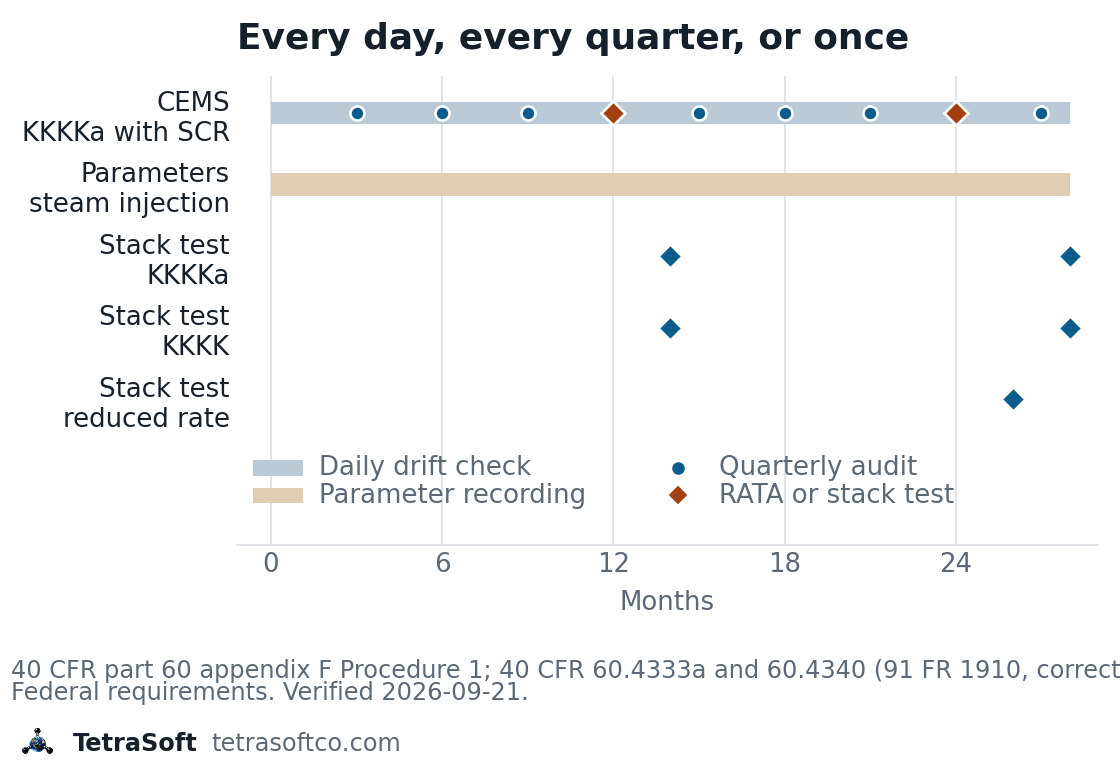
Each row is one equipment class and the standard it falls under: subpart KKKKa for the two turbine cases, subpart KKKK for the older turbines, subpart JJJJ for the engines. [1] The paths differ in kind rather than in degree: one is a daily and quarterly program, one is a recording obligation, and the rest are appointments.
Failing an audit is expensive in data rather than in fees. During an out-of-control period the CEMS data “may not be used in calculating emission compliance nor be counted towards meeting minimum data availabilty [sic]” [4]. A relative accuracy test audit must always be used following an out-of-control period that a relative accuracy test audit caused [4].
Two bad quarters in a row escalate past the monitor itself [4]. Whenever excessive inaccuracies occur for two consecutive quarters, the owner must revise the quality control procedures or modify or replace the CEMS [4]. That is a rule about the program, not about the instrument.
TetraSoft Atlas, our subscription platform, puts well, production and emissions records for eight states in one dashboard, which is where locating a fleet’s units starts. We are expanding Atlas to every US state.
Continuous Methane Monitoring Is Not a CEMS
The two instruments answer different questions, which is why one is not a version of the other. A CEMS measures the concentration of a regulated pollutant in a stack, where the gas is contained and the flow is known [3]. A CEMS exists to prove a numeric emission limit is being met [1]. Under these turbine standards that means NOx, or sulfur dioxide where a unit demonstrates that limit with a CEMS [1].
Continuous methane monitoring points the other way: it watches the air around equipment for leaks that have no stack and no permitted limit [6]. A methane monitor is an alternative to walking the site with a camera, not an alternative to a CEMS [6]. Nothing in appendix B or appendix F applies to it. The methane monitor shares the word continuous with a CEMS and nothing else.
Subpart OOOOb, which carries section 60.5398b, was amended in April 2026 with discrete technical changes to its flaring and net heating value monitoring provisions [22]. Treat what follows as the current text of a rule still being amended. What that April 2026 amendment changed is covered in EPA’s April 2026 OOOOb/OOOOc Amendment: What Changed.
An operator evaluating a continuous methane monitor is usually not shopping for a CEMS at all. Section 60.5398b sets alternative standards that pair an advanced methane detection technology with a work practice, covering both periodic screening and continuous monitoring solutions [6].
The Two Regimes Grade Adequacy Differently
The two regimes do not share their measures of adequacy. A CEMS is judged by relative accuracy against a reference method at the stack [4]. An alternative test method under 60.5398b is judged by its minimum detection level for methane [6]. That level sets the screening frequency, across a range from 1 to 15 kilograms per hour [6].
Neither number converts into the other. A monitor with an excellent detection level has said nothing about relative accuracy. A certified CEMS has said nothing about how small a leak it would find.
A Methane Monitor Does Not Replace a CEMS in a Budget
The practical consequence is that the two cannot be substituted for each other. A continuous methane monitor at a well site does not discharge a turbine’s NOx obligation. A certified NOx CEMS on a turbine stack does not satisfy a fugitive components work practice.
Budgeting them separately is the honest starting point. Where a site carries both, it carries both programs.
The alternative to a CEMS on the equipment side is a periodic stack test, which has its own methods and its own limits [9]. Those are covered in What Is Stack Testing? Methods, Rules, and Its Limits. Which monitoring a permit imposes on top of the standards is a separate question, covered in Air Quality Permit Types: Title V, PSD, and Their Thresholds.
Frequently Asked Questions
What does a cylinder gas audit cost you that a RATA does not?
Coverage rather than money. A cylinder gas audit challenges the system with known-concentration gas, passed through its normal sampling train, rather than against a reference method [4]. A cylinder gas audit therefore tests the monitor’s response but not its accuracy against a measured stack. That is why appendix F caps it at three of four quarters and forbids more than three in succession [4].
What happens to CEMS data during an out-of-control period?
It cannot be used to calculate compliance and does not count toward minimum data availability [4]. The period runs from the end of the failed audit to the end of the next successful one [4]. A failed relative accuracy test audit can only be cleared by another one [4].
Does a CEMS satisfy a Title V monitoring condition on its own?
Not by itself. A permit can require monitoring the standards do not, and it can impose reporting on top of the CEMS data [23]. Read the permit alongside the subpart rather than assuming the certified monitor discharges both.
Get regulatory updates and emissions data insights in your inbox. Subscribe to the TetraSoft newsletter.
References
- 40 CFR part 60, appendix B. Performance Specifications. US Code of Federal Regulations.
- 40 CFR part 60, appendix F, Procedure 1. Quality Assurance Requirements for Gas Continuous Emission Monitoring Systems Used for Compliance Determination. US Code of Federal Regulations.
- EPA, Continuous Emission Monitoring Systems, Emissions Measurement Center. US Environmental Protection Agency. https://www.epa.gov/emc/emc-continuous-emission-monitoring-systems
- 91 FR 1910, 15 January 2026. EPA, New Source Performance Standards Review for Stationary Combustion Turbines and Stationary Gas Turbines. Final rule, docket EPA-HQ-OAR-2024-0419, pages 1910 to 2005.
- 40 CFR 60.4333a. What are my general requirements for complying with this subpart? Subpart KKKKa, as promulgated at 91 FR 1910.
- 40 CFR 60.4340. How do I demonstrate continuous compliance for NOX if I do not use water or steam injection? Subpart KKKK, as amended at 91 FR 1910.
- 40 CFR 60.4243. What are my compliance requirements if I am an owner or operator of a stationary SI internal combustion engine? Subpart JJJJ, US Code of Federal Regulations.
- 40 CFR 60.5398b. What alternative GHG and VOC standards apply to fugitive emissions components affected facilities. Subpart OOOOb, US Code of Federal Regulations.
- 40 CFR 70.6. Permit content, monitoring and compliance requirements. US Code of Federal Regulations.
- 91 FR 43561, 16 July 2026. EPA, New Source Performance Standards Review for Stationary Combustion Turbines and Stationary Gas Turbines; Correction.
- 91 FR 18056, 9 April 2026. EPA, Reconsideration of Standards of Performance for New, Reconstructed, and Modified Sources and Emissions Guidelines for Existing Sources: Oil and Natural Gas Sector Climate Review. Final rule. Deadlines previously extended at 90 FR 35966 and 90 FR 55671.
- 40 CFR 60.5365b. Am I subject to this subpart? Subpart OOOOb.
- 40 CFR 60.5375b. Standards for well completions at well affected facilities. Subpart OOOOb.
- 40 CFR 60.5376b. Standards for gas well liquids unloading operations. Subpart OOOOb.
- 40 CFR 60.5377b. Standards for associated gas wells at well affected facilities. Subpart OOOOb.
- 40 CFR 60.5395b. Standards for storage vessel affected facilities. Subpart OOOOb.
- 40 CFR 60.5397b. Standards for fugitive emissions components affected facilities. Subpart OOOOb.
- 40 CFR 60.5407b. Monitoring requirements for sweetening unit affected facilities. Subpart OOOOb.
- 40 CFR 60.5412b. Initial compliance requirements for control devices. Subpart OOOOb.
- 40 CFR 60.5417b. Continuous monitoring requirements for control devices. Subpart OOOOb.
- 40 CFR 60.5430b. Definitions. Subpart OOOOb.
- 40 CFR 63.773. Inspection and monitoring requirements. Part 63, subpart HH.
- 40 CFR part 63, subpart HH. National Emission Standards for Hazardous Air Pollutants From Oil and Natural Gas Production Facilities.
This post is for informational purposes only and does not constitute legal or compliance advice. Consult qualified legal counsel or a compliance professional for guidance specific to your operations and jurisdiction.
Interactive tool
Does this turbine need a CEMS?
Two facts decide it: when the turbine commenced construction, modification or reconstruction, and what controls its NOx. The answer changed on 15 January 2026 for turbines built after 13 December 2024.
Performance test history
CEMS required
Yes
- Subpart
- Subpart KKKKa
- Test interval
- not applicable
- Next test due
- not applicable
What this turbine owes
- Calibration drift checked at two concentration values at least once daily.
- An accuracy audit at least once each calendar quarter, successive audits no closer than two months apart.
- A relative accuracy test audit at least once every four calendar quarters.
- A cylinder gas audit in at most three of four calendar quarters, and no more than three quarters in succession.
- Data from an out-of-control period excluded from compliance and from minimum data availability.
- Excessive inaccuracy in two consecutive quarters forces revised QC procedures, or modifying or replacing the CEMS.
91 FR 1910, 15 January 2026
Built from 91 FR 1910, 15 January 2026 and 40 CFR part 60, appendix F, Procedure 1, with the periodic-test intervals from 40 CFR 60.4333a and 40 CFR 60.4340. It covers subparts KKKK and KKKKa only. A turbine that commenced on or before 18 February 2005 falls under subpart GG, and this tool says so rather than guessing. A permit can impose monitoring the standards do not, so read your permit as well as the subpart. Nothing leaves your browser.
Comments
0Share your thoughts. All comments are moderated before appearing.
No comments yet. Be the first to share your thoughts!