Buying EHS software to solve an emissions-reporting problem is a category error that costs a licence fee to discover. An environmental, health and safety management system is a system of record, and that is the right shape for most of what an operator owes. Title V reporting is deadlines, documents and signatures, which a record system handles well [1].
A minority of obligations is instead a quantity somebody has to derive, and for those the software holds whatever figure is typed in. That minority is where the emissions work sits.
Quick Answer: EHS management software is a system of record, and most regulatory obligations are records. Title V asks for semiannual monitoring results, prompt deviation reports and an annual compliance certification [1]. The exceptions are derived quantities: Subpart W sets four calculation methods in a fixed order and the rule chooses, not the vendor [2].
What an EHS Management System Is For
An EHS management system tracks documents, deadlines, tasks, assignments and sign-off, and the category has consolidated around a handful of platforms offering the same list. Incidents, inspections, audits, corrective actions, training, permits, tasks and documents appear on nearly every one.
Those modules solve a real and expensive problem. A compliance obligation that nobody is assigned and nothing tracks is one that gets missed.
Title V Obligations Are Dates, Documents and Signatures
Title V spells out exactly what each record has to be, which makes it the clearest case in the set [1]. Reports of any required monitoring are submitted at least every six months under 40 CFR 70.6(a)(3)(iii)(A) [1]. That is the EPA regulation setting what a Title V permit must contain [1].
The six-month floor is statutory, from Clean Air Act section 504(a) [1]. Deviations are reported promptly under 70.6(a)(3)(iii)(B), with the permitting authority defining what prompt means [1]. Compliance certifications go in not less than annually under 70.6(c)(5)(i) [1].
Every one of those is a date, a document and an owner. Which permits impose them, and at what thresholds, is covered in Air Quality Permit Types: Title V, PSD, and Their Thresholds.
The Obligations That Really Are Documents
A spill prevention plan is a document to prepare, keep and amend, with no calculation attached [3]. The requirement is self-implementing, so there is no agency approval to chase and the obligation is to prepare, keep and amend the plan itself [3]. A system that stores the current version, tracks the review date and records who signed it has genuinely discharged the software’s part.
Fugitive component surveys sit here too, in the sense that matters for software [4]. The work practice generates survey records and repair records on a schedule, which is document and deadline work [4]. That subpart is under reconsideration, so treat its schedule as current rather than settled. What the plan itself has to contain is covered in SPCC Plan Requirements: Do You Need One, and Which Tier?.
Where the Software Stops
Four of the ten obligations in the card below are a quantity rather than a document. For each of those the rule specifies how the quantity is to be produced [2]. No amount of workflow turns a system of record into a calculation engine.
The card above will happily return zero for a site whose obligations are all records. Tick your own list rather than assuming either result.
The System Stores Whatever You Type
An emissions figure entered into an EHS system is stored, versioned and routed for approval, and none of that examines whether it is right. None of that makes the figure right.
The provenance question survives the purchase intact. Where the number came from and which method the rule required are both still open after the software is installed. So is whether it can be reconciled against a measurement.
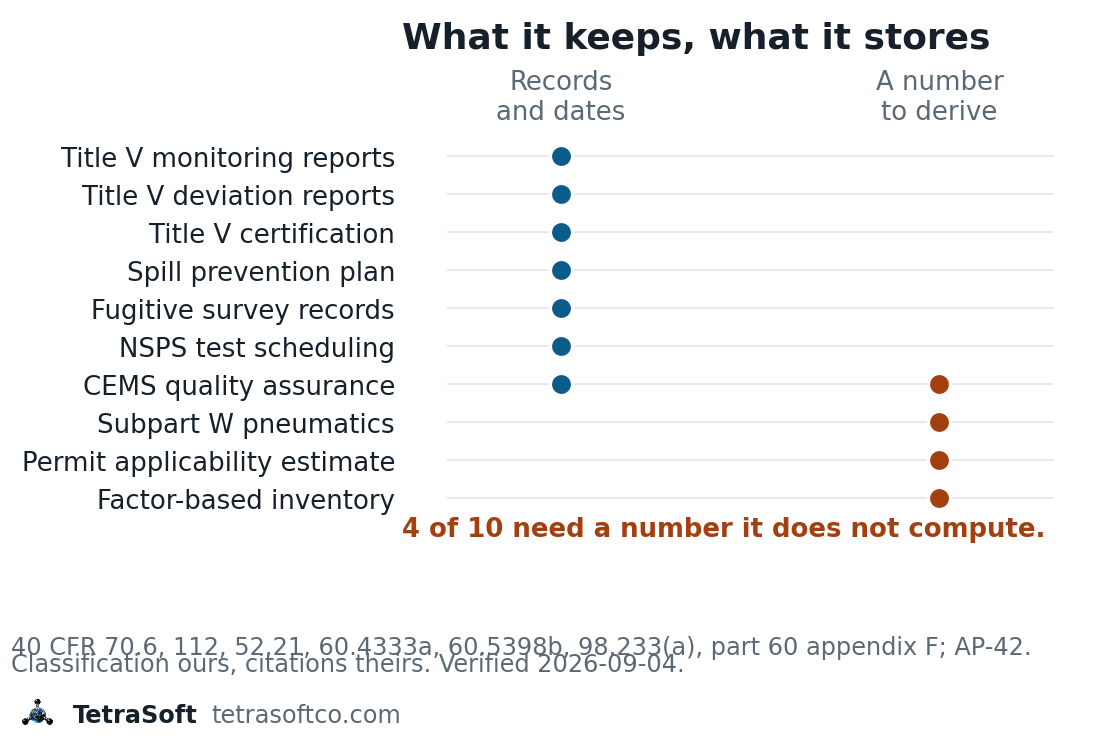
Six of the ten are document work. The four that are not are the ones an operator was hoping the purchase would answer.
The Rule Chooses the Method, Not the Vendor
Subpart W gives natural gas pneumatic devices four calculation methods in a fixed order, and the rule picks which one applies [5]. They run from a supply-line flow meter to per-vent measurement, then intermittent-bleed monitoring, then population factors [2]. Method 1 reads a continuous flow meter on the supply line and Method 2 measures each device vent [2]. Method 3 monitors intermittent-bleed devices and Method 4 applies population factors [2].
Default Emission Factors: Subpart W Bars Them for Pneumatics sets out all four [5]. No configuration setting overrides that hierarchy. Where a continuous flow meter sits on the supply line, 40 CFR 98.233(a) says you must use the meter [2].
The default population factors are the last of the four [5]. EPA states that Calculation Method 4 may not be used for devices a reporter is required or elects to measure [5]. A configurable field in a compliance system cannot know which of those applies to a given device, and it does not ask.
What Subpart W still requires, and what is under reconsideration, is covered in GHGRP Subpart W Reporting in 2026: What Is Still Required.
What to Ask a Vendor Before Buying
The question worth asking at a vendor demonstration is which of your obligations the system derives rather than stores. Which modules exist separates almost none of them.
Three Questions That Separate the Two Halves
Three questions separate the halves, and the first is which obligations the system computes rather than records. Ask what happens when the underlying emission factor table is revised, because those tables do get replaced [6]. Ask who is accountable when a stored figure cannot be reconciled against a measurement.
A vendor who answers the first question with a module name has answered a different question. A monitoring program the system schedules but cannot validate is the same pattern again. What periodic testing does and does not establish is covered in What Is Stack Testing? Methods, Rules, and Its Limits.
Where the Number Comes From Instead
For a derived obligation the number comes from a model of the site, not from the record system that stores it. TetraSoft does not sell an EHS management system.
It will not track your training records or your incident investigations, and has no opinion about your corrective action workflow. If the list you ticked above came back at zero, an EHS suite is very likely the whole answer for you.
What a wrong derived number costs is set by the rule it was filed under, not by the software licence [2]. A Subpart W figure produced by the wrong calculation method is not a smaller number or a larger one. It is a number produced by a method the rule did not permit for those devices. A Title V certification rests on the monitoring reports behind it, and those are signed [1].
For the obligations that came back on the other side, the work is modelling rather than filing. A default factor answers what equipment of this type usually emits. A mechanistic model answers what this equipment, at these conditions, would be expected to emit across a range of operating and failure states.
The rule decides the method for the derived obligations, and the record system stores the result without examining it. Producing a figure that survives that comparison is what the MAES Platform, built on a CSU partnership, is for [7].
The other half of a vendor answer is the source records themselves. A well count or an operator name is only as good as the register behind it. TetraSoft Atlas, our subscription platform, keeps the well and operator records for eight states on one map [8].
The factor-based route it replaces is covered in AP-42 Emission Factors by Source Type, and What They Assume.
Frequently Asked Questions
What does EHS management software actually do?
It is a system of record. It holds documents, deadlines, tasks, assignments and an audit trail, and it is genuinely good at those. Most regulatory obligations are exactly that shape, which is why the category exists and why it sells.
Will EHS software produce my emissions inventory?
It will hold one. Whether it derives one depends on the source, and for the sources that matter most in oil and gas the answer is usually no. The system stores the figure you enter and does not choose the calculation method the rule requires [2].
What happens to my stored numbers when an emission factor table is revised?
Nothing, unless somebody recalculates. The system holds a value rather than the table version or the method behind it, so last year’s figure sits there looking current. EPA replaced the Subpart W pneumatic tables in 2024, and the factors moved in both directions [6].
Can the software tell me which calculation method I am required to use?
No, because the trigger is a physical fact about your site. Subpart W sets four calculation methods in a fixed order [5]. Method 1, the meter-reading route, is mandatory where a continuous flow meter sits on the gas supply line [2].
Method 2 measures each device vent, Method 3 monitors intermittent-bleed devices and Method 4 applies population factors [2]. The system only knows that if somebody records it. The determination lives in the rule and the equipment, not in the configuration.
What should I ask a vendor before buying?
Ask which of your obligations the system derives rather than stores. Ask what happens when the underlying emission factor table is revised [6]. Ask who is accountable when a stored number cannot be reconciled against a measurement.
Get regulatory updates and emissions data insights in your inbox. Subscribe to the TetraSoft newsletter.
References
- 40 CFR 70.6. Permit content, monitoring and compliance requirements. US Code of Federal Regulations, including 70.6(a)(3)(iii)(A), 70.6(a)(3)(iii)(B) and 70.6(c)(5)(i).
- 40 CFR 112. Oil pollution prevention: spill prevention, control and countermeasure requirements. US Code of Federal Regulations.
- 40 CFR 60.5398b. What alternative GHG and VOC standards apply to fugitive emissions components affected facilities. Subpart OOOOb, US Code of Federal Regulations.
- 40 CFR 98.233(a). Calculating GHG emissions, natural gas pneumatic device venting. US Code of Federal Regulations.
- EPA, Subpart W Final Amendments Effective for RY2025. US Environmental Protection Agency, Greenhouse Gas Reporting Program briefing, December 2024.
- 40 CFR part 98, subpart W, table W-1. Default Whole Gas Population Emission Factors. US Code of Federal Regulations, as promulgated at 89 FR 42324.
- Mollel et al., 2025, ACS ES&T Air, 2, 723-735, DOI 10.1021/acsestair.4c00168. “Using Prototypical Oil and Gas Sites to Model Methane Emissions in Colorado’s Denver-Julesburg Basin Using a Mechanistic Emission Estimation Tool.” https://doi.org/10.1021/acsestair.4c00168
- TetraSoft Atlas, multi-state well and operator dataset covering Colorado, New Mexico, Ohio, Oklahoma, Pennsylvania, Texas, West Virginia and Wyoming, September 2026. https://www.tetrasoftco.com/atlas-landing.html
Disclosure: Arthur Santos, the author of this post, is a co-author of the Mollel et al. (2025) study cited here.
This post is for informational purposes only and does not constitute legal or compliance advice. Consult qualified legal counsel or a compliance professional for guidance specific to your operations and jurisdiction.
Interactive tool
Which obligations still need a number?
Tick what your sites actually carry. An EHS management system is a system of record, so the question is not which modules exist, it is how many of these leave a quantity the system can only store.
Obligations you carry
Still need a number
4 of 10
- Records and dates
- 6
- A number to derive
- 3
- Both
- 1
What each one actually asks for
- Title V semiannual monitoring reports Records and dates Submittal of reports of any required monitoring at least every 6 months.
- Title V deviation reporting Records and dates Prompt reporting of deviations, with the permitting authority defining what prompt means.
- Title V annual compliance certification Records and dates Compliance certifications submitted not less than annually.
- Spill prevention plan Records and dates A plan to prepare, keep and amend. Self-implementing, with no agency approval to track.
- Fugitive component survey records Records and dates A work practice with survey records behind it. The subpart is under reconsideration.
- NSPS performance test scheduling Records and dates A test due a fixed number of calendar months after the last one, on a schedule that changes with the result.
- CEMS quality assurance programme Both A daily and quarterly calendar the system can carry, around monitor data it cannot produce or validate.
- GHGRP Subpart W pneumatic devices A number to derive Four calculation methods in a fixed order, and the rule chooses, not the software.
- Preconstruction permit applicability estimate A number to derive Potential to emit, compared against a threshold. The comparison is trivial; the estimate is not.
- Factor-based emission inventory A number to derive Activity times a factor, less a control efficiency, in whatever unit the factor was published in.
Each row names the provision it comes from, so the classification can be checked against the rule rather than taken on trust. Where a line is drawn between keeping a record and deriving a quantity is our reading, not the regulation's wording. Subpart OOOOb and the Greenhouse Gas Reporting Program are both under reconsideration, so treat those rows as current rather than settled. TetraSoft does not sell an EHS management system. Nothing leaves your browser.
Comments
0Share your thoughts. All comments are moderated before appearing.
No comments yet. Be the first to share your thoughts!