Building before the permit is in hand is a violation that a later permit does not undo. Several oil and gas permits must come before construction or drilling starts. For example, an injection well that needs a permit cannot be built until the permit is issued [1]. Before a US oil and gas well is drilled or a compressor station is built, the operator needs authorizations from several agencies under different laws.
The scale is large: the injection well program alone covers approximately 180,000 Class II oil and gas wells in operation, by EPA’s count [2]. Searchers asking what permits an oil and gas site needs usually want three answers: the list, who issues each item, and the order.
This post gives all three for onshore production sites and for midstream sites such as compressor stations and gathering lines. Coverage runs from drilling and air through spill prevention, underground injection, stormwater, wetlands and greenhouse gas reporting. Water withdrawal, waste pits and road permits get less depth, because each state sets those its own way.
Quick Answer: Almost every onshore well needs a state drilling permit; most sites also need an air authorization and a spill prevention plan. A disposal or enhanced-recovery injection well needs authorization, and one that needs a permit cannot be built before the permit issues [1]. Oil and gas site stormwater needs no federal permit unless it is contaminated by contact with materials on the site [3]. The operator prepares the spill prevention plan and a Professional Engineer certifies it, unless a qualified facility self-certifies; no agency issues it [4].
On this page
- The Permits and Plans an Oil and Gas Site Needs
- Some Requirements Are Not Permits at All
- Most Permits Come From the State, With Clear Exceptions
- Each Program Measures Something Different
- Midstream Operations Add Pipeline and Interstate Permits
- Permit Order Is Where Oil and Gas Projects Usually Go Wrong
- Frequently Asked Questions
The Permits and Plans an Oil and Gas Site Needs
A producing well site typically answers to a state oil and gas agency, a state air agency and EPA. A few requirements reach almost every site, and others apply only when the site does something specific, such as injecting fluid or filling a wetland. The table lists both.
| Requirement | Issued by | When it applies |
|---|---|---|
| Drilling permit | State oil and gas agency; BLM on federal or Indian leases | Each new well, deepening or re-entry |
| Preconstruction air authorization | State or local air agency; the form varies by state | Emitting equipment the state’s minor source rules cover |
| Spill prevention (SPCC) plan | No one; prepared by the operator | Oil storage above the capacity threshold where a discharge could reach navigable waters |
| Underground injection permit | State UIC program or EPA | Disposal or enhanced-recovery injection |
| Title V operating permit | State air agency, or EPA | Major sources (100 short tons a year, or 10 of one hazardous air pollutant or 25 combined), plus some sources under federal emission standards |
| Stormwater permit | State water agency or EPA | Only after a reportable-quantity discharge or a water quality violation, or where a state rule requires it |
| Section 404 permit | US Army Corps of Engineers, or the state in Michigan and New Jersey | Fill placed in waters of the US, such as a pad, road or pipeline crossing |
| Emissions reporting (GHGRP) | Report to EPA; no permit | Onshore production or gathering emitting 25,000 metric tons CO2e or more a year in one basin |
Rows one to three reach most producing sites; the others turn on what the site does or how large it is.
EPA has proposed removing most source categories from greenhouse gas reporting and suspending the remaining Subpart W segments until reporting year 2034. The proposal was not final when this post was checked, so the 25,000-metric-ton CO2e threshold still applies. EPA is reconsidering Subpart W reporting requirements through 2034; data availability for future reporting years is uncertain.
The proposal put the program at about 8,200 facilities, suppliers and CO2 injection sites reporting each year. For reporting year 2023, 2,298 oil and gas facilities reported 322 million metric tons CO2e under Subpart W [5]. EPA cited a conservative estimate of $303 million a year in reporting burden, including the oil and natural gas sector. In a separate final rule, EPA moved the reporting year 2025 deadline from March 31 to October 30, 2026.
Some Requirements Are Not Permits at All
Operators often expect the spill prevention rule to produce an issued permit, but it does not. The rule sits at 40 CFR Part 112, EPA’s oil pollution prevention rule under the Clean Water Act [6]. 40 CFR is Title 40 of the Code of Federal Regulations, where EPA’s rules are published [7].
Part 112 applies to facilities that drill, produce, gather, store or process oil and could reasonably discharge it to navigable waters [6]. Such a facility is exempt only if its aboveground storage is 1,320 US gallons or less, counting containers of 55 gallons or more [6]. Its buried storage must also be 42,000 gallons or less [6].
The operator writes and implements a Spill Prevention, Control, and Countermeasure (SPCC) plan; a licensed Professional Engineer certifies it unless the facility qualifies to self-certify [4]. A production facility that starts operating must have its plan within six months [4]. Unlike some other federal environmental programs, EPA cannot delegate SPCC to the states [8].
A missing permit leaves a gap in an agency’s register.
A missing SPCC plan does not, because the plan is kept at the site or nearest field office, not filed [4]. EPA can ask to see it during working hours [4]. A discharge to water of over 1,000 gallons, or two of over 42 gallons within twelve months, triggers a report [9]. The operator then sends EPA specified facility and discharge information within 60 days [9].
Whether the rule applies at all is covered in SPCC Plan Requirements: Do You Need One, and Which Tier?.
Most Permits Come From the State, With Clear Exceptions
Most of these programs are federal laws that states run under EPA approval, so the application usually goes to a state agency. The exceptions matter, because in them the application goes to EPA, the Corps of Engineers or no one.
Drilling permits, spacing and pooling are state programs outright. Title V permits are mostly “issued by state or local agencies,” with a small number issued by EPA [10]. EPA runs the injection program for every well class, Class II included, in Hawaii, Iowa, Minnesota, New York, Pennsylvania and Virginia, and in DC [11].
Class II is the injection well class used only for fluids associated with oil and natural gas production [2]. EPA puts the number in operation in the United States at approximately 180,000 [2]. Disposal wells make up about 20 percent of them, and enhanced recovery wells as much as 80 percent [2].
How two states run their drilling permits, and where the records sit, is covered in NMOCD Permitting: Find and Map New Mexico Drilling Permits and Colorado Well Permit Search: Where ECMC Keeps the Records.
NPDES stormwater and wastewater permits are state-run in most states; EPA issues them in New Mexico and, for oil and gas activities, Oklahoma [12]. In Indian country, EPA almost always runs these programs directly [12]. SPCC stays with EPA in every state, because EPA cannot delegate it [8].
A state program can be stricter than the federal floor, so the state’s approved rule is the one to read. The federal rule gives the shape of the requirement rather than the requirement itself.
Each Program Measures Something Different
No two of these programs measure the same thing. The table sets out the trigger for each, with the rule that sets it.
| Program | The trigger | Where it is set |
|---|---|---|
| Spill prevention (SPCC) | Above 1,320 gallons aboveground or 42,000 gallons buried | 40 CFR 112.1 |
| Title V operating permit | Potential to emit 100 short tons a year of a pollutant, or 10 of one hazardous air pollutant or 25 combined; lower in some nonattainment areas | 40 CFR 70.2 |
| Federal preconstruction review (PSD) | A new major source: 250 short tons a year, or 100 for listed categories | 40 CFR 52.21 |
| Underground injection | Injecting fluid through a well, except gas storage and non-diesel hydraulic fracturing; by permit or by rule | 40 CFR 144.11 |
| Stormwater | A reportable-quantity discharge, or runoff contributing to a water quality standard violation | 40 CFR 122.26 |
| Greenhouse gas reporting | 25,000 metric tons CO2e a year | 40 CFR 98.231 |
Four of the six are compared against a number; injection turns on the act, and stormwater on a spill or a water quality violation.
Potential to emit is “the maximum capacity of a stationary source to emit” under its physical and operational design, not a measured rate [13]. Well sites below the major-source lines fall under state minor source review, and each state decides which facilities that review covers [14]. The thresholds are covered in Air Quality Permit Types: Title V, PSD, and Their Thresholds.
Part 70 makes one exception for wells when it counts hazardous air pollutants against its 10 and 25 tons per year thresholds [13]. Emissions from a production well and its equipment “shall not be aggregated with emissions from other similar units,” even under common control [13]. Pipeline compressor and pump stations get the same treatment [13]. The exception covers the hazardous air pollutant test only, not the 100 tons per year test for other pollutants.
Stormwater is the runoff from rain and snowmelt that flows over land or paved surfaces instead of soaking into the ground [15]. Section 402(l)(2) of the Clean Water Act bars EPA from requiring a permit for uncontaminated stormwater from oil and gas exploration, production, processing, treatment or transmission [3]. The same section bars EPA from making a state require one, though a state may still require one under its own law.
The exemption turns on contact [16]. The rule requires an application after a reportable-quantity discharge of oil or a hazardous substance, or where runoff contributes to a water quality standard violation [16].
For a detailed breakdown of injection well classes, see: UIC Well Classes: Class II, Class VI, and Where to Look.
Midstream Operations Add Pipeline and Interstate Permits
Midstream sites, the compressor stations, gas processing plants and gathering lines between well and market, need the same air, spill and wetland permits. SPCC names gathering and processing facilities explicitly [6]. A large compressor station is more likely than a well site to reach a Title V major-source threshold.
Pipelines add their own layer. Pipeline safety rules at 49 CFR Part 192 sort onshore gas gathering lines into types by location class, operating stress and, for Type C, diameter [17]. A location class counts buildings intended for human occupancy within 220 yards either side of a mile of pipe; Class 1 has 10 or fewer [18]. Lines that meet no type’s test are Type R, which carry reporting duties but are not regulated under Part 192 [17].
Type A lines follow most transmission-line requirements, with listed exceptions [19]. A Type B line runs a damage prevention program and a public education program, keeps line markers and conducts leakage surveys [19]. Type C lines are 8.625 inches or more in outside diameter, in Class 1 locations [17]. Above 12.75 inches, they also set a maximum allowable operating pressure and keep its records [19].
An interstate gas pipeline needs a certificate from the Federal Energy Regulatory Commission [20]. The Natural Gas Act does not apply to natural gas production or gathering [21]. Pipeline crossings of streams and wetlands can be authorized under the Corps of Engineers’ Nationwide Permit 12, subject to its conditions [22]. The permit covers up to half an acre of waters lost per single and complete project; each separate and distant pipeline crossing counts as one [22].
Get regulatory updates and emissions data insights in your inbox. Subscribe to the TetraSoft newsletter.
Permit Order Is Where Oil and Gas Projects Usually Go Wrong
The order matters more than the list, because several of these must be held before the work they govern. The chart places each requirement in the phase it belongs to.
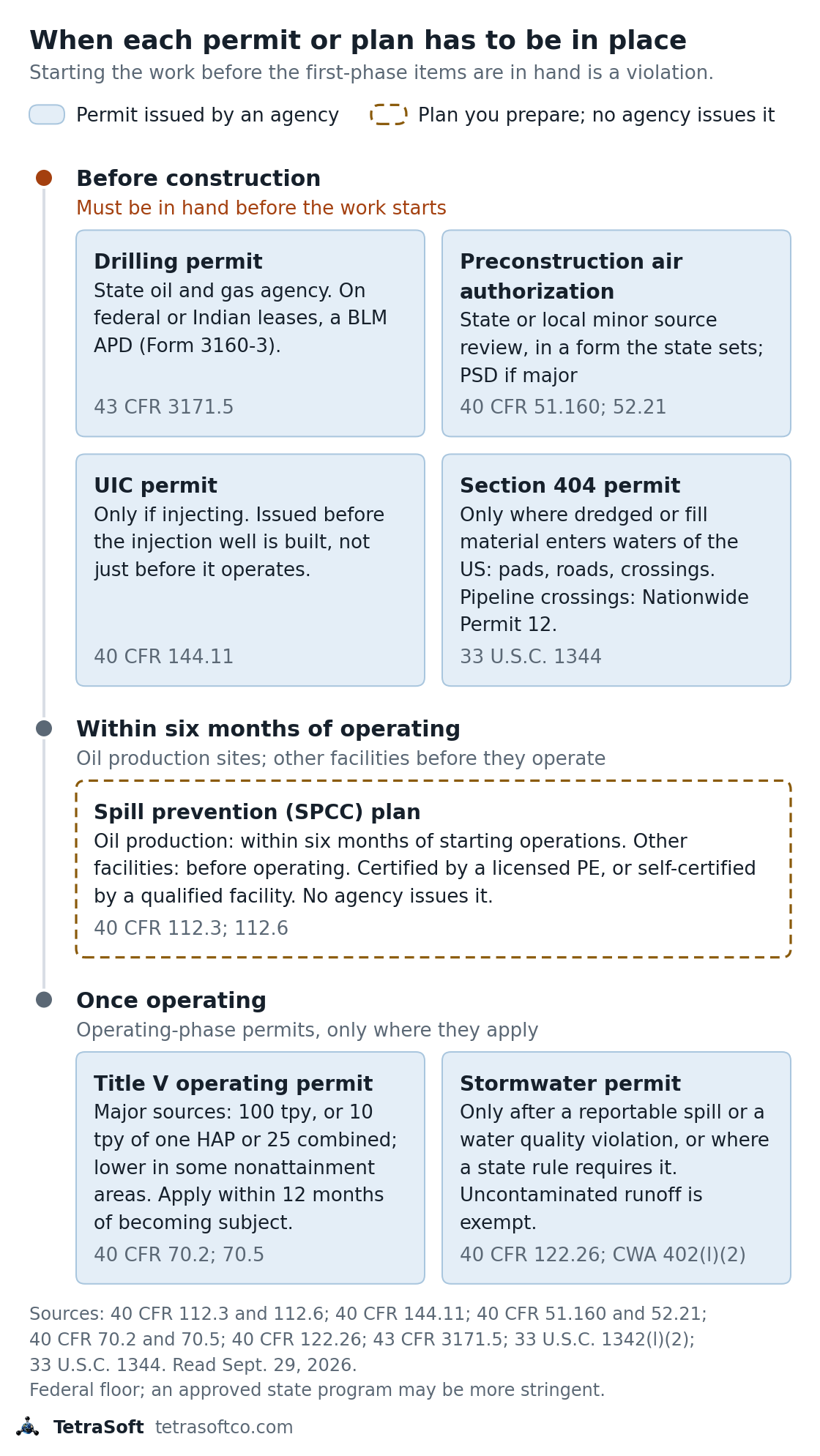
Everything in the first column authorizes an act, so starting the act without it is a violation.
Construction Permits Come Before Construction
A drilling permit authorizes the act of drilling, so it precedes the rig. On federal or Indian leases, an Application for Permit to Drill is required for each well [23]. Federal rules bar building an injection well that needs a permit until the permit is issued [1].
Preconstruction air authorization works the same way. State plans must include procedures to decide, before construction, whether a new facility would violate air rules [14]. A major source may not “begin actual construction without a permit” under federal PSD [24]. An operating permit obtained later cannot cure a construction that skipped these steps.
The operating-phase items come after. An oil production facility has six months after it begins operations to implement its SPCC plan; other facilities need one before operating [4]. A new major source must apply within 12 months of becoming subject to Title V, or sooner if the permitting authority sets an earlier date [25].
What Changes When a Site Is Modified
Modifying a site can restart several of these tests. Federal preconstruction review asks about the emissions increase a major modification produces, not the facility total [24]. Adding storage can cross the SPCC capacity threshold on its own [6].
An existing SPCC plan must also be amended when a change materially affects the facility’s potential to discharge oil [26]. The safest course is to re-check every trigger, from storage capacity to potential to emit, after any physical change.
Frequently Asked Questions
Who issues oil drilling permits?
The state oil and gas agency issues them, such as the Railroad Commission in Texas or the Oil Conservation Division in New Mexico. On federal or Indian leases, the Bureau of Land Management also requires an Application for Permit to Drill for each well [23]. After an APD arrives, BLM “typically conducts an onsite inspection” with the operator, surface owners and resource specialists [27].
How much oil can I have on site before I need an SPCC plan?
A site that could discharge oil to navigable waters needs a plan once aboveground storage exceeds 1,320 US gallons [6]. Only containers of 55 gallons or more count toward that total [6]. Buried storage over 42,000 gallons also triggers the rule [6].
A container that is permanently closed, as the rule defines it, counts toward neither total [6]. The buried total also leaves out intra-facility gathering lines regulated under 49 CFR Part 192 or 195 [6].
How long is an SPCC plan good for?
An SPCC plan does not expire, but the operator must review and evaluate it at least once every five years [26]. The plan must also be amended when the facility changes in a way that materially affects its potential to discharge oil [26]. The operator documents each review and signs a statement saying whether the plan will be amended [26]. A Professional Engineer certifies any technical amendment, unless the facility qualifies to self-certify [26].
What is the difference between SPCC and FRP?
An SPCC plan is a spill prevention plan kept at the facility, or at the nearest field office if the site is not normally attended [4]. A facility response plan covers responding to a discharge; a facility needs one if it could cause substantial harm, or if EPA requires one [28]. Unlike an SPCC plan, a facility response plan is submitted to EPA [28].
What is a Part 70 air permit?
The Title V operating permit takes its name from 40 CFR Part 70 [13]. Title V applies to major sources: generally 100 short tons a year of a pollutant, or 10 of one hazardous air pollutant or 25 combined [13]. The permit sets out, in legally enforceable form, the federal and state pollution control requirements that apply to the source [10].
A Title V permit runs for a term of no more than 5 years, except for certain municipal waste incinerators [29]. When it expires, the source loses its right to operate unless it filed a timely and complete renewal application [30].
Never miss an ONGAEIR or GHGRP deadline. Subscribe for compliance updates and regulatory news.
References
- 40 CFR 144.11, Prohibition of unauthorized injection. https://www.ecfr.gov/current/title-40/section-144.11
- EPA, Class II Oil and Gas Related Injection Wells, updated June 3, 2026. https://www.epa.gov/uic/class-ii-oil-and-gas-related-injection-wells
- 33 U.S.C. 1342(l)(2), Clean Water Act section 402(l)(2). https://www.govinfo.gov/link/uscode/33/1342?link-type=html
- 40 CFR 112.3, Requirement to prepare and implement an SPCC Plan. https://www.ecfr.gov/current/title-40/section-112.3
- EPA, Subpart W Petroleum and Natural Gas Systems industry profile, reporting year 2023. https://www.epa.gov/system/files/documents/2024-10/subpartw_profile_2023.pdf
- 40 CFR 112.1, General applicability. https://www.ecfr.gov/current/title-40/section-112.1
- EPA, Regulations: Title 40, Code of Federal Regulations. https://www.epa.gov/laws-regulations/regulations
- EPA, SPCC Guidance for Regional Inspectors, chapter 2. https://www.epa.gov/sites/default/files/2014-04/documents/2_applicability_2014.pdf
- 40 CFR 112.4, Amendment of SPCC Plan by Regional Administrator. https://www.ecfr.gov/current/title-40/section-112.4
- EPA, Basic Information about Operating Permits. https://www.epa.gov/title-v-operating-permits/basic-information-about-operating-permits
- EPA, Primary Enforcement Authority for the Underground Injection Control Program, state table for Hawaii, Iowa, Minnesota, New York, Pennsylvania, Virginia and the District of Columbia, updated September 15, 2026. https://www.epa.gov/uic/primary-enforcement-authority-underground-injection-control-program-0
- EPA, NPDES State Program Authority, state table including New Mexico and Oklahoma. https://www.epa.gov/npdes/npdes-state-program-authority
- 40 CFR 70.2, Definitions. https://www.ecfr.gov/current/title-40/section-70.2
- 40 CFR 51.160, Legally enforceable procedures. https://www.ecfr.gov/current/title-40/section-51.160
- EPA, NPDES Stormwater Program. https://www.epa.gov/npdes/npdes-stormwater-program
- 40 CFR 122.26, Storm water discharges. https://www.ecfr.gov/current/title-40/section-122.26
- 49 CFR 192.8, How are onshore gathering pipelines and regulated onshore gathering pipelines determined? https://www.ecfr.gov/current/title-49/section-192.8
- 49 CFR 192.5, Class locations. https://www.ecfr.gov/current/title-49/section-192.5
- 49 CFR 192.9, What requirements apply to gathering lines? https://www.ecfr.gov/current/title-49/section-192.9
- 15 U.S.C. 717f, Natural Gas Act certificates. https://www.govinfo.gov/link/uscode/15/717f?link-type=html
- Natural Gas Act section 1(b), exemption for production and gathering, 15 U.S.C. 717(b). https://www.govinfo.gov/link/uscode/15/717?link-type=html
- 91 FR 768, Reissuance and Modification of Nationwide Permits, January 8, 2026. https://www.federalregister.gov/documents/2026/01/08/2026-00121/reissuance-and-modification-of-nationwide-permits
- 43 CFR 3171.5, Application for Permit to Drill. https://www.ecfr.gov/current/title-43/section-3171.5
- 40 CFR 52.21, Prevention of significant deterioration of air quality. https://www.ecfr.gov/current/title-40/section-52.21
- 40 CFR 70.5, Permit applications. https://www.ecfr.gov/current/title-40/section-70.5
- 40 CFR 112.5, Amendment of SPCC Plan by owners or operators. https://www.ecfr.gov/current/title-40/section-112.5
- Bureau of Land Management, Oil and Gas Operations and Production. https://www.blm.gov/programs/energy-and-minerals/oil-and-gas/operations-and-production
- 40 CFR 112.20, Facility response plans. https://www.ecfr.gov/current/title-40/section-112.20
- 40 CFR 70.6, Permit content. https://www.ecfr.gov/current/title-40/section-70.6
- 40 CFR 70.7, Permit issuance, renewal, reopenings, and revisions. https://www.ecfr.gov/current/title-40/section-70.7
- 90 FR 44591, Reconsideration of the Greenhouse Gas Reporting Program, September 16, 2025. https://www.federalregister.gov/documents/2025/09/16/2025-17923/reconsideration-of-the-greenhouse-gas-reporting-program
- 91 FR 9712, Extending the Reporting Deadline Under the Greenhouse Gas Reporting Rule for 2025, February 27, 2026. https://www.federalregister.gov/documents/2026/02/27/2026-03995/extending-the-reporting-deadline-under-the-greenhouse-gas-reporting-rule-for-2025
Interactive tool
Which permits attach, and in what order
Pick what you are doing. This lists the federal requirements in the order they attach and flags the ones that cannot be obtained after the work has started.
Must be held before the work starts
3 of 6 requirements
Sequence matters here
In order
- Before construction Drilling permit State law; 43 CFR 3171.5 on federal or Indian leases State oil and gas agency; BLM (Form 3160-3 APD) on federal or Indian leases Cannot be obtained after the act
- Before construction Preconstruction air authorization (state minor NSR, permit-by-rule or general permit; PSD if major) 40 CFR 51.160; 52.21 State air agency, or EPA where undelegated PSD applies only to a new major source or a major modification Cannot be obtained after the act
- Before construction Clean Water Act Section 404 permit 33 U.S.C. 1344 US Army Corps of Engineers, or the state in Michigan and New Jersey Only where fill is placed in waters of the US: pads, roads, pipeline crossings (Nationwide Permit 12 for pipelines) Cannot be obtained after the act
- Within six months of operating Spill prevention (SPCC) plan 40 CFR 112.3 Nobody: certified by a licensed PE, or self-certified by a qualified facility (40 CFR 112.6) An oil production facility prepares and implements it within six months after operations begin; other facilities need it before operating
- Once operating Title V operating permit 40 CFR 70.5 State air agency, or EPA where undelegated Major sources only; apply within 12 months of becoming subject
- Once operating Stormwater permit 33 U.S.C. 1342(l)(2) State NPDES programme or EPA Only after a reportable-quantity discharge or runoff contributing to a water quality violation, or where state law requires one (Colorado requires construction stormwater coverage); other oil and gas runoff is exempt
Federal requirements, from 40 CFR 51.160, 52.21, 70.5, 112.3 and 144.11, 43 CFR 3171.5 and 33 U.S.C. 1342(l)(2) and 1344, read September 29, 2026. Drilling permits are issued by the state oil and gas agency, or by BLM on federal or Indian leases. The SPCC plan is prepared and certified by the operator; no agency issues it. An approved state programme may be more stringent, and this is a sequence reference rather than an applicability determination. Whether a threshold is actually crossed is a separate question with its own tools. Nothing leaves your browser.
Comments
0Share your thoughts. All comments are moderated before appearing.
No comments yet. Be the first to share your thoughts!