If you own minerals under a producing well, the company paying you each month also prepares every figure the payment rests on. Nothing on the stub compares its volume with the state’s record, and in this post’s worked example one unpaid month costs about $1,467. The Railroad Commission of Texas (RRC), the state’s oil and gas regulator, says it cannot intervene in royalty matters [1]. The Oklahoma Corporation Commission (OCC), Oklahoma’s regulator, says in its owner booklet that district court has jurisdiction over payment of proceeds [2].
An oil and gas royalty is your share of what a well sells, paid under your lease, the contract letting a company produce your minerals. Each check arrives with a stub, the statement of figures behind it, and both come from the payor, the company paying you. Every royalty check rests on four figures: volume sold, price, your decimal interest, and taxes and deductions. Your stub usually shows all four figures, but the volume comes from a well you cannot see.
Since neither the RRC nor the OCC reviews payments, the first check, comparing the check with the well’s production, is yours to make. Texas, Oklahoma, Colorado, Wyoming and Pennsylvania generally require the stub to show volume, price, your interest and taxes, as does West Virginia for horizontal wells [3]. In order, the guide covers royalty math and taxes, checking your check against production, why the two differ, where to turn and unclaimed royalties. Texas, the largest oil-producing state in 2025, is the worked example, and tables give every covered state’s rule [4].
The guide does not cover federal or American Indian leases, whose revenues the Office of Natural Resources Revenue manages, or buying and selling royalties [5]. The guide is written for royalty owners in the eight states that TetraSoft Atlas, our subscription map of public oil and gas records, covers today [6]. The eight are Colorado, Texas, Oklahoma, Wyoming, New Mexico, Pennsylvania, West Virginia and Ohio, and we plan to expand Atlas to every US state [7]. Together they produced 68% of US crude oil, including lease condensate, and 83% of US marketed gas in 2025 [4].
Quick Answer: A royalty check is your decimal share of what the well sold, less taxes and deductions. Texas requires the stub to show the volume sold, the price, your decimal, the taxes and deductions taken, and your net value [1]. To check the volume, compare it with what the operator reported to the state, which in Texas covers a whole lease rather than one well [8].
How Are Oil and Gas Royalties Calculated?
Oil and gas royalties come to volume sold times price times your decimal interest, less production taxes and other deductions. The Railroad Commission’s royalties FAQ, its page of common owner questions, lists what Texas law makes each payment report [1]. It covers volume sold, price per barrel or Mcf (a thousand cubic feet of gas), taxes, other deductions, your decimal, and gross and net value [1]. Oklahoma’s Production Revenue Standards Act, its law on paying owners, lists ten similar items, among them the price and the taxes deducted [2].
Texas and Oklahoma are the examples here because both regulators publish plain guides for royalty owners; other states set their own rules. Texas House Bill 129, effective September 1, 2017, requires payors mailing paper checks to send stub details with the check unless the owner consents otherwise [9]. Oklahoma’s Governor approved House Bill 1371 on May 6, 2026, which amends the Act’s rules on interest and remittance [10]. Since November 1, 2026, it amends interest and unpaid-proceeds rules but leaves the booklet’s ten stub items and six-month first payment unchanged [10].
Your decimal interest is the share of the well’s revenue your division order assigns you [2]. Forty net mineral acres at a three-sixteenths royalty in a 640-acre unit gives a decimal of about 0.011719 [2]. Net mineral acres are the acres you own in the unit, 640 is the unit’s total acreage, and three-sixteenths is your royalty rate. The formula and its exceptions are covered in Division Order: What It Is and How to Check the Decimal.
Gas adds a step to the price line. Oklahoma requires the stub’s gas price to carry a British thermal unit (BTU) adjustment; a BTU is a standard unit of heat energy [2]. The adjustment scales the price to the gas’s heating value [2]. What that heating value measures is explained in Natural Gas BTU: What Wellhead Gas Actually Measures.
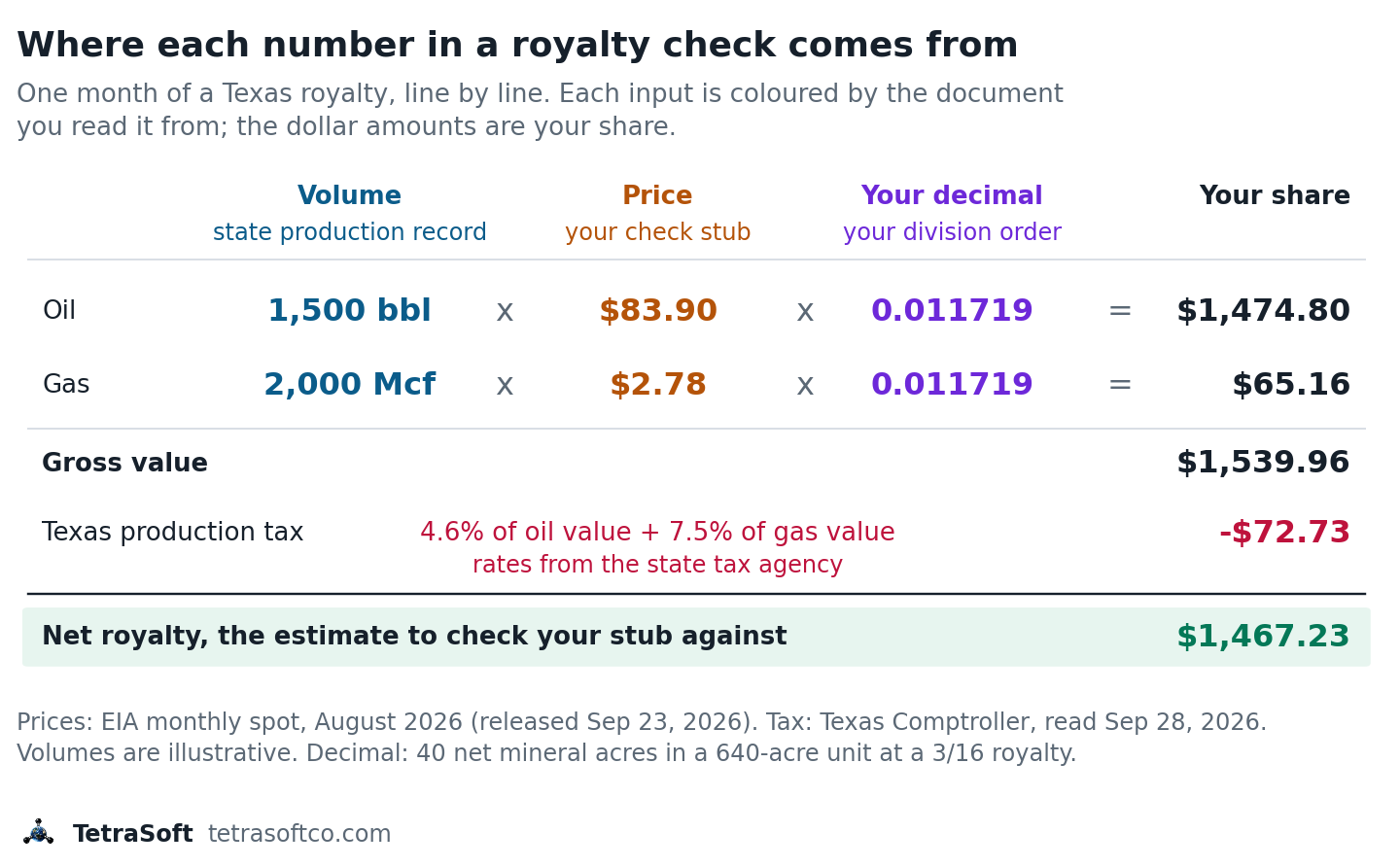
One month of the worked Texas example in the calculator below, and the document each number comes from.
State Production Taxes Come Out Before the Check
The tax line comes next in the formula, and a royalty owner’s share of it depends on the state the well is in [11]. A production tax, also called a severance or gross production tax, is collected on oil and gas as it is produced [12]. The table gives each state’s rule as the state’s own tax or fee agency states it, read September 28, 2026.
| State | Production tax, as the state describes it | Default in the calculator |
|---|---|---|
| Texas | Oil 4.6% and gas 7.5% of market value | 4.6% oil, 7.5% gas |
| Oklahoma | 5% for a new well’s first 36 months, 7% for all other production | 7% |
| New Mexico | Five taxes on taxable value, net of federal, state and tribal royalties | Your stub’s rate |
| Colorado | Royalty owners owe severance tax of 2% to 5% of gross income, stripper wells exempt; payors withhold 1% toward it | 1% withheld, or your stub’s rate |
| Wyoming | Base severance tax of 6.0% for oil and natural gas; stripper oil and some wells pay 4% or 5% | 6%, or your stub’s rate |
| West Virginia | 5% standard rate, but a royalty-only owner is not subject to it | 0%, or your stub’s rate |
| Ohio | 10 cents a barrel and 2.5 cents per Mcf, paid by the well owner that severs | 0% |
| Pennsylvania | An impact fee per unconventional well, paid by producers | 0% |
Texas taxes oil at 4.6% and gas at 7.5% of market value [11]. Oklahoma charges 5% for the first 36 months of a new well’s production and 7% for all other production [12]. Colorado’s payors withhold 1% of gross income toward the owner’s severance tax, which the owner settles on an annual return [13]. Wyoming’s base severance rate for oil and gas is 6.0% [14].
West Virginia’s standard rate is 5% of gross value, yet an owner who only receives royalty payments is not subject to that tax [15]. Ohio’s tax is paid by the persons or firms that sever, or extract, the oil or gas [16]. New Mexico levies five taxes on the taxable value of production, which is the price less government royalties and trucking [17]. The five are the severance, conservation, emergency school, ad valorem production and production equipment ad valorem taxes [17].
Pennsylvania’s Act 13 of 2012 charges producers an impact fee per unconventional gas well, set from the average natural gas price [18]. These are standard rates, and Texas taxes high-cost gas at 0% to 7.5%, depending on the well’s drilling and completion costs [11]. Colorado credits part of county ad valorem (property) taxes against severance tax, 75% for 2024 and 2025 and a per-well formula from 2026 [19]. For an Oklahoma well in its first 36 months, Form 341, the Tax Commission’s monthly tax report, sets the rate at 5%, so enter 5% [12].
The calculator applies one rate, so type your stub’s combined rate when it lists several taxes.
How to Check Your Royalty Check Against the Well’s Production
With the formula and the tax rate in hand, checking a royalty check means rebuilding it and asking the payor about any gap. Enter one month from your stub in the calculator below. Leave the tax rate blank to use your state’s default, or type the rate your stub shows.
The default prices are August 2026 averages from the US Energy Information Administration (EIA), the federal energy statistics agency [20]. They are $83.90 a barrel for West Texas Intermediate (WTI), a US benchmark crude, and $2.78 per million Btu for Henry Hub gas [20]. Both are benchmark spot prices, published market prices rather than what your payor received.
Enter the net amount the check paid, and the calculator shows the gap in dollars and as a percentage of the estimate. A gap is worth one question to the payor, and the reasons below say which line to ask about. The worked example applies Henry Hub’s price per million Btu to each Mcf and takes no deductions, so replace both with your stub’s figures.
Find Your Well’s Reported Production in Your State
The calculator needs a volume from outside the stub, and the state’s reported production for your well or lease is public [8]. States report it at different grains, though, and the grain decides what you can compare [8]. Grain here means what one reported figure covers: a single well, a well site, or a whole lease. Texas reports production by lease rather than by individual well [8].
An oil lease can include numerous wells, while each gas lease holds one gas well [8]. A lease in this sense is the Commission’s reporting unit with its own RRC identification number, which may differ from the number on your stub.
A Texas owner can request the lease’s RRC identification number from the payor by certified mail, with an answer due within 60 days [1]. With that number, the Commission’s free Production Data Query shows the lease’s reported production [1]. The query costs no money but costs time: without the lease and district numbers, you fall back on a lease-name search [21]. For an oil lease, its answer is still a lease total, not your one well’s output [8].
Oklahoma publishes production on a lease basis under the Tax Commission’s production unit number (PUN), the identifier the Commission assigns to each producing unit [12]. In Atlas, New Mexico, Wyoming, West Virginia, Pennsylvania and Ohio report by well and Colorado by well site, with Ohio’s figures yearly [6]. How to find a Texas lease’s records is covered in RRC Wellbore Query: How to Search Texas Well Records Online. Oklahoma’s search tools are covered in OCC Well Data Finder, Mapped: Oklahoma Wells and Gas Data.
| State | What one production figure in Atlas covers | How often |
|---|---|---|
| Texas | The lease total divided evenly among the wells on the lease | Monthly |
| Oklahoma | Not in Atlas: the Tax Commission’s lease data by production unit (PUN) | Monthly, at the Tax Commission |
| New Mexico, Wyoming, West Virginia | One well | Monthly |
| Pennsylvania | One well | Monthly and annual |
| Colorado | One well site | Monthly |
| Ohio | One well | Annual |
Atlas’s Texas oil-well figure is an even split of the lease total, not a number the operator reported for that one well [6]. Where your payment covers a whole oil lease, compare against the lease total.
See the Well’s Production in TetraSoft Atlas
Outside Oklahoma, TetraSoft Atlas puts the well behind your check on a map, with its operator, status and reported production in one record [6]. In Atlas you find a Texas well by its lease name or its API number, the unique identifier each well carries [6]. Elsewhere you search by the well’s name or API number, and in Colorado by site name, site ID (its identification number) or well API number [6]. Without the lease number from the stub or a name search, the free state lookup can mean a certified letter and up to 60 days.
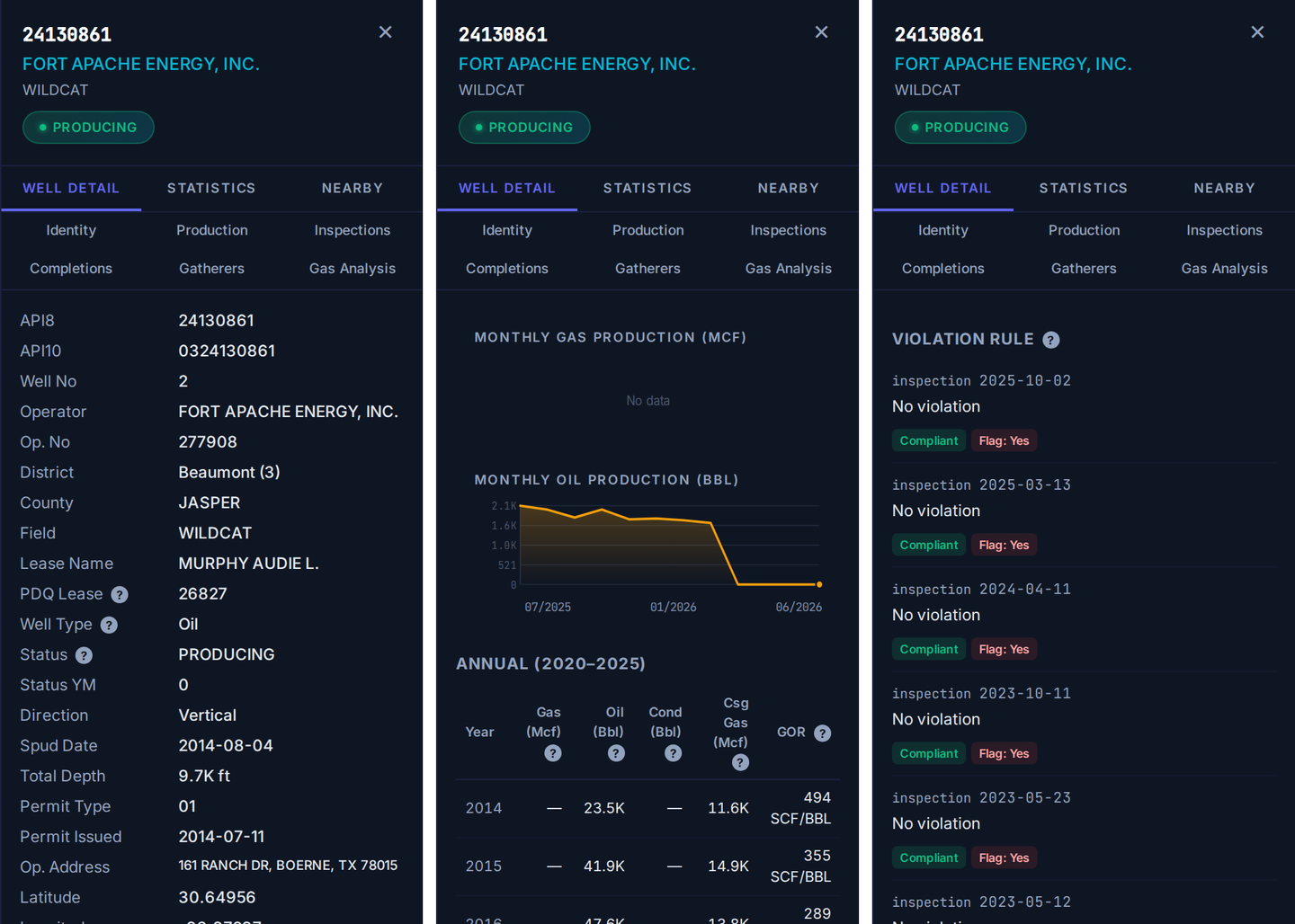
One Texas well in TetraSoft Atlas: its operator and lease, its monthly production (the lease total split across the lease’s wells) and its state inspections.
Atlas does not see your check, your lease terms or your ownership, and it does not replace the payor’s line items [6]. Atlas’s figures come from the production operators reported to the state, while your stub pays on the volume sold. A missing month is one error that comparison catches. At the worked example’s estimate, one unpaid month costs the owner about $1,467, and a 10% volume shortfall about $147 a month.
The decimal and the price are on paper you already hold. Atlas shows the third number: your well’s reported production, or in Texas the lease total split evenly across its wells, not one well’s volume [6]. It does so in seven of its eight states; Oklahoma is the exception [6].
The TetraSoft Atlas free trial runs 7 days and is self-serve, with no sales call and no credit card [7].
Why Your Estimate and Your Check Stub Differ
Once the calculator shows a gap, the question is why: estimate and stub can differ on price, volume, deductions, timing, tax and held payments. The price on your stub is what the payor received, which differs from a benchmark like WTI. A Texas oil lease’s volume is shared among its wells, so a per-well figure is an allocation, not a meter reading [8].
Your stub also reports the volume sold, while the state record shows the volume produced [1]. Texas tracks each lease’s disposition, meaning how the operator handled what it produced, and that is where the two figures part [8]. The Commission’s crude oil figures do not include condensate, the liquid hydrocarbons produced from a gas well; the Commission reports condensate separately [8].
Texas owners can ask the payor for itemized deductions and the gas’s heating value by certified mail [1]. Whether your lease allows a given deduction is a lease question, and the Railroad Commission says lease matters are outside its authority [1]. A Texas payor may also hold payments until they total $100, which shifts when money arrives [1].
Timing moves the numbers too: Texas production reports are due at the end of the next month, a two-month lag online [8]. Operators also revise late or corrected reports, and the Railroad Commission says records are substantially complete after about six months [8]. That six-month settling period surprised us. Compare a month at least six months old before treating a Texas gap as real.
Where to Turn in Your State When the Check Looks Wrong
When a gap survives the six-month wait, call the payor named on the stub first. Each state’s payment law sets what happens next. For unpaid Texas royalties, the owner mails written notice and, after 30 days without payment or a reasonable cause, can sue in the well’s county [22]. The table gives each Atlas state’s law, whether it lists what the stub must show, and who decides a dispute [3].
| State | Payment law | Stub must list the figures | Who decides a dispute |
|---|---|---|---|
| Texas | Natural Resources Code ch. 91 | Yes, 12 items | For late or missing payment: court in the well’s county, after written notice and 30 days |
| Oklahoma | Production Revenue Standards Act | Yes, 10 items | District court; the Corporation Commission has no power over payment of proceeds |
| New Mexico | Oil and Gas Proceeds Payment Act | Not confirmed here; the Act sets payment deadlines and late-payment interest | District court, in the reported cases under the Act |
| Colorado | C.R.S. §34-60-118.5 | Yes, 9 items | ECMC hearing on Form 38, the Commission’s payment-of-proceeds hearing request, unless a bona fide dispute over the contract’s meaning sends it to court |
| Wyoming | Royalty Payment Act | Yes, 11 items | District court in the well’s county; unpaid royalties earn 18% interest |
| Pennsylvania | Oil and Gas Lease Act, Act 153 of 2022 | Yes, 10 items each, separate lists for conventional and unconventional wells | Not set by this law; for unconventional wells, payment is due 120 days after first sale, then 60 days after the sale month, with interest if late; you can sue for missing stub data 60 days after a certified-mail request |
| West Virginia | W. Va. Code §37C-1-1, horizontal wells | Yes, 10 items | Not set by this law; you can sue for missing stub data 60 days after a certified-mail request |
| Ohio | Ohio Rev. Code §1509.30 | On request, for gas wells: volume paid, price per Mcf and metered volume | Not set by §1509.30 |
State payment statutes as read October 27, 2026. Oklahoma’s House Bill 1371 changes the Act’s interest and unpaid-proceeds rules from November 1, 2026.
On federal or American Indian leases, the Office of Natural Resources Revenue runs a State and Indian Outreach service that it says “is designed to resolve royalty related problems.” [23]
Unclaimed Oil Royalties Go to the State
A check that never arrives is a different kind of gap, and the money may already sit with the state. Royalties that go unclaimed are turned over to the state, and in Texas the Comptroller’s unclaimed property program holds them [1]. Mineral royalties were among the property types the Comptroller returned to owners in fiscal 2024 [24]. In Texas, a person who tells you about such property may not charge a finder’s fee above 10 percent of its value [1].
Oklahoma sends the royalties of owners listed as unlocatable in a pooling order to the Corporation Commission’s Mineral Owner Escrow Account [2]. A pooling order is the Commission’s order setting participation options for unit owners who have not agreed on a well, including unlocatable ones. Money already deposited with the state is claimed through the State Treasurer’s unclaimed property office [2]. House Bill 1371 also lets a payor in contact with the owner send proceeds unpaid for 36 months to the Treasurer’s Mineral Owner’s Fund [10].
Finding the right well first helps, and reading its API number is explained in API Well Number Lookup: What It Is and How to Read One.
This post is for informational purposes only and does not constitute legal or compliance advice. Consult qualified legal counsel or a compliance professional for guidance specific to your operations and jurisdiction.
Frequently Asked Questions
Do royalty owners pay severance tax?
That depends on the state: Colorado says royalty owners owe severance tax on gross income, and payors withhold 1% toward it [13]. West Virginia says an owner who only receives royalty payments is not subject to its severance tax [15]. Oklahoma requires the stub to show the production and severance taxes deducted [2]. Texas requires a line for taxes deducted as well [1].
When should my first royalty check arrive?
In Texas, the first payment is due 120 days after the end of the month of first sale [1]. Later payments follow 60 days after the month oil sold and 90 days after the month gas sold [1]. Oklahoma calls for the first payment within six months of first sale [2].
How are oil and gas royalties taxed?
On a federal return, royalties from oil, gas or mineral properties go on line 4 of Schedule E, the schedule for rental and royalty income [25]. A payer who paid you $10 or more in royalties in 2025 should send a Form 1099-MISC, the return reporting those payments [25]. Owners of an economic interest in mineral property may be able to deduct depletion [25]. Royalty owners and independent producers may deduct 15 percent depletion on average daily output up to 1,000 barrels, within 65 percent of pre-depletion taxable income [26].
Why did my royalty checks stop?
A title dispute is one cause: unless the lease says otherwise, Texas lets a payor suspend payment without interest until the dispute is resolved [1]. Small amounts can also be held until they total $100, or after 12 months once they exceed $10 [1]. If neither applies, ask the payor in writing why payment stopped.
How much does TetraSoft Atlas cost?
Atlas plans scale with the number of seats, and self-serve plans start with a 7-day free trial [7]. The trial needs no credit card, and no sales call is required [7]. For current plans and prices, see the Atlas pricing page [7].
References
- Railroad Commission of Texas, Royalties FAQ.
- Oklahoma Corporation Commission, Royalty Owners Information booklet, November 2020. https://oklahoma.gov/content/dam/ok/en/occ/documents/og/pubasst/Royalty-Owners-Booklet-112020.pdf
- State royalty payment statutes: Tex. Nat. Res. Code §91.502; Okla. Production Revenue Standards Act, 52 O.S. §570.1 et seq.; C.R.S. §34-60-118.5; Wyo. Stat. §§30-5-301 to -305; Pa. Oil and Gas Lease Act as amended by Act 153 of 2022; W. Va. Code §37C-1-1; NMSA 1978 §§70-10-1 to -6; Ohio Rev. Code §1509.30
- U.S. Energy Information Administration, 2025 state crude oil and marketed gas production. https://www.eia.gov/dnav/pet/pet_crd_crpdn_adc_mbbl_a.htm and https://www.eia.gov/dnav/ng/ng_prod_sum_a_EPG0_VGM_mmcf_a.htm
- USA.gov, Office of Natural Resources Revenue agency page. https://www.usa.gov/agencies/office-of-natural-resources-revenue
- TetraSoft Atlas, eight-state oil and gas dataset read September 2026. https://www.tetrasoftco.com/atlas-landing.html
- TetraSoft Atlas pricing page, read September 2026. https://www.tetrasoftco.com/atlas/pricing/
- Railroad Commission of Texas, PDQ production data FAQs.
- Texas Legislature, House Bill 129, 85th Legislature, enrolled text. https://capitol.texas.gov/tlodocs/85R/billtext/html/HB00129F.htm
- Oklahoma House Bill 1371 of 2026, enrolled act and bill history. http://www.oklegislature.gov/BillInfo.aspx?Bill=HB1371&Session=2600
- Texas Comptroller of Public Accounts, Crude Oil and Natural Gas Production Tax pages. https://comptroller.texas.gov/taxes/crude-oil/ and https://comptroller.texas.gov/taxes/natural-gas/
- Oklahoma Tax Commission, gross production tax page and Form 341 instructions.
- Colorado Department of Revenue, FYI General 4, Severance Tax Information for Owners. https://tax.colorado.gov/sites/tax/files/General%204.pdf
- Wyoming Mineral Tax Division, Severance Tax Rates 1/1/25 through 12/31/26. https://mineral-tax-div.wyo.gov/oil/severance
- West Virginia Tax Division, Annual Severance Tax SEV-401 Instructions, March 2025. https://tax.wv.gov/Documents/SEV/sev401.instructions.pdf
- Ohio Department of Taxation, Severance Tax. https://tax.ohio.gov/business/severance-tax/severance-tax
- New Mexico Taxation and Revenue Department, Oil and Gas Production Taxes. https://www.tax.newmexico.gov/businesses/2020/10/22/oil-gas-production-taxes/
- Pennsylvania Public Utility Commission, Unconventional Gas Well Impact Fee FAQs. https://www.puc.pa.gov/NaturalGas/pdf/MarcellusShale/Act13_FAQs.pdf
- Colorado Revised Statutes §39-29-105, severance tax credit for ad valorem taxes. https://colorado.public.law/statutes/crs_39-29-105
- U.S. Energy Information Administration, WTI and Henry Hub monthly spot prices, released September 23, 2026. https://www.eia.gov/dnav/pet/hist/LeafHandler.ashx?n=PET&s=RWTC&f=M and https://www.eia.gov/dnav/ng/hist/rngwhhdM.htm
- Railroad Commission of Texas, Production Data Query home page, read November 2, 2026. https://webapps.rrc.texas.gov/PDQ/home.do
- Texas Natural Resources Code, Chapter 91, Subchapters J and L (§§91.401–91.406, 91.501–91.506). https://tcss.legis.texas.gov/resources/NR/htm/NR.91.htm
- Office of Natural Resources Revenue, Roles and Responsibilities booklet. https://onrr.gov/document/Roles-and-Responsibilities-Booklet.pdf
- Texas Comptroller news release on fiscal 2024 unclaimed property, September 5, 2024.
- Internal Revenue Service, 2025 Instructions for Schedule E (Form 1040). https://www.irs.gov/instructions/i1040se
- 26 U.S.C. 613A, Limitations on percentage depletion in case of oil and gas wells. https://www.law.cornell.edu/uscode/text/26/613A
Interactive tool
Royalty check estimator
Your royalty is the well's volume times the price times your decimal, less your share of state tax and any deductions. Enter one month from your check stub, then the net amount the check paid, to see the gap.
Estimated net royalty for the month
$1,467.23
before any income tax, for this well or lease
- Your share of oil value
- $1,474.80
- Your share of gas value
- $65.16
- State production tax
- -$72.73
- Deductions
- $0.00
- Check minus estimate
- enter the check amount
Why a stub and an estimate differ, easiest to check first
- Price: the stub shows the price the payor actually received, which differs from a benchmark.
- Volume: the stub shows volume sold, the state record volume produced, and a Texas oil lease reports its wells together.
- Deductions: gathering, processing and transport charges depend on your lease terms.
- Timing: a check pays for production sold months earlier, and late reports are revised.
- Taxes: rates vary by well age, volume and state, and some states settle the tax annually.
An estimate of one owner's royalty for one month, with state rates read 2026-09-28 from each state's own tax or fee agency. It is not tax or legal advice and does not know your lease's deduction terms. A gap is a reason to ask the payor for the stub's line items.
Comments
0Share your thoughts. All comments are moderated before appearing.
No comments yet. Be the first to share your thoughts!